
[Paper Review] Probing out-of-distribution generalization in machine learning for materials
The paper shows heuristic OOD tests in materials ML often probe interpolation, not true extrapolation; many models generalize well across diverse OOD tasks, and scaling can even hurt in representationally OOD cases.
Scientific machine learning (ML) endeavors to develop generalizable models with broad applicability. However, the assessment of generalizability is often based on heuristics. Here, we demonstrate in the materials science setting that heuristics based evaluations lead to substantially biased conclusions of ML generalizability and benefits of neural scaling. We evaluate generalization performance in over 700 out-of-distribution tasks that features new chemistry or structural symmetry not present in the training data. Surprisingly, good performance is found in most tasks and across various ML models including simple boosted trees. Analysis of the materials representation space reveals that most tasks contain test data that lie in regions well covered by training data, while poorly-performing tasks contain mainly test data outside the training domain. For the latter case, increasing training set size or training time has marginal or even adverse effects on the generalization performance, contrary to what the neural scaling paradigm assumes. Our findings show that most heuristically-defined out-of-distribution tests are not genuinely difficult and evaluate only the ability to interpolate. Evaluating on such tasks rather than the truly challenging ones can lead to an overestimation of generalizability and benefits of scaling.
Motivation & Objective
- Expose biases in how OOD tasks are defined in materials ML.
- Systematically evaluate >700 OOD tasks across multiple datasets and models.
- Distinguish representational vs statistical (domain) OOD and their impact on generalization.
- Investigate how training size and time affect OOD performance and neural scaling claims.
Proposed method
- Evaluate six OOD criteria across JARVIS, Materials Project (MP), and Open Quantum Materials Database (OQMD).
- Train representative models: random forest and XGBoost with Matminer descriptors; GMP Gaussian multipole neural network; ALIGNN graph neural network; LLM-based LLM-Prop with crystal text descriptions.
- Assess performance with MAE and R^2 metrics on leave-one-X tasks (elements, groups, space groups, etc.).
- Use SHAP-based corrections to separate compositional vs structural sources of bias.
- Apply UMAP to visualize representation space and perform kernel-density based domain identification.
- Examine neural scaling by varying training time and dataset size for OOD vs ID data.
Experimental results
Research questions
- RQ1How do common heuristics for defining OOD tasks relate to true extrapolation beyond training data?
- RQ2Do ML models generalize across chemical and structural groups when left out from training?
- RQ3Are there systematic biases in OOD predictions, and can they be explained by compositional or structural factors?
- RQ4How does representational domain (ID vs OOD in embedding space) influence observed scaling laws?
- RQ5What are the implications for evaluating and designing materials ML models for robust generalization?
Key findings
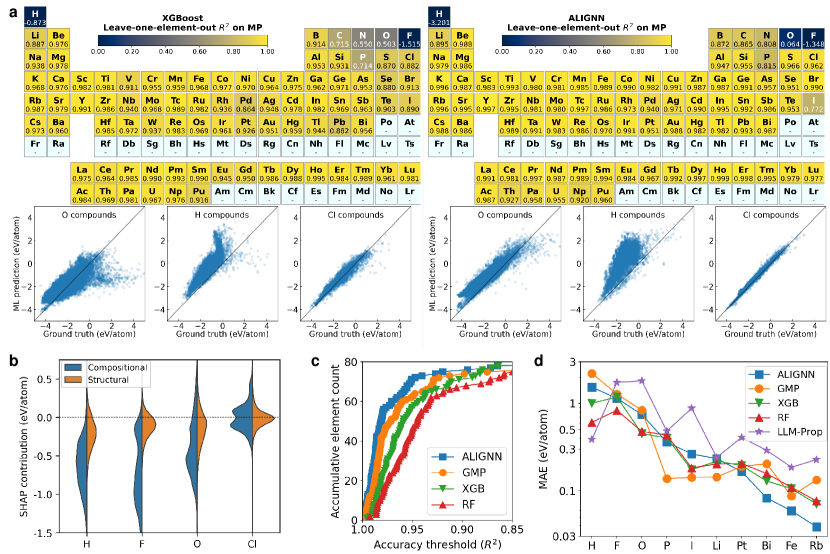
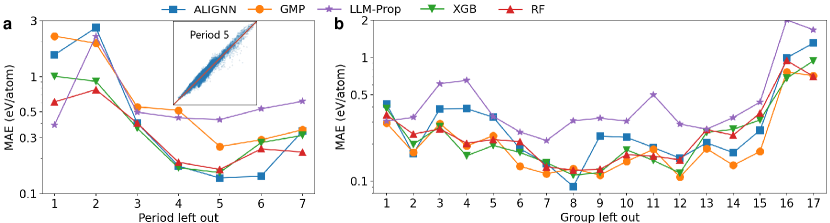
- Many models, including simple tree ensembles, generalize well across most chemistry- and structure-based OOD tasks.
- A large portion of OOD test data lie within the training distribution in representation space, implying interpolation rather than true extrapolation.
- Nonmetals like H, F, and O show poorer OOD performance due to chemical dissimilarity rather than insufficient data alone, with identifiable compositional biases.
- Structure-based OOD tasks tend to be more challenging than chemistry-based ones, but still show strong generalization for mid-to-high symmetry classes; triclinic systems are harder.
- Neural scaling laws hold for representationally ID generalization but often fail or reverse for representationally OOD tasks, indicating scaling benefits may be overstated for true OOD generalization.
- Density-based domain identification (via UMAP and kernel density) can distinguish representationally ID/OOD points and correlate with prediction errors, though not perfectly.
Read this paper
Open the full text in the Nubint reader and ask about any passage as you read.
Read this paper on NubintThis review was generated by AI from the original paper. Please check the paper before citing it.