
[Paper Review] Progressive Prompts: Continual Learning for Language Models
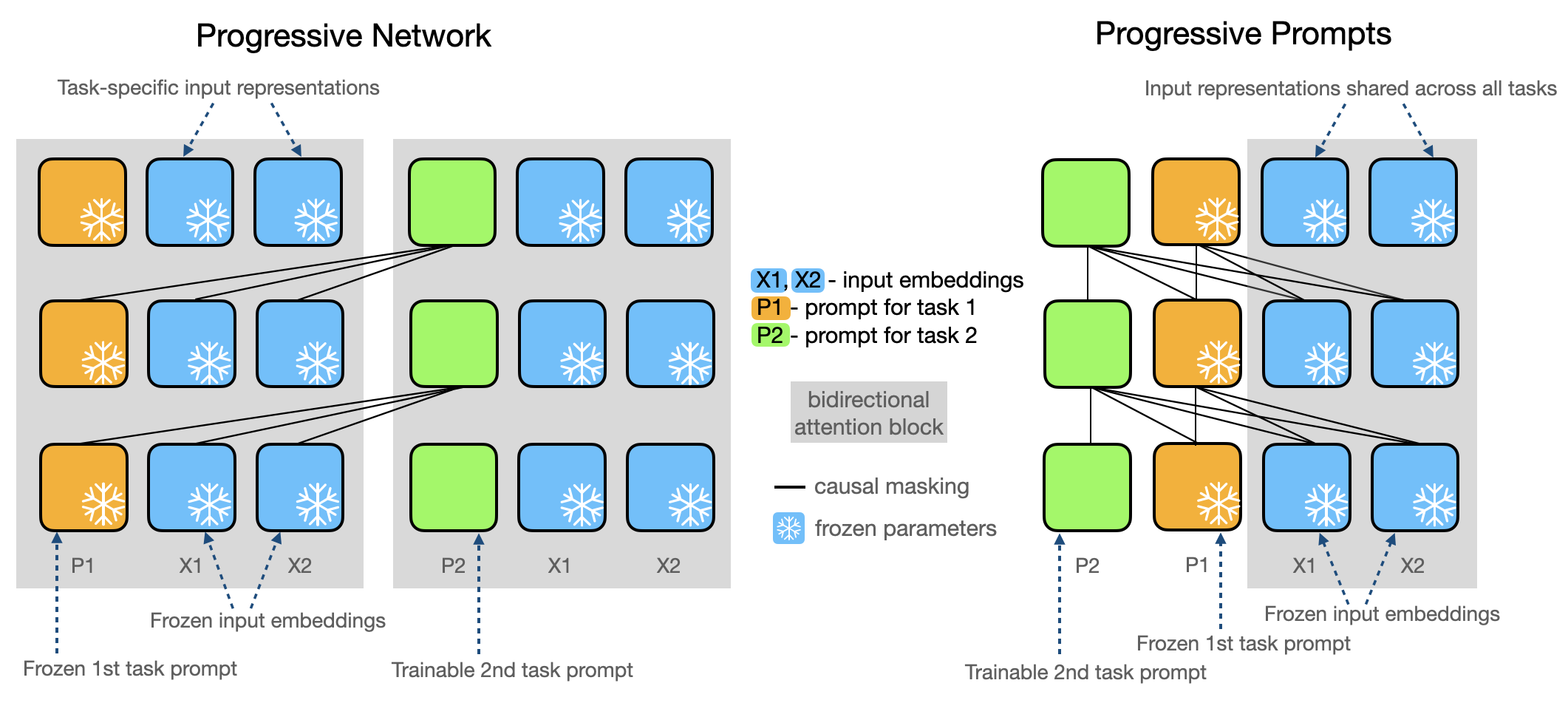
Progressive Prompts introduces a memory-efficient continual learning method for language models by learning a new soft prompt per task and progressively concatenating it with previous prompts while keeping the base model frozen, achieving strong forward transfer and no forgetting.
We introduce Progressive Prompts - a simple and efficient approach for continual learning in language models. Our method allows forward transfer and resists catastrophic forgetting, without relying on data replay or a large number of task-specific parameters. Progressive Prompts learns a new soft prompt for each task and sequentially concatenates it with the previously learned prompts, while keeping the base model frozen. Experiments on standard continual learning benchmarks show that our approach outperforms state-of-the-art methods, with an improvement >20% in average test accuracy over the previous best-preforming method on T5 model. We also explore a more challenging continual learning setup with longer sequences of tasks and show that Progressive Prompts significantly outperforms prior methods.
Motivation & Objective
- Motivate continual learning in language models by addressing catastrophic forgetting and forward transfer.
- Propose a memory-efficient method that uses task-specific prompts without replay or large parameter growth.
- Demonstrate effectiveness on standard CL benchmarks for BERT and T5 and in longer sequences of tasks.
- Showcase a prompt embedding reparameterization technique to stabilize training.
Proposed method
- Learn a separate soft prompt P_k for each incoming task T_k.
- Sequentially concatenate the new prompt with all previously learned prompts, while freezing the base model.
- Train only the new prompt parameters θ_{P_k} for task T_k.
- Use a residual MLP to reparameterize prompt embeddings P_k -> P_k' = MLP(P_k) + P_k to stabilize training.
- After training, discard the MLP but keep the projected P_k' for future use.
- Apply the approach to transformer models (BERT and T5) and evaluate without data replay.
Experimental results
Research questions
- RQ1Does Progressive Prompts prevent catastrophic forgetting across a sequence of tasks?
- RQ2Can Progressive Prompts achieve forward transfer to improve learning of future tasks without re-training the base model?
- RQ3How does prompt embedding reparameterization affect stability and performance in continual learning for LMs?
Key findings
- Progressive Prompts outperforms state-of-the-art continual learning methods on standard text classification benchmarks for both BERT and T5.
- On T5, Progressive Prompts achieves over 20% average accuracy improvement over the previous best method in few-shot setups.
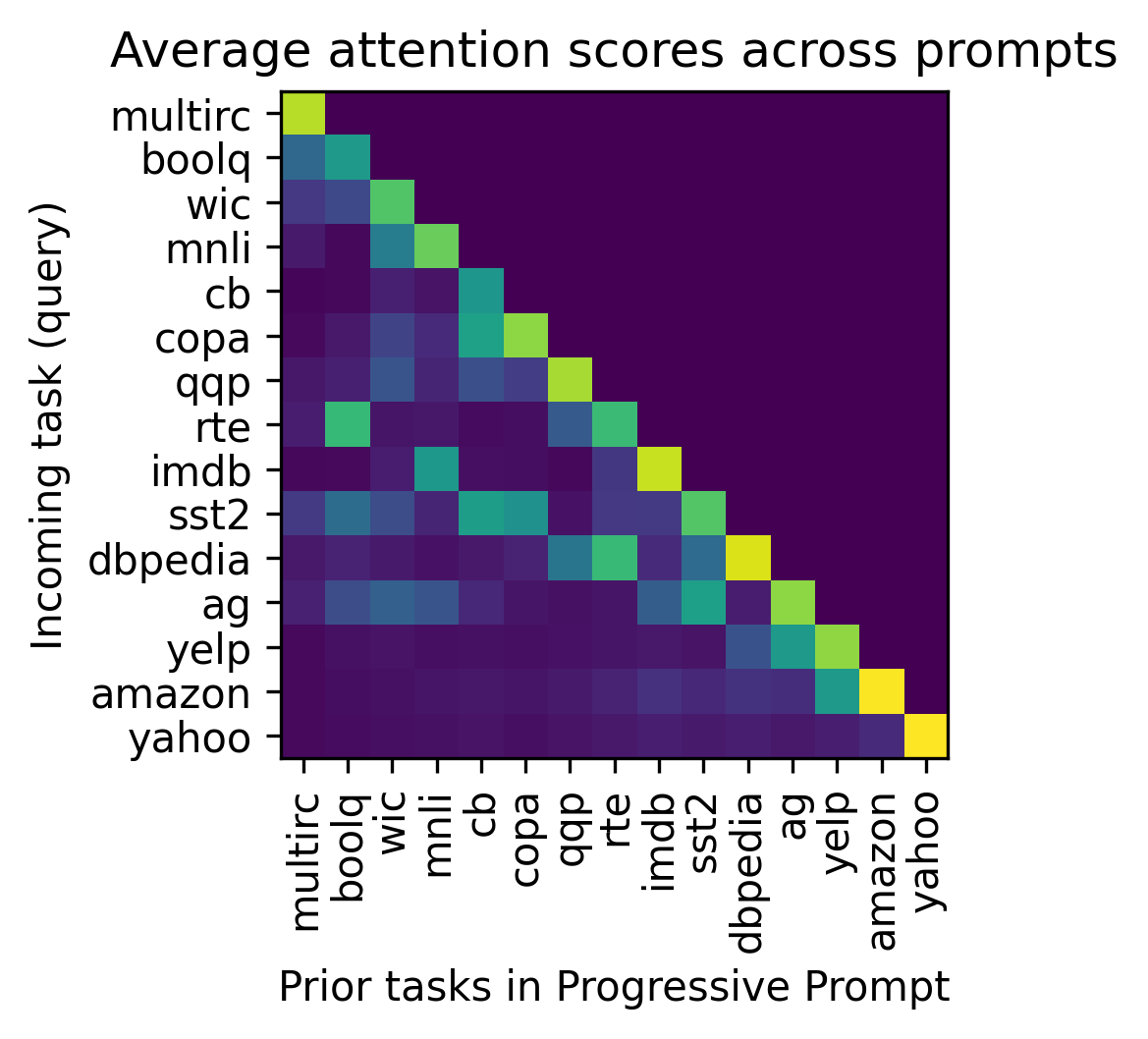
- In longer task sequences (15 tasks), Progressive Prompts significantly outperforms prior approaches for both BERT and T5.
- Embedding reparameterization with a residual MLP stabilizes and improves prompt-tuning performance without increasing parameter counts long-term.
- The method is model-agnostic and does not require data replay or storing many task-specific parameters.
Read this paper
Open the full text in the Nubint reader and ask about any passage as you read.
Read this paper on NubintThis review was generated by AI from the original paper. Please check the paper before citing it.