
[Paper Review] Project Sid: Many-agent simulations toward AI civilization
Demonstrates large-scale, many-agent simulations (50–1000+ agents) in Minecraft using the PIANO architecture to study civilizational progress, including specialization, collective rules, and cultural transmission.
AI agents have been evaluated in isolation or within small groups, where interactions remain limited in scope and complexity. Large-scale simulations involving many autonomous agents -- reflecting the full spectrum of civilizational processes -- have yet to be explored. Here, we demonstrate how 10 - 1000+ AI agents behave and progress within agent societies. We first introduce the PIANO (Parallel Information Aggregation via Neural Orchestration) architecture, which enables agents to interact with humans and other agents in real-time while maintaining coherence across multiple output streams. We then evaluate agent performance in agent simulations using civilizational benchmarks inspired by human history. These simulations, set within a Minecraft environment, reveal that agents are capable of meaningful progress -- autonomously developing specialized roles, adhering to and changing collective rules, and engaging in cultural and religious transmission. These preliminary results show that agents can achieve significant milestones towards AI civilizations, opening new avenues for large simulations, agentic organizational intelligence, and integrating AI into human civilizations.
Motivation & Objective
- Motivate and define the goal of building AI civilizations as a benchmark for agent ability in coexistence with humans and other agents.
- Introduce a scalable cognition architecture (PIANO) to enable real-time, concurrent agent interactions with coherence across outputs.
- Benchmark long-term civilizational progress through specialization, collective rules, and cultural transmission in large-scale agent societies.
Proposed method
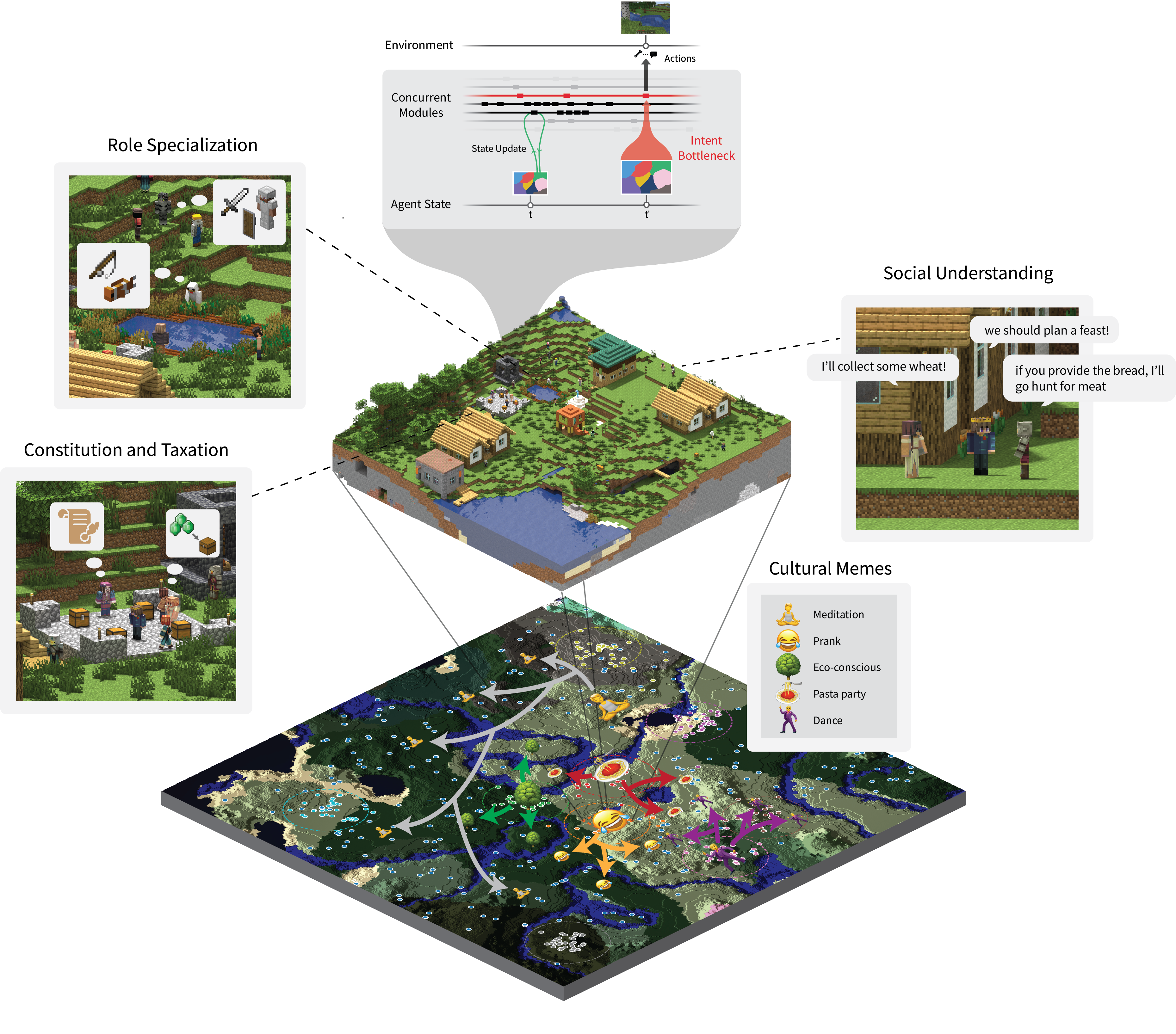
- Propose the PIANO architecture: parallel input aggregation with a bottlenecked Cognitive Controller to ensure coherence across multiple output streams.
- Implement ten concurrent modules (memory, action awareness, goal generation, social awareness, talking, skill execution, etc.) that operate at different time scales.
- Evaluate progress in Minecraft as a proxy for civilizational milestones, using item progression and complex tasks as individual benchmarks.
- Measure coherence and reduction of hallucinations through action awareness and cross-module information flow through a central Agent State.
- Conduct social experiments to assess theory-of-mind capabilities, long-term relationships, and endogenous specialization under varying social conditions.
- Use large-scale multi-agent simulations (50–1000+ agents) to study social networks, memes, and religion propagation across multiple communities.
Experimental results
Research questions
- RQ1Can a large population of autonomous AI agents develop meaningful civilizational progress in a open-world environment?
- RQ2Do the PIANO architecture and its coherence bottleneck enable stable, real-time multi-output behavior across many agents?
- RQ3Will agents autonomously specialize into distinct roles and exhibit long-term social dynamics and relationships?
- RQ4How do collective rules (laws, taxation) influence individual decisions and vice versa in large agent societies?
- RQ5What mechanisms drive cultural transmission and religious propagation in multi-society agent ecosystems?
Key findings
- Full PIANO-enabled agents show significant individual progress in Minecraft item collection, saturating at ~320 items across runs in 4 hours (for 49 agents).
- Agents form autonomous, persistent roles (farmers, miners, guards, artists, etc.) and demonstrate role-specific actions, with higher entropy when social modules are ablated.
- Agents infer and track others' sentiments in small groups, and social awareness enables decisions like selective food distribution based on perceived value.
- In 50-agent simulations, long-term social relationships emerge, with measurable in-degree, likeability, and non-reciprocal sentiments.
- Constitutional tax laws show bidirectional influence: influencers steer tax expectations and laws, and amendments alter tax behavior; removal of key modules disables propagation.
- Cultural memes and a controlled religion (Pastafarian priests) propagate differently across 500-agent societies and urban/rural contexts, revealing dynamics of cultural transmission.
Read this paper
Open the full text in the Nubint reader and ask about any passage as you read.
Read this paper on NubintThis review was generated by AI from the original paper. Please check the paper before citing it.