
[Paper Review] Prometheus 2: An Open Source Language Model Specialized in Evaluating Other Language Models
Prometheus 2 presents open-source evaluator LMs that perform both direct assessment and pairwise ranking, achieving higher agreement with humans and proprietary LMs than prior open evaluators by merging weights from models trained on different evaluation formats.
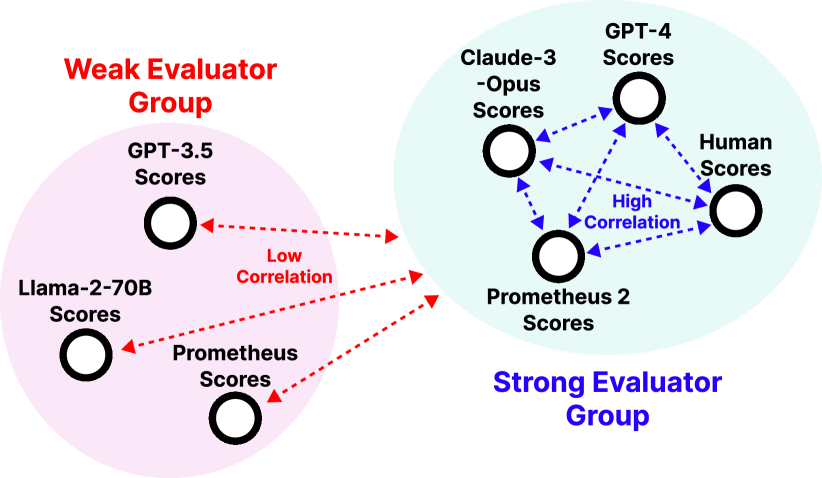
Proprietary LMs such as GPT-4 are often employed to assess the quality of responses from various LMs. However, concerns including transparency, controllability, and affordability strongly motivate the development of open-source LMs specialized in evaluations. On the other hand, existing open evaluator LMs exhibit critical shortcomings: 1) they issue scores that significantly diverge from those assigned by humans, and 2) they lack the flexibility to perform both direct assessment and pairwise ranking, the two most prevalent forms of assessment. Additionally, they do not possess the ability to evaluate based on custom evaluation criteria, focusing instead on general attributes like helpfulness and harmlessness. To address these issues, we introduce Prometheus 2, a more powerful evaluator LM than its predecessor that closely mirrors human and GPT-4 judgements. Moreover, it is capable of processing both direct assessment and pair-wise ranking formats grouped with a user-defined evaluation criteria. On four direct assessment benchmarks and four pairwise ranking benchmarks, Prometheus 2 scores the highest correlation and agreement with humans and proprietary LM judges among all tested open evaluator LMs. Our models, code, and data are all publicly available at https://github.com/prometheus-eval/prometheus-eval.
Motivation & Objective
- Motivate the development of open, transparent evaluators to assess LM outputs without relying on proprietary models.
- Develop a unified evaluator LM capable of two common evaluation formats: direct assessment and pairwise ranking.
- Propose a data-and-training recipe (weight merging) to combine evaluators trained on different formats.
- Introduce the Preference Collection, a fine-grained pairwise ranking dataset with diverse evaluation criteria.
- Demonstrate that Prometheus 2 achieves high correlation with humans and proprietary judges across benchmarks.
Proposed method
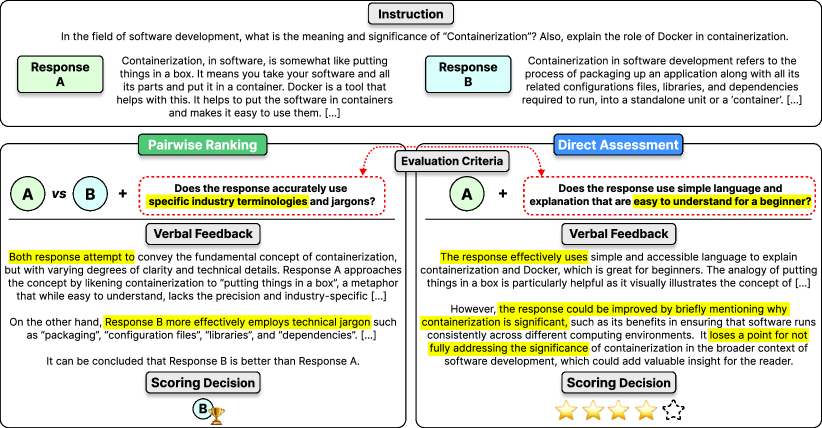
- Formalize direct assessment and pairwise ranking evaluation pipelines with explicit input components (including reference answers, verbal feedback, and evaluation criteria).
- Construct two datasets: Feedback Collection (direct assessment) and Preference Collection (pairwise ranking with 1K evaluation criteria).
- Propose weight merging (theta_final = alpha * theta_d + (1 - alpha) * theta_p) to fuse evaluators trained on different formats, and compare with single-format and joint-training baselines.
- Explore alternative merging strategies (Task Arithmetic, TIES, DARE) and show linear merging as effective for Prometheus 2, with alpha tuned for best cross-format performance.
- Evaluate Prometheus 2 on four direct assessment benchmarks and four pairwise ranking benchmarks against baselines and proprietary LMs.
Experimental results
Research questions
- RQ1Can an open-source evaluator LM achieve high alignment with human judgments and proprietary LM judges across both direct assessment and pairwise ranking?
- RQ2Does weight merging of evaluators trained separately on direct assessment and pairwise ranking outperform single-format or jointly trained evaluators?
- RQ3What role does a diverse, criteria-rich dataset (Preference Collection) play in improving evaluation fidelity?
- RQ4How robust is Prometheus 2 across in-domain and out-of-domain evaluation settings?
- RQ5Does training on one evaluation format positively transfer to the other, and to what extent?
Key findings
- Prometheus 2 (7B & 8x7B) achieves the highest correlation with humans and proprietary LMs across four direct assessment benchmarks and four pairwise ranking benchmarks among tested open evaluators.
- Weight merging outperforms single-format and jointly trained evaluators across multiple benchmarks, indicating positive task transfer from unifying formats.
- The Preference Collection enables fine-grained evaluation with 1K criteria, enhancing the model’s ability to evaluate based on user-defined standards.
- Prometheus 2-8x7B reduces the performance gap with proprietary LMs by about half on out-of-domain tests, compared to prior open evaluators.
- Consistency across evaluation formats improves when using merged weights from direct assessment and pairwise ranking formats, demonstrating robustness.
Read this paper
Open the full text in the Nubint reader and ask about any passage as you read.
Read this paper on NubintThis review was generated by AI from the original paper. Please check the paper before citing it.