
[Paper Review] Prompt-augmented Temporal Point Process for Streaming Event Sequence
PromptTPP proposes a novel continual learning framework for streaming event sequences using a continuous-time retrieval prompt pool, enabling efficient, memory-efficient, and task-agnostic learning without rehearsal buffers or task identity. It achieves state-of-the-art performance across three real-world user behavior datasets by jointly optimizing learnable prompts and a base neural temporal point process.
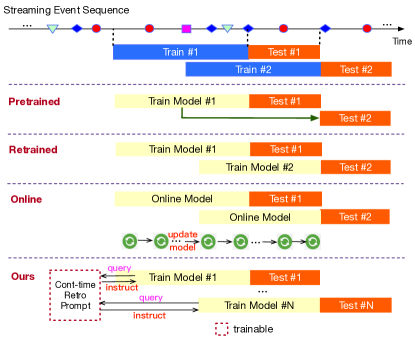
Neural Temporal Point Processes (TPPs) are the prevalent paradigm for modeling continuous-time event sequences, such as user activities on the web and financial transactions. In real-world applications, event data is typically received in a \emph{streaming} manner, where the distribution of patterns may shift over time. Additionally, \emph{privacy and memory constraints} are commonly observed in practical scenarios, further compounding the challenges. Therefore, the continuous monitoring of a TPP to learn the streaming event sequence is an important yet under-explored problem. Our work paper addresses this challenge by adopting Continual Learning (CL), which makes the model capable of continuously learning a sequence of tasks without catastrophic forgetting under realistic constraints. Correspondingly, we propose a simple yet effective framework, PromptTPP\footnote{Our code is available at {\small \url{ https://github.com/yanyanSann/PromptTPP}}}, by integrating the base TPP with a continuous-time retrieval prompt pool. The prompts, small learnable parameters, are stored in a memory space and jointly optimized with the base TPP, ensuring that the model learns event streams sequentially without buffering past examples or task-specific attributes. We present a novel and realistic experimental setup for modeling event streams, where PromptTPP consistently achieves state-of-the-art performance across three real user behavior datasets.
Motivation & Objective
- Address the challenge of continual learning for streaming event sequences under real-world constraints like privacy and memory limits.
- Overcome catastrophic forgetting in neural temporal point processes (TPPs) when processing sequential data in real time.
- Develop a task-agnostic, memory-efficient method that avoids rehearsal buffers and does not require task identity at inference.
- Enable effective knowledge transfer and plasticity in TPPs through a learnable prompt-based mechanism for continuous-time event modeling.
Proposed method
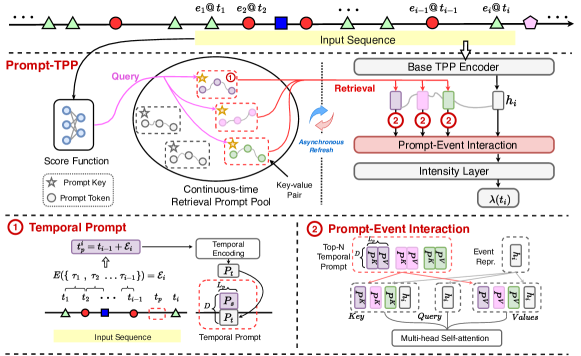
- Introduce a continuous-time retrieval prompt pool that stores small, learnable parameters as prompts in a key-value memory space.
- Design a dynamic retrieval mechanism that selects task-relevant prompts based on input event sequences using query-key matching.
- Jointly optimize the base neural TPP and the prompt pool via a generative loss to preserve shared knowledge and adapt to task-specific patterns.
- Implement an asynchronous prompt update mechanism with refresh frequency $C$ to improve training efficiency without sacrificing performance.
- Structure prompts in a key-value shared memory space to decouple query and prompt learning, enhancing retrieval accuracy and model stability.
- Ensure compatibility with any neural TPP architecture by treating the prompt pool as a modular, plug-in component.
Experimental results
Research questions
- RQ1Can a prompt-augmented framework effectively mitigate catastrophic forgetting in neural temporal point processes under streaming, real-time data conditions?
- RQ2How does the retrieval-based prompt mechanism compare to traditional rehearsal-based or task-identity-dependent continual learning methods in streaming event modeling?
- RQ3To what extent does the prompt pool size, prompt length, and selection size influence model performance and generalization in continual event sequence learning?
- RQ4Can the proposed method achieve state-of-the-art performance while maintaining low memory and computational overhead in realistic deployment scenarios?
- RQ5How effective is the asynchronous prompt update strategy in accelerating convergence without degrading predictive performance?
Key findings
- PromptTPP achieves state-of-the-art performance on three real-world user behavior datasets (Amazon, Taobao, and another unspecified dataset) under streaming, continual learning settings.
- The model increases total parameters by only 8–12% compared to the base TPP, with minimal impact on training speed, demonstrating high parameter efficiency.
- The asynchronous prompt update with $C=2$ improves convergence speed on the Amazon dataset while maintaining competitive performance, showing scalability and efficiency.
- Removing the key-value prompt design (w/o CtRroPP) leads to a notable performance drop, confirming the importance of structured prompt retrieval for knowledge retention.
- Replacing learnable keys with mean pooling (w/o k-v) causes a moderate performance decline, indicating that learnable keys significantly enhance retrieval accuracy and model stability.
- Increasing the prompt pool size $M$ consistently improves performance, confirming that larger prompt capacity enhances knowledge encoding and transfer.
Better researchstarts right now
From reading papers to final review, dramatically reduce your research time.
No credit card · Free plan available
This review was created by AI and reviewed by human editors.