
[Paper Review] Prompt Engineering and Calibration for Zero-Shot Commonsense Reasoning
This paper investigates prompt engineering and calibration for zero-shot commonsense reasoning in smaller language models (up to 3B parameters). It proposes combining instruction prompts and option-aware templates with probability calibration via null-prompt normalization. Results show that while each technique helps specific models (e.g., prompt engineering boosts Flan-T5, calibration aids GPT-2), their joint application mostly degrades performance, indicating no universal configuration works across models.
Prompt engineering and calibration make large language models excel at reasoning tasks, including multiple choice commonsense reasoning. From a practical perspective, we investigate and evaluate these strategies on smaller language models. Through experiments on five commonsense reasoning benchmarks, we find that each strategy favors certain models, but their joint effects are mostly negative.
Motivation & Objective
- To evaluate whether prompt engineering and calibration improve zero-shot commonsense reasoning in smaller language models (≤3B parameters).
- To assess the effectiveness of instruction prompts and option-aware templates in enhancing model reasoning without fine-tuning.
- To investigate the impact of probability calibration using null-prompt normalization on model fairness and accuracy.
- To determine whether the combination of prompt engineering and calibration yields synergistic improvements or negative interactions.
- To provide practical guidance on applying these techniques to smaller models, given their limited availability and computational cost.
Proposed method
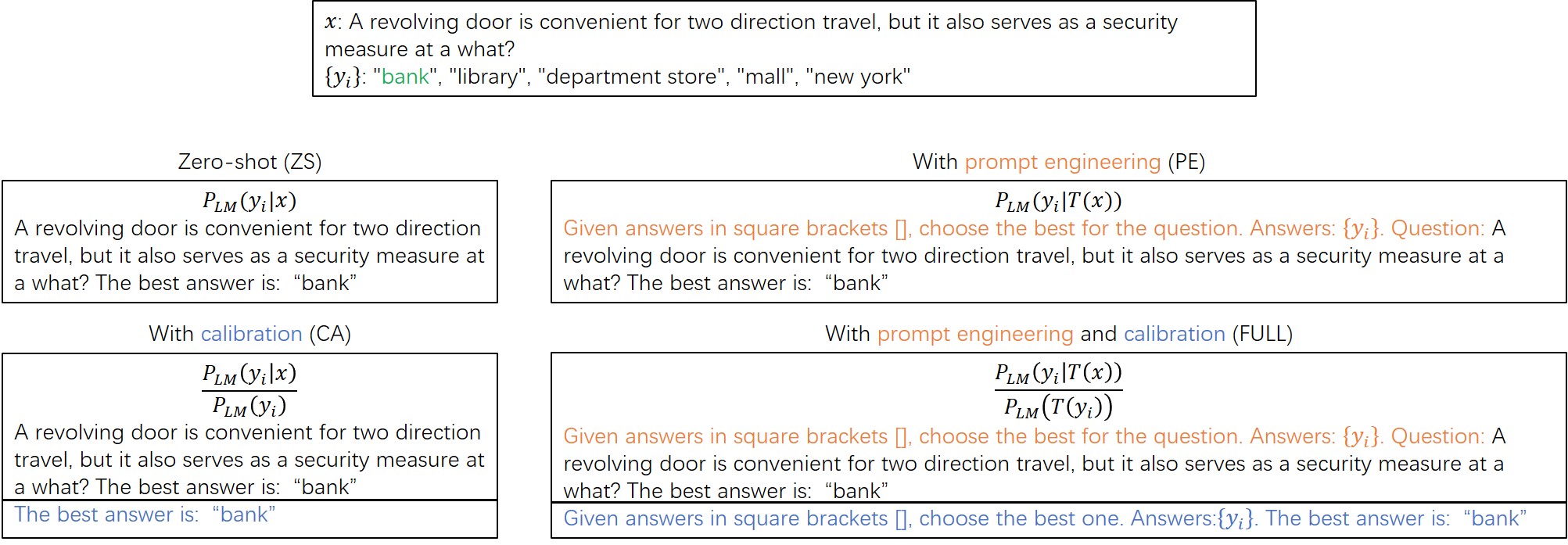
- Prompt engineering involves constructing templates that include the question, all answer options in a list, and an instruction to select the best answer, without binding options to symbols like (A).
- Calibration normalizes the conditional probability P(y_i|x) by dividing it by P(y_i), the probability of the option alone, to correct for model bias toward certain options.
- The method uses standard zero-shot inference with conditional probability scoring, enhanced by either prompt engineering, calibration, or both.
- Templates are designed consistently across five benchmarks: CommonsenseQA, COPA, OpenBookQA, PIQA, and Social IQA.
- The evaluation uses accuracy on development sets across three model families: GPT-2, T5, and Flan-T5, with model sizes ranging from 80M to 3B parameters.
- All experiments are conducted in a zero-shot setting, with no fine-tuning, to isolate the effects of prompt design and calibration.
Experimental results
Research questions
- RQ1Does prompt engineering improve zero-shot commonsense reasoning accuracy in smaller language models?
- RQ2Can calibration improve model fairness and performance by correcting for option bias in smaller models?
- RQ3Do prompt engineering and calibration have synergistic effects when applied together in smaller models?
- RQ4Are the benefits of these techniques consistent across different model architectures and sizes?
- RQ5Is there a universal configuration of prompt engineering and calibration that works well across diverse smaller language models?
Key findings
- Prompt engineering significantly improves performance on the two largest Flan-T5 models (Flan-T5-Large and Flan-T5-XL), with gains up to 30 accuracy points on some benchmarks.
- Calibration improves performance on GPT-2 models, particularly on CSQA and SIQA, but shows inconsistent results on other models.
- The joint application of prompt engineering and calibration results in performance degradation on most models and benchmarks, indicating negative interaction effects.
- On Flan-T5 models, the FULL method (both techniques) underperforms ZS and CA, with accuracy drops of up to 10 points on COPA and SIQA.
- On GPT-2, FULL performs worse than ZS and CA on all benchmarks except one, suggesting that combining strategies is counterproductive for this architecture.
- No universal configuration of prompt engineering and calibration works across all models, highlighting the need for model-specific tuning.
Read this paper
Open the full text in the Nubint reader and ask about any passage as you read.
Read this paper on NubintThis review was generated by AI from the original paper. Please check the paper before citing it.