
[Paper Review] Prompt Pre-Training with Twenty-Thousand Classes for Open-Vocabulary Visual Recognition
POMP pre-trains a universal soft prompt on ImageNet-21K to achieve zero-shot open-vocabulary recognition across image classification, semantic segmentation, and object detection, with strong transfer performance and efficiency gains.
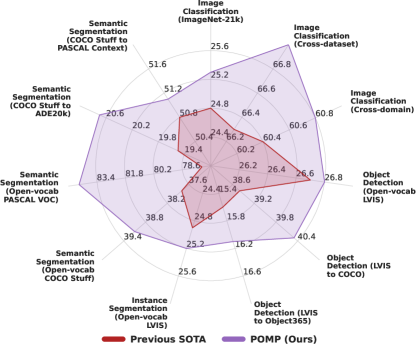
This work proposes POMP, a prompt pre-training method for vision-language models. Being memory and computation efficient, POMP enables the learned prompt to condense semantic information for a rich set of visual concepts with over twenty-thousand classes. Once pre-trained, the prompt with a strong transferable ability can be directly plugged into a variety of visual recognition tasks including image classification, semantic segmentation, and object detection, to boost recognition performances in a zero-shot manner. Empirical evaluation shows that POMP achieves state-of-the-art performances on 21 datasets, e.g., 67.0% average accuracy on 10 classification datasets (+3.1% compared to CoOp) and 84.4 hIoU on open-vocabulary Pascal VOC segmentation (+6.9 compared to ZSSeg). Our code is available at https://github.com/amazon-science/prompt-pretraining.
Motivation & Objective
- Motivate open-vocabulary visual recognition and the need for a universal, transferable prompt that generalizes across tasks.
- Propose a memory- and computation-efficient prompt pre-training method (POMP) on a large-scale, fine-grained class set.
- Demonstrate that a pre-trained soft prompt can be plugged into downstream tasks without fine-tuning to boost zero-shot performance.
Proposed method
- Introduce POMP, a universal soft prompt pre-trained on ImageNet-21K with a large number of classes.
- Use local contrast to sample a subset of K negative classes per image to reduce memory and computation.
- Apply local correction with an adaptive margin m to counteract bias from negative sampling (m = -log((K-1)/(N-1))).
- Transfer the pre-trained prompt to downstream tasks (classification, segmentation, detection) in a zero-shot manner.
- Evaluate memory/training efficiency and performance against baselines like CoOp, CoCoOp, MaPLe, CLIP-based zero-shot methods.
Experimental results
Research questions
- RQ1Can a universal soft prompt pre-trained on ImageNet-21K generalize to open-vocabulary classification, segmentation, and detection without task-specific fine-tuning?
- RQ2Does local contrast with local correction enable memory-efficient prompt pre-training on >20k classes while maintaining or improving transfer performance?
- RQ3How does the adaptive margin in local correction affect cross-dataset and cross-domain generalization?
- RQ4What is the comparative performance and training efficiency of POMP versus state-of-the-art prompt-tuning and open-vocabulary methods across multiple datasets?
- RQ5Can POMP prompts maintain alignment and improve uniformity in the learned feature space for robust open-vocabulary recognition?
Key findings
- POMP achieves up to 25.3% accuracy on ImageNet-21K with ViT-B/16 after pre-training under memory limits below 16 GB.
- On 10 downstream image classification datasets, POMP attains 67.0% average accuracy, surpassing CoOp by 3.1%.
- In open-vocabulary semantic segmentation, POMP achieves 39.1 hIoU on COCO Stuff and 84.4 hIoU on Pascal VOC, outperforming ZSSeg by 1.3 and 6.9 hIoU respectively.
- For open-vocabulary LVIS object detection, POMP reaches 37.2 AP and 57.9 AP50, surpassing Detic by 1.9 AP50 and 0.8 AP50 in respective settings.
- POMP demonstrates strong cross-dataset and cross-domain transfer, achieving state-of-the-art accuracy with improved generalization and robustness across tasks.

Read this paper
Open the full text in the Nubint reader and ask about any passage as you read.
Read this paper on NubintThis review was generated by AI from the original paper. Please check the paper before citing it.