
[Paper Review] Prompt Tuning Large Language Models on Personalized Aspect Extraction for Recommendations
This paper proposes an end-to-end framework that jointly optimizes personalized aspect extraction and aspect-based recommendation using prompt-tuned large language models (LLMs). By constructing task-specific soft prompts from user and item embeddings, the method generates contextually relevant, user-personalized aspect terms that significantly improve both aspect extraction accuracy and recommendation performance on three industrial datasets.
Existing aspect extraction methods mostly rely on explicit or ground truth aspect information, or using data mining or machine learning approaches to extract aspects from implicit user feedback such as user reviews. It however remains under-explored how the extracted aspects can help generate more meaningful recommendations to the users. Meanwhile, existing research on aspect-based recommendations often relies on separate aspect extraction models or assumes the aspects are given, without accounting for the fact the optimal set of aspects could be dependent on the recommendation task at hand. In this work, we propose to combine aspect extraction together with aspect-based recommendations in an end-to-end manner, achieving the two goals together in a single framework. For the aspect extraction component, we leverage the recent advances in large language models and design a new prompt learning mechanism to generate aspects for the end recommendation task. For the aspect-based recommendation component, the extracted aspects are concatenated with the usual user and item features used by the recommendation model. The recommendation task mediates the learning of the user embeddings and item embeddings, which are used as soft prompts to generate aspects. Therefore, the extracted aspects are personalized and contextualized by the recommendation task. We showcase the effectiveness of our proposed method through extensive experiments on three industrial datasets, where our proposed framework significantly outperforms state-of-the-art baselines in both the personalized aspect extraction and aspect-based recommendation tasks. In particular, we demonstrate that it is necessary and beneficial to combine the learning of aspect extraction and aspect-based recommendation together. We also conduct extensive ablation studies to understand the contribution of each design component in our framework.
Motivation & Objective
- Address the gap in existing methods that treat aspect extraction and aspect-based recommendation as separate tasks.
- Improve the quality and relevance of extracted aspects by grounding them in the downstream recommendation task.
- Leverage pre-trained large language models to enhance aspect extraction from user reviews with minimal supervision.
- Develop a personalized prompt-tuning mechanism that dynamically generates soft prompts based on user and item features.
- Demonstrate that joint learning of aspect extraction and recommendation leads to better performance than isolated training.
Proposed method
- Use a fine-tuned GPT-2 model as the aspect extractor, with input composed of tokenized user reviews concatenated with soft prompts.
- Construct soft prompts from user and item feature embeddings, which are learned during end-to-end training.
- Concatenate the output aspect terms with standard user and item embeddings to form the input for the aspect-based recommendation model.
- Train the entire framework end-to-end, allowing the recommendation task to guide the learning of aspect terms.
- Employ prompt tuning to adapt the pre-trained LLM without full fine-tuning, preserving generalization while enabling task-specific adaptation.
- Use an attentive neural network to generate final aspect-based recommendations from the extracted aspects and user-item features.

Experimental results
Research questions
- RQ1Can joint training of aspect extraction and aspect-based recommendation improve performance compared to training them separately?
- RQ2How effective is prompt tuning with user- and item-specific soft prompts in generating personalized and contextually relevant aspect terms?
- RQ3To what extent do LLM-based aspect extraction methods outperform traditional NLP models in low-resource settings with limited ground-truth aspect annotations?
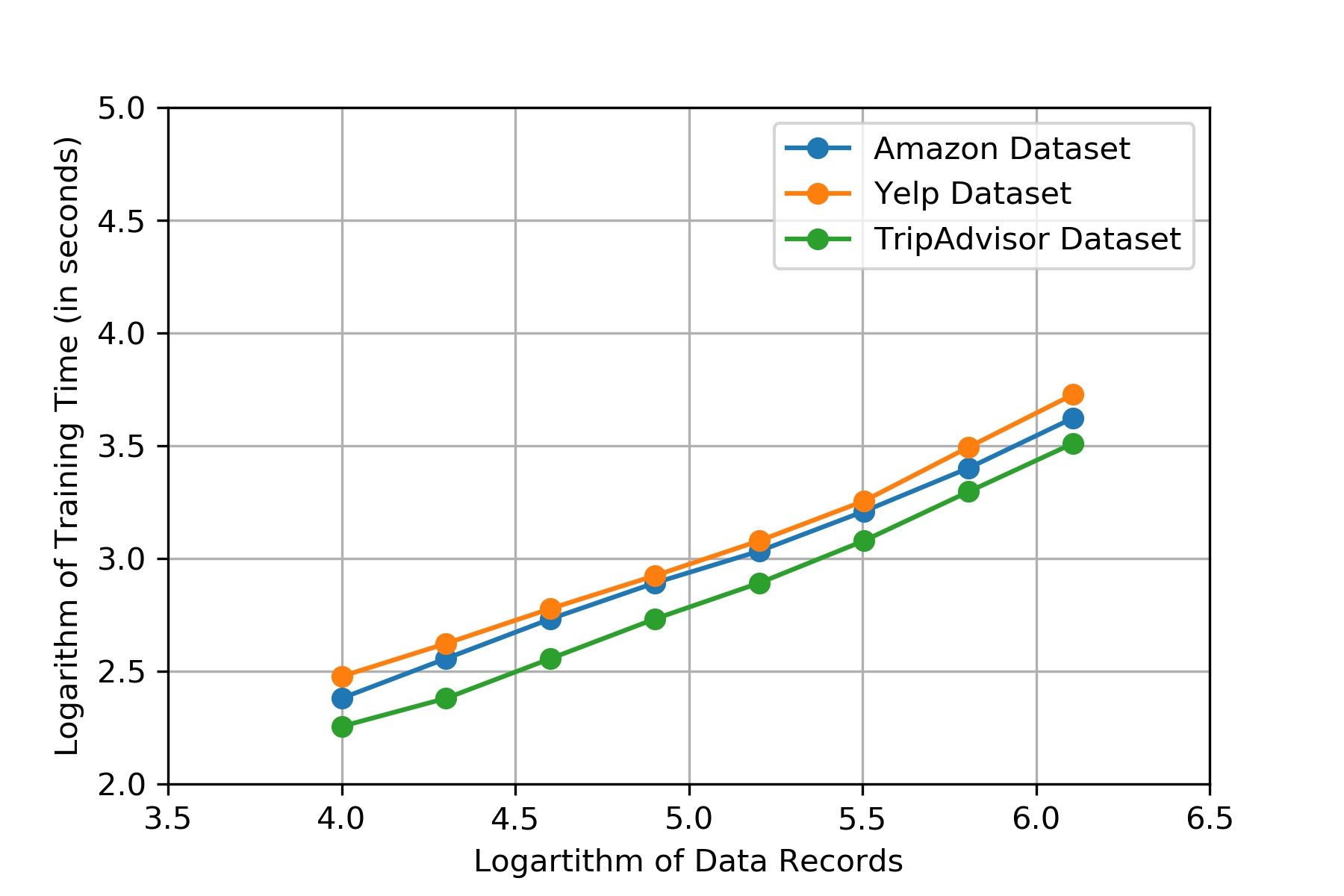
- RQ4How does the proposed framework scale to large user and item populations in industrial recommendation systems?
- RQ5What is the contribution of each component (e.g., soft prompt design, joint training) to the overall performance?
Key findings
- The proposed framework significantly outperforms state-of-the-art baselines in both personalized aspect extraction and aspect-based recommendation tasks across three industrial datasets.
- The joint training of aspect extraction and recommendation leads to more accurate and useful aspect terms, as evidenced by case studies showing closer alignment with ground-truth annotations.
- The model’s aspect extraction performance is superior to baselines such as DE-CNN, LCFS, and ABAE, particularly in capturing nuanced user feedback like 'Worth Purchasing' or 'Water Pressure'.
- The scalability analysis shows that the framework maintains efficient training times even as the number of users and items increases, supporting deployment in large-scale systems.
- Ablation studies confirm that the soft prompt mechanism based on user and item features is critical for personalization and performance improvement.
- The method effectively leverages few-shot or zero-shot capabilities of LLMs, making it suitable for real-world recommendation systems with limited labeled aspect data.
Better researchstarts right now
From reading papers to final review, dramatically reduce your research time.
No credit card · Free plan available
This review was created by AI and reviewed by human editors.