
[Paper Review] PromptBench: A Unified Library for Evaluation of Large Language Models
PromptBench is a unified Python library to evaluate LLMs across prompts, datasets, adversarial prompts, dynamic protocols, and analysis tools.
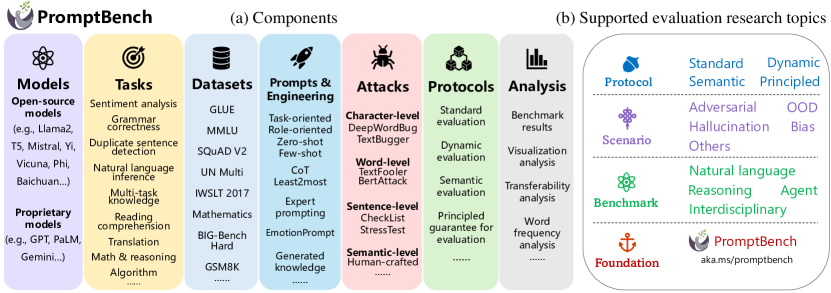
The evaluation of large language models (LLMs) is crucial to assess their performance and mitigate potential security risks. In this paper, we introduce PromptBench, a unified library to evaluate LLMs. It consists of several key components that are easily used and extended by researchers: prompt construction, prompt engineering, dataset and model loading, adversarial prompt attack, dynamic evaluation protocols, and analysis tools. PromptBench is designed to be an open, general, and flexible codebase for research purposes that can facilitate original study in creating new benchmarks, deploying downstream applications, and designing new evaluation protocols. The code is available at: https://github.com/microsoft/promptbench and will be continuously supported.
Motivation & Objective
- Motivate the need for a unified, extensible evaluation framework for LLMs to assess capabilities and security risks.
- Provide a modular, research-focused library that supports diverse models, datasets, prompts, and evaluation protocols.
- Facilitate exploration of prompt engineering, adversarial prompt attacks, and dynamic evaluation through an open-source platform.
Proposed method
- Introduce a modular Python library with components for models, datasets, prompts, adversarial prompts, dynamic evaluation, and analysis tools.
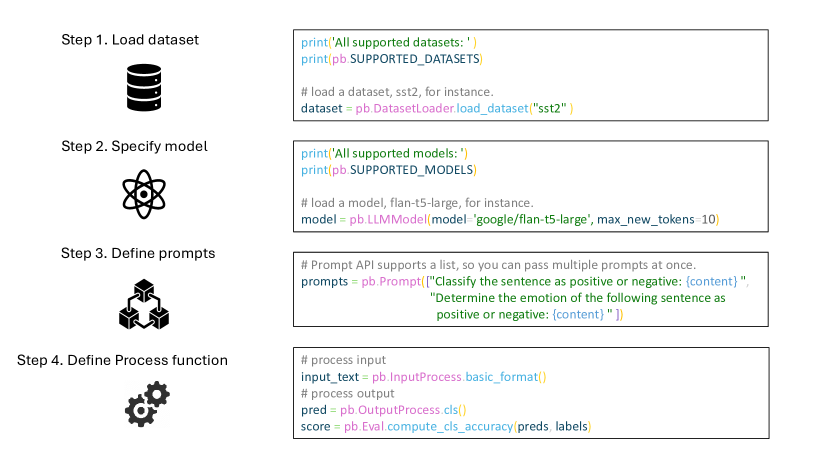
- Offer a unified LLMModel interface and DatasetLoader for easy pipeline construction.
- Incorporate four prompt types plus a Prompt interface and six prompt engineering methods for flexible experimentation.
- Integrate seven adversarial prompt attack types and multiple evaluation protocols including dynamic and semantic evaluation.
- Provide leaderboards and extensible analysis tools for results interpretation and comparison.
- Open-source availability with documentation and tutorials to support community contributions.
Experimental results
Research questions
- RQ1How can a unified, extensible framework streamline comprehensive evaluation of diverse LLMs across prompts, tasks, and protocols?
- RQ2What role do prompt engineering and adversarial prompts play in assessing LLM robustness within a standardized library?
- RQ3Can dynamic and semantic evaluation protocols provide more robust benchmarking compared to static Inference setups?
- RQ4How well does PromptBench support researchers in building, sharing, and comparing evaluation pipelines across models and datasets?
Key findings
- PromptBench supports a wide range of models, datasets, tasks, prompts, and evaluation protocols in a modular pipeline.
- The library includes adversarial prompt attacks and prompt engineering techniques to study robustness and prompts effectiveness.
- Dynamic and semantic evaluation capabilities are integrated to address data contamination and robustness beyond direct inference.
- Three leaderboards (adversarial prompt attack, prompt engineering, dynamic evaluation) enable easy comparison of results.
- The framework emphasizes research-oriented extensibility and open collaboration through open-source code and documentation.
Read this paper
Open the full text in the Nubint reader and ask about any passage as you read.
Read this paper on NubintThis review was generated by AI from the original paper. Please check the paper before citing it.