
[Paper Review] Promptbreeder: Self-Referential Self-Improvement Via Prompt Evolution
Promptbreeder automatically evolves domain-specific prompts and their mutation strategies using a self-referential evolutionary loop driven by an LLM, outperforming several state-of-the-art prompting methods on arithmetic, commonsense, and hate-speech tasks without parameter updates.
Popular prompt strategies like Chain-of-Thought Prompting can dramatically improve the reasoning abilities of Large Language Models (LLMs) in various domains. However, such hand-crafted prompt-strategies are often sub-optimal. In this paper, we present Promptbreeder, a general-purpose self-referential self-improvement mechanism that evolves and adapts prompts for a given domain. Driven by an LLM, Promptbreeder mutates a population of task-prompts, and subsequently evaluates them for fitness on a training set. Crucially, the mutation of these task-prompts is governed by mutation-prompts that the LLM generates and improves throughout evolution in a self-referential way. That is, Promptbreeder is not just improving task-prompts, but it is also improving the mutationprompts that improve these task-prompts. Promptbreeder outperforms state-of-the-art prompt strategies such as Chain-of-Thought and Plan-and-Solve Prompting on commonly used arithmetic and commonsense reasoning benchmarks. Furthermore, Promptbreeder is able to evolve intricate task-prompts for the challenging problem of hate speech classification.
Motivation & Objective
- Motivate and enable automated, domain-adaptive prompt engineering without modifying model parameters.
- Propose a self-referential evolutionary mechanism where prompts and their mutation strategies co-evolve.
- Show that evolving prompts yields superior performance on arithmetic, commonsense reasoning, and hate-speech tasks.
- Investigate the contribution of self-referential components to performance gains.
Proposed method
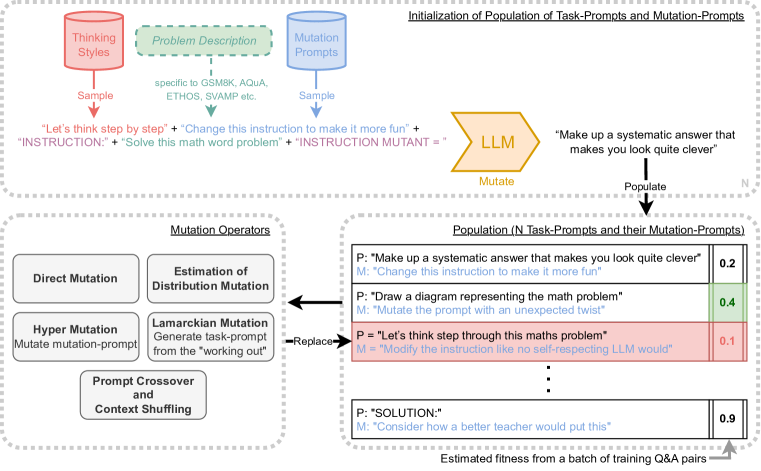
- Maintain a population of evolution units, each with one or more task-prompts and an associated mutation-prompt.
- Use an LLM as the mutation operator: P' = LLM(M + P) where M is a mutation-prompt and P is a task-prompt.
- Evolve both task-prompts and mutation-prompts via a binary tournament genetic algorithm over multiple generations.
- Employ nine mutation operators spanning zero- and first-order prompts, estimation-of-distribution, lineage-based, hypermutation, Lamarckian mutation, and crossover/context-shuffling to promote diversity and self-improvement.
- Initialize prompts by concatenating problem descriptions with mutation-prompts and thinking-styles to produce diverse seed prompts.
- Evaluate fitness by sampling 100 Q&A pairs from the domain’s training set and measuring prompt-driven performance.
Experimental results
Research questions
- RQ1Can self-referential prompt evolution improve LLM reasoning across arithmetic, commonsense, and ethics benchmarks?
- RQ2Do evolving mutation-prompts and task-prompts jointly yield more domain-adaptive strategies than evolving task-prompts alone?
- RQ3What is the impact of diverse mutation operators and hypermutation on prompt quality and performance?
- RQ4Is self-improvement via prompts scalable with larger LLMs without parameter updates?
Key findings
- PB outperforms state-of-the-art prompt strategies such as Chain-of-Thought and Plan-and-Solve on multiple benchmarks.
- PB achieves strong zero-shot and few-shot results, including improvements when using PaLM 2-L as the underlying LLM.
- PB evolves intricate domain-specific prompts, e.g., a GSM8K-style prompt detailing steps and notation.
- Ablation analyses show self-referential operators contribute positively across math datasets and ETHOS hate-speech classification.
- All nine mutation classes contribute to performance, with hyper-mutation enabling self-referential improvement.
- PB demonstrates solution-aware prompt evolution on hate speech classification, outperforming hand-designed prompts.
Read this paper
Open the full text in the Nubint reader and ask about any passage as you read.
Read this paper on NubintThis review was generated by AI from the original paper. Please check the paper before citing it.