
[Paper Review] Prompting and Fine-Tuning Open-Sourced Large Language Models for Stance Classification
The paper evaluates open-source LLMs with four prompting schemes for stance classification across five datasets, finding results often close to supervised models but not consistently better, and highlights context-rich prompts as the most impactful factor.
Stance classification, the task of predicting the viewpoint of an author on a subject of interest, has long been a focal point of research in domains ranging from social science to machine learning. Current stance detection methods rely predominantly on manual annotation of sentences, followed by training a supervised machine learning model. However, this manual annotation process requires laborious annotation effort, and thus hampers its potential to generalize across different contexts. In this work, we investigate the use of Large Language Models (LLMs) as a stance detection methodology that can reduce or even eliminate the need for manual annotations. We investigate 10 open-source models and 7 prompting schemes, finding that LLMs are competitive with in-domain supervised models but are not necessarily consistent in their performance. We also fine-tuned the LLMs, but discovered that fine-tuning process does not necessarily lead to better performance. In general, we discover that LLMs do not routinely outperform their smaller supervised machine learning models, and thus call for stance detection to be a benchmark for which LLMs also optimize for. The code used in this study is available at \url{https://github.com/ijcruic/LLM-Stance-Labeling}
Motivation & Objective
- Assess how open-source LLMs with prompting perform on stance classification without fine-tuning
- Compare four prompting schemes from task-only to context plus reasoning across multiple datasets
- Evaluate using minimal labeled data (few-shot) to mimic real-world scenarios
- Investigate whether prompting can enable unsupervised stance detection and cross-language applicability
Proposed method
- Use five public stance datasets (covid-lies, election2016, phemerumors, semeval2016, wtwt)
- Test four prompting schemes of increasing contextual information (task-only, context, context+few-shot, context+few-shot+reasoning)
- Evaluate encoder-decoder LLMs (Flan-Alpaca-GPT4-T5-3B and Flan-UL2) with zero-shot and few-shot prompts
- Conduct repeated runs (three per setting) to report average macro-F1 scores
- Compare results to established supervised benchmarks from original datasets
- Perform a sentiment-prompt proxy experiment to assess stance vs sentiment handling
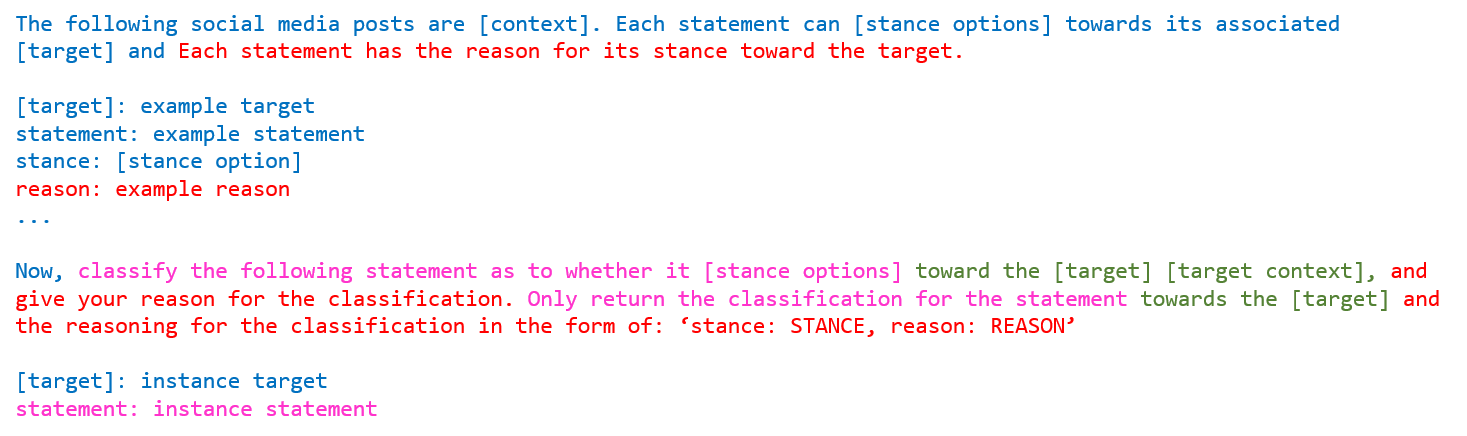
Experimental results
Research questions
- RQ1Can open-source LLMs with prompting match or exceed supervised stance classification models without fine-tuning?
- RQ2Which prompting scheme yields the best performance across datasets?
- RQ3Does including context or reasoning in prompts improve stance classification?
- RQ4Are encoder-decoder models consistently better than decoder-only models for stance tasks?
- RQ5Is sentiment prompting a viable proxy for stance classification?
Key findings
- Encoder-decoder LLMs with prompting can outperform some benchmarks but not consistently across all datasets
- Including context in prompts consistently improves stance classification performance
- Few-shot prompting does not universally improve results and depends on sample selection
- Decoder-only models underperform compared to encoder-decoder models for this task
- Stance classification performance with prompting approaches sometimes approaches supervised models, but not reliably superior
- Context-based prompting enables multilingual and generalizable stance analysis without explicit target-specific data
Read this paper
Open the full text in the Nubint reader and ask about any passage as you read.
Read this paper on NubintThis review was generated by AI from the original paper. Please check the paper before citing it.