
[Paper Review] Propagating Knowledge Updates to LMs Through Distillation
This paper proposes a context distillation method to inject and propagate knowledge updates in large language models (LLMs), enabling them to make inferences based on new facts. By generating continuations from entity definitions and distilling the model to match the distribution of a 'teacher' model conditioned on those definitions, the approach outperforms fine-tuning and gradient-based editing methods in knowledge propagation and scalability, even when injecting up to 150 entities with minimal performance degradation.
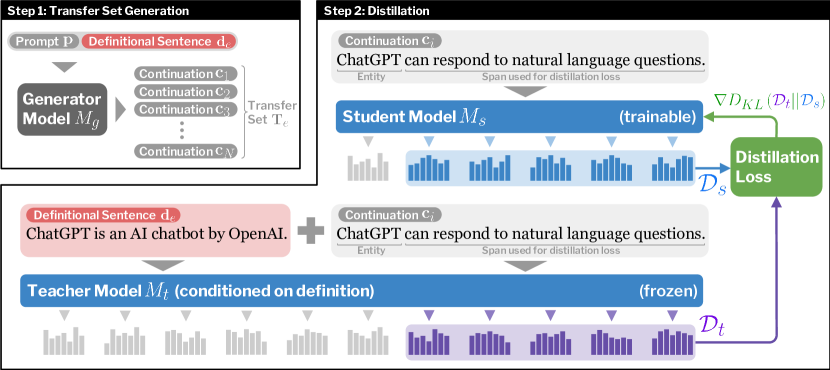
Modern language models have the capacity to store and use immense amounts of knowledge about real-world entities, but it remains unclear how to update such knowledge stored in model parameters. While prior methods for updating knowledge in LMs successfully inject atomic facts, updated LMs fail to make inferences based on injected facts. In this work, we demonstrate that a context distillation-based approach can both impart knowledge about entities and propagate that knowledge to enable broader inferences. Our approach consists of two stages: transfer set generation and distillation on the transfer set. We first generate a transfer set by prompting a language model to generate continuations from the entity definition. Then, we update the model parameters so that the distribution of the LM (the student) matches the distribution of the LM conditioned on the definition (the teacher) on the transfer set. Our experiments demonstrate that this approach is more effective at propagating knowledge updates than fine-tuning and other gradient-based knowledge-editing methods. Moreover, it does not compromise performance in other contexts, even when injecting the definitions of up to 150 entities at once.
Motivation & Objective
- To address the limitation of existing knowledge-editing methods in LLMs, which inject facts but fail to propagate them for inference.
- To bridge the gap between retrieval-augmented prompting (which enables reasoning) and parameter-based knowledge injection (which lacks reasoning capacity).
- To develop a scalable, parameter-efficient method that enables LMs to generalize from injected entity definitions without compromising performance on other tasks.
- To evaluate whether distillation can effectively propagate knowledge across diverse models and entity sets, including large-scale updates.
Proposed method
- Generate a transfer set by prompting a language model to produce continuations of entity definition sentences.
- Use knowledge distillation to align the student model’s next-token distribution with that of a teacher model conditioned on the entity definition, minimizing KL divergence on the transfer set.
- Train the student model using a KL loss between its unconditional output and the teacher’s conditional output on the same context.
- Construct the transfer set using a generator model, with ablation studies comparing outputs from base models versus larger models like GPT-3.5.
- Apply the distillation process to update model parameters in a targeted way, avoiding broad distributional shifts.
- Scale the method to inject up to 150 entities simultaneously, evaluating performance and specificity on multiple benchmarks.
Experimental results
Research questions
- RQ1Can knowledge distillation effectively propagate injected knowledge to enable inference beyond atomic facts in LMs?
- RQ2How does the distillation-based method compare to fine-tuning and gradient-based editing (e.g., MEND, MEMIT) in terms of knowledge propagation and performance retention?
- RQ3Does the method scale to injecting knowledge for large numbers of entities (e.g., 100+), and does it maintain performance on unrelated tasks?
- RQ4How does the choice of generator model (e.g., base vs. large model) affect the quality and effectiveness of the transfer set and final model performance?
- RQ5Does the distillation approach preserve specificity when injecting counterfactual or false knowledge, as in the CounterFact benchmark?
Key findings
- The distillation method significantly outperforms fine-tuning and prior editing methods (MEND, MEMIT) on both the Entity Inferences and Entity Cloze by Date benchmarks across three language models.
- The method maintains high performance on unrelated tasks even when injecting definitions for up to 150 entities simultaneously, with minimal degradation.
- Distillation on transfer sets generated from the base model itself is competitive with those from GPT-3.5, indicating the method does not require a larger teacher model.
- On the CounterFact benchmark, the distillation method achieves better specificity (neighborhood score +) than MEND and MEMIT, though with lower efficacy and generalization, suggesting trade-offs in handling false facts.
- The approach shows robustness in scalability, outperforming MEMIT, which exhibits increased perplexity when injecting more than 25 entities.
- Specificity degradation is observed on GPT-Neo but not on GPT2-XL, indicating model-dependent behavior in specificity under large-scale edits.
Read this paper
Open the full text in the Nubint reader and ask about any passage as you read.
Read this paper on NubintThis review was generated by AI from the original paper. Please check the paper before citing it.