
[Paper Review] Propagating photo-$z$ uncertainties: a functional derivative approach
This paper introduces a functional derivative approach to propagate photometric redshift (photo-$z$) uncertainties in cosmic shear surveys, enabling efficient sensitivity analysis of the angular power spectrum to arbitrary perturbations in the source redshift distribution (SRD). The method allows for fast, one-time computation of functional derivatives, showing that only the mean and variance of the SRD matter for EUCLID-level accuracy, while higher-order moments (n > 2) are negligible for bias control.
Photometric redshifts are a key ingredient in the analysis and interpretation of large-scale structure (LSS) surveys. The accuracy and precision of these redshift estimates are directly linked to the constraining power of photometric surveys. It is hence necessary to define precision and accuracy requirements for the redshift calibration evision{to not} infer biased results in the final analysis. For weak gravitational lensing of the LSS, the photometry culminates in the estimation of the source redshift distribution (SRD) in each of the tomographic bins used in the analysis. The focus has been on shifts of the mean of the SRDs and how well the calibration must be able to recover those. Since the estimated SRDs are usually given as a normalized histogram with corresponding errors, it would be advantageous to propagate these uncertainties accordingly to see whether the requirements of the given survey are indeed fulfilled. Here we propose the use of functional derivatives to calculate the sensitivity of the final observables, e.g. the lensing angular power spectrum, with respect to the SRD at a specific redshift. This allows the propagation of arbitrarily shaped small perturbations to the SRD, without having to run the whole analysis pipeline for each realization again. We apply our method to an EUCLID survey and demonstrate it with SRDs of the KV450 data set, recovering previous results. Lastly, we note that the moments of the SRD of order larger than two will probably not be relevant when propagating redshift uncertainties in cosmic shear analysis.
Motivation & Objective
- To address the challenge of propagating photometric redshift uncertainties in cosmic shear surveys without re-running the full analysis pipeline for each realization.
- To assess whether current and future surveys like EUCLID and KV450 meet required accuracy standards for the source redshift distribution (SRD) to avoid biased cosmological constraints.
- To determine which statistical moments of the SRD (mean, variance, skewness, etc.) are most sensitive to bias in cosmological parameter inference.
- To develop a computationally efficient method for evaluating the impact of SRD uncertainties on the angular power spectrum, using functional derivatives.
Proposed method
- The method computes the functional derivative of the cosmic shear angular power spectrum $C_\ell$ with respect to the SRD at a fixed comoving distance $\chi_0$, enabling sensitivity analysis to arbitrary small perturbations in the SRD.
- The functional derivative is calculated once and then used to propagate perturbations sampled from the SRD posterior, avoiding repeated full analysis runs.
- The approach accounts for the normalization constraint of the SRD by incorporating the delta-function constraint in the functional derivative calculation.
- Error propagation is performed via $\Delta\chi^2 = \int d\chi \, \delta n(\chi) \cdot \frac{\delta C_\ell}{\delta n(\chi)} \cdot \delta n(\chi)$, where $\delta n(\chi)$ represents small perturbations in the SRD.
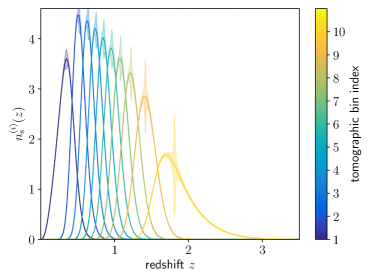
- The method is applied to EUCLID-like survey specifications and validated on KV450 data, using the DIR covariance matrix to sample realistic SRD realizations.
- The analysis includes a comparison of perturbations in the mean, variance, and higher-order moments (up to skewness), with results assessed via $\Delta\chi^2$ and derived shifts in $S_8$.
Experimental results
Research questions
- RQ1How do small, arbitrary perturbations in the source redshift distribution (SRD) affect the cosmic shear angular power spectrum?
- RQ2What is the sensitivity of cosmological constraints to the mean, variance, and higher-order moments of the SRD?
- RQ3To what extent do full-shape uncertainties in the SRD, beyond simple mean shifts, bias cosmological parameter inference in stage-3 and stage-4 surveys?
- RQ4Can functional derivatives provide an efficient alternative to full Monte Carlo sampling for SRD uncertainty propagation in cosmic shear?
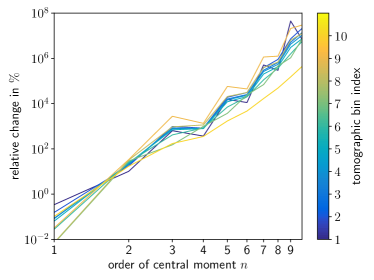
- RQ5Are higher-order moments of the SRD (n > 2) relevant for bias control in upcoming surveys like EUCLID?
Key findings
- Perturbations that preserve the mean of the SRD can be significantly larger without introducing bias, supporting the common practice of using only mean shifts in calibration.
- For EUCLID, the mean of the SRD must be calibrated to better than 0.01% to 1% accuracy, depending on the tomographic bin, to avoid cosmological bias.
- The variance of the SRD remains relevant at the 10% level, while sensitivity to skewness is weak but non-zero; higher-order moments (n > 2) are negligible for bias control.
- The KV450 SRD uncertainties, when propagated via the functional derivative method, induce biases of at most 1σ in the final cosmological constraints, confirming the robustness of the current calibration.
- The method enables fast, one-time computation of functional derivatives, making it computationally efficient for uncertainty propagation without re-running the full analysis pipeline for each realization.
- The functional derivative approach is shown to be a viable and scalable alternative to full-shape sampling or parametric modeling, particularly for self-calibration and sensitivity analysis.
Read this paper
Open the full text in the Nubint reader and ask about any passage as you read.
Read this paper on NubintThis review was generated by AI from the original paper. Please check the paper before citing it.