
[Paper Review] ProRes: Exploring Degradation-aware Visual Prompt for Universal Image Restoration
ProRes introduces degradation-aware visual prompts to enable a controllable, universal image restoration framework based on a ViT backbone, with prompt tuning for adapting to new tasks/datasets.
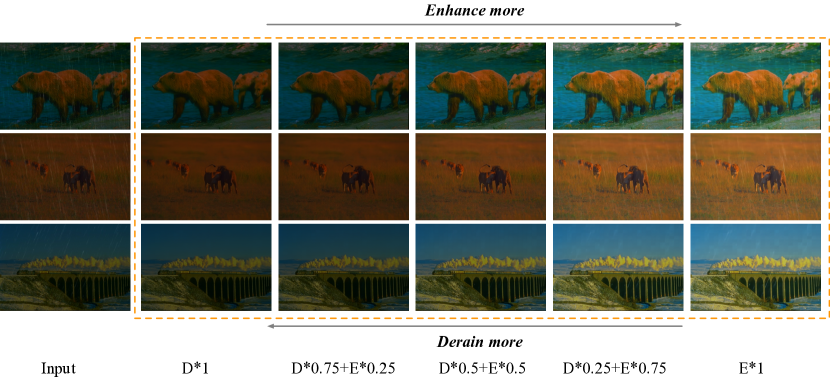
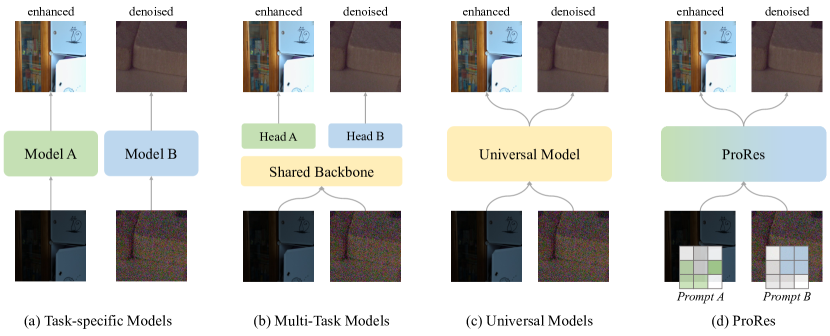
Image restoration aims to reconstruct degraded images, e.g., denoising or deblurring. Existing works focus on designing task-specific methods and there are inadequate attempts at universal methods. However, simply unifying multiple tasks into one universal architecture suffers from uncontrollable and undesired predictions. To address those issues, we explore prompt learning in universal architectures for image restoration tasks. In this paper, we present Degradation-aware Visual Prompts, which encode various types of image degradation, e.g., noise and blur, into unified visual prompts. These degradation-aware prompts provide control over image processing and allow weighted combinations for customized image restoration. We then leverage degradation-aware visual prompts to establish a controllable and universal model for image restoration, called ProRes, which is applicable to an extensive range of image restoration tasks. ProRes leverages the vanilla Vision Transformer (ViT) without any task-specific designs. Furthermore, the pre-trained ProRes can easily adapt to new tasks through efficient prompt tuning with only a few images. Without bells and whistles, ProRes achieves competitive performance compared to task-specific methods and experiments can demonstrate its ability for controllable restoration and adaptation for new tasks. The code and models will be released in \url{https://github.com/leonmakise/ProRes}.
Motivation & Objective
- Motivate universal image restoration that handles diverse degradations without task-specific architectures.
- Propose degradation-aware visual prompts that encode different degradations as image-like prompts.
- Build ProRes as a simple ViT-based universal restoration framework leveraging prompt-based control.
- Demonstrate prompt tuning as an efficient way to adapt ProRes to new tasks/datasets.
Proposed method
- Define degradation-aware visual prompts with the same height/width as input images to encode specific degradations.
- Add a single degradation prompt to the degraded image and process it with a vanilla ViT encoder and a simple pixel decoder.
- Train prompts while freezing the rest of a pre-trained restoration model to stabilize optimization.
- Use a lightweight prompt-tuning protocol to adapt ProRes to new tasks/datasets without full model fine-tuning.
- Explore different prompt initialization strategies and training losses, selecting pre-trained prompts and Smooth-L1 loss for stability and performance.
Experimental results
Research questions
- RQ1Can degradation-aware visual prompts give a controllable and universal restoration capability across multiple tasks?
- RQ2How does ProRes compare to task-specific and vanilla universal models on denoising, deraining, enhancement, and deblurring?
- RQ3Can prompt tuning efficiently adapt ProRes to new degradation tasks or datasets without retraining the entire model?
- RQ4What is the impact of prompt initialization and where prompts should be integrated in the network?
Key findings
- ProRes achieves competitive performance with task-specific methods on several benchmarks using a simple ViT-based architecture.
- The degradation-aware prompts provide controllable restoration by weighting and combining prompts for complex degradations.
- Prompt tuning enables effective transfer to new tasks/datasets (e.g., FiveK for low-light, RESIDE-6K for dehazing) without full model fine-tuning.
- Using pre-trained prompts with detached optimization yields stable training and good results across tasks.
- The approach demonstrates visualization-based control and transferability, suggesting potential for larger-scale universal restoration with prompts.
Read this paper
Open the full text in the Nubint reader and ask about any passage as you read.
Read this paper on NubintThis review was generated by AI from the original paper. Please check the paper before citing it.