
[Paper Review] Prospective and retrospective coding in cortical neurons
This paper proposes that individual cortical neurons can exhibit prospective coding—advancing their output firing relative to inputs—through intrinsic membrane dynamics, particularly sodium channel inactivation and adaptation mechanisms. Using the Hodgkin-Huxley model and simulation-based inference, it identifies a minimal set of three key parameters controlling this timing advance, demonstrating that single-neuron dynamics can enable real-time anticipation of future inputs, reconciling fast neural processing with biophysical delays.
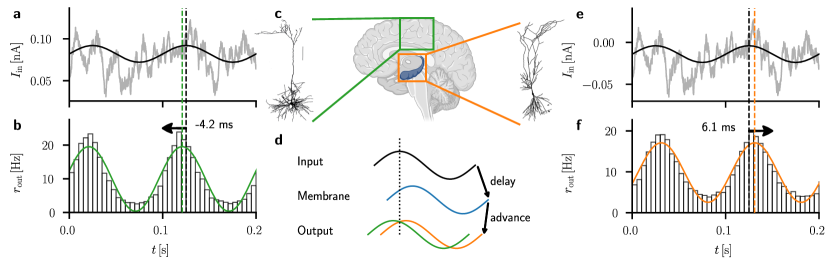
Brains can process sensory information from different modalities at astonishing speed; this is surprising as the integration of inputs through the membrane of each individual neuron already causes a delayed response. Neuronal recordings {\em in vitro} reveal a possible explanation for this fast processing, in terms of individual neurons advancing their output firing rates with respect to the input, a concept which we refer to as prospective coding. The underlying mechanisms of prospective coding, however, are not completely understood. We propose a mechanistic explanation for individual neurons advancing their output on the level of single action potentials and instantaneous firing rates. We show that the spike generation mechanism can be the source for prospective (advanced) or retrospective (delayed) responses. A simplified Hodgkin-Huxley model identifies sodium inactivation as a source for prospective firing, controlling the timing of the neuron's output as a function of the voltage and its temporal derivative. We further show that slow adaptation processes, such as spike-frequency adaptation or deactivating dendritic currents, represent mechanisms generating prospective firing for inputs that undergo slow temporal modulations. In general, we show that adaptation processes at different time scales can cause advanced neuronal responses to time-varying inputs that are modulated on the corresponding time scales.
Motivation & Objective
- To investigate whether individual cortical neurons can generate prospective (advanced) responses to time-varying inputs, challenging the assumption that such timing advances require population-level mechanisms.
- To identify the biophysical mechanisms within single neurons that enable prospective coding, particularly focusing on ion channel dynamics and adaptation processes.
- To determine which parameters of the Hodgkin-Huxley model control the transition between prospective and retrospective (delayed) responses.
- To develop a simplified rate model that captures prospective coding at a fraction of the computational cost of full Hodgkin-Huxley simulations.
- To validate that prospective responses are not statistical artifacts but emerge from intrinsic neuronal dynamics in single trials.
Proposed method
- The authors use experimentally fitted Hodgkin-Huxley models of neocortical and hippocampal neurons to simulate responses to noisy, sinusoidally modulated inputs at 10 Hz.
- They apply simulation-based inference (SBI) to solve the inverse problem, identifying the minimal set of parameters that determine whether a neuron's output is prospective or retrospective.
- The SBI framework conditions posterior distributions on observed phase shifts (e.g., +4.2 ms advance), enabling parameter space analysis and validation via posterior predictive checks.
- A simplified rate model is derived to reproduce prospective responses with reduced computational cost, extending it to longer timescales using adaptation processes.
- Signal analysis involves fitting sinusoidal functions to output firing rates to estimate phase shifts and using discrete cross-correlation to quantify temporal lags between spike trains.
- The study analyzes gating variable dynamics (m, h, n) and their time constants, focusing on how changes in activation and inactivation kinetics affect response timing.
Experimental results
Research questions
- RQ1Can individual cortical neurons generate output responses that are advanced relative to their inputs, even in single trials?
- RQ2What biophysical mechanisms within the Hodgkin-Huxley framework enable prospective versus retrospective coding in single neurons?
- RQ3Which specific parameters of the Hodgkin-Huxley model control the timing of neuronal output relative to input modulation?
- RQ4Can adaptation processes at different time scales (e.g., spike-frequency adaptation, slow inactivation) generate prospective responses to slowly varying inputs?
- RQ5Is the observed phase advance a statistical artifact, or does it emerge from intrinsic neuronal dynamics?
Key findings
- The Hodgkin-Huxley model reproduces a 4.2 ms phase advance in output firing relative to a 10 Hz amplitude-modulated input, matching experimental observations in vitro.
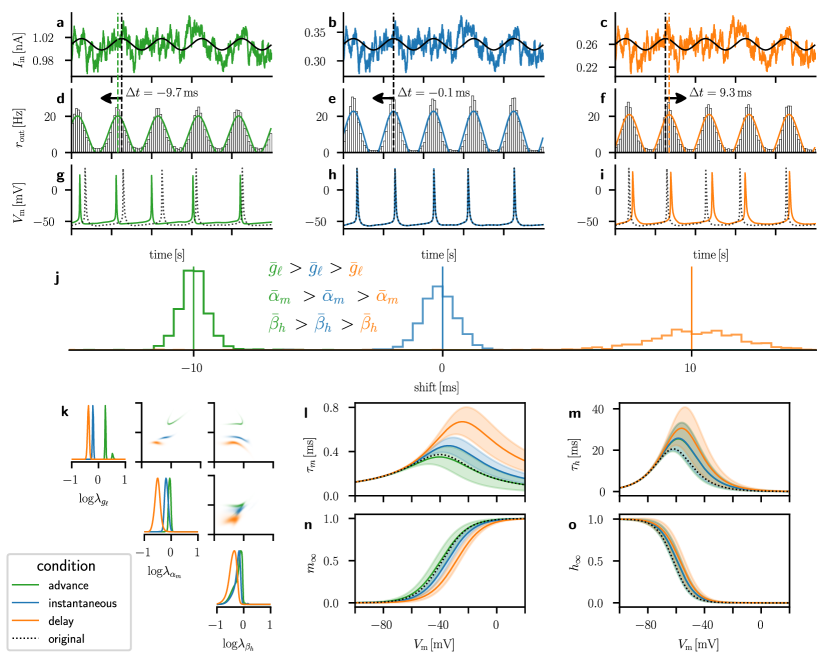
- SBI identifies a minimal parameter space of three key parameters—λgℓ, λαm, and λβh—that control whether a neuron's response is prospective or retrospective.
- Sodium channel inactivation (governed by h-gate kinetics) is identified as a primary mechanism enabling prospective firing, with the timing of the output controlled by both voltage and its derivative.
- The study shows that adaptation processes at different time scales, including spike-frequency adaptation and slow inactivation, can generate prospective responses to inputs modulated on those corresponding timescales.
- The simplified rate model successfully replicates prospective coding from full Hodgkin-Huxley simulations at a fraction of the computational cost, enabling efficient exploration of long-timescale dynamics.
- Posterior predictive checks confirm that the model accurately reproduces the conditioned phase shifts, validating the inference framework and the biological plausibility of the identified mechanisms.
Read this paper
Open the full text in the Nubint reader and ask about any passage as you read.
Read this paper on NubintThis review was generated by AI from the original paper. Please check the paper before citing it.