
[Paper Review] Prototype Global Analysis of LISA Data with Multiple Source Types
This paper presents GLASS, the first prototype global analysis pipeline for LISA data that simultaneously fits multiple gravitational wave source types—ultra-compact binaries (UCBs), verification binaries (VGBs), massive black hole mergers (MBHBs), and instrumental noise—using a blocked Metropolis-Hastings algorithm. The method successfully reconstructs source populations and noise models in simulated LISA Data Challenge 2a-v2 data, demonstrating the feasibility of a modular, scalable global fitting framework for future LISA operations.
The novel data analysis challenges posed by the Laser Interferometer Space Antenna (LISA) arise from the overwhelmingly large number of astrophysical sources in the measurement band and the density with which they are found in the data. Robust detection and characterization of the numerous gravitational wave sources in LISA data can not be done sequentially, but rather through a simultaneous global fit of a data model containing the full suite of astrophysical and instrumental features present in the data. While previous analyses have focused on individual source types in isolation, here we present the first demonstration of a LISA global fit analysis containing combined astrophysical populations. The prototype pipeline uses a blocked Metropolis Hastings algorithm to alternatingly fit to a population of ultra compact galactic binaries, known ``verification binaries'' already identified by electromagnetic observations, a population of massive black hole mergers, and an instrument noise model. The Global LISA Analysis Software Suite (GLASS) is assembled from independently developed samplers for the different model components. The modular design enables flexibility to future development by defining standard interfaces for adding new, or updating additional, components to the global fit without being overly prescriptive for how those modules must be internally designed. The GLASS pipeline is demonstrated on data simulated for the LISA Data Challenge 2b. Results of the analysis and a road-map for continued development are described in detail.
Motivation & Objective
- To address the challenge of analyzing LISA data with an overwhelming number of overlapping gravitational wave sources and complex noise.
- To develop a scalable, modular framework capable of simultaneously fitting multiple source types and instrumental effects.
- To demonstrate the feasibility of a global fit approach using realistic simulated LISA data from the LISA Data Challenge 2a-v2.
- To lay the foundation for future integration of advanced noise models, glitches, and self-calibration techniques in LISA data analysis.
Proposed method
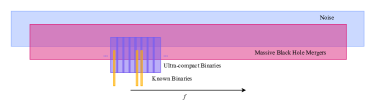
- GLASS uses a blocked Metropolis-Hastings algorithm to jointly sample parameters across four model components: UCBs, VGBs, MBHBs, and a phenomenological noise model.
- Each source type is modeled with analytic waveforms: UCBs and VGBs via time-domain templates, MBHBs via post-Newtonian waveforms.
- The noise model accounts for both instrumental noise and the unresolved galactic binary foreground, treated as a stochastic signal.
- The pipeline is modular, with independent samplers for each component communicating via standardized interfaces to enable extensibility.
- Data are processed sequentially in time strides to simulate real-time mission operations, improving computational scalability.
- Wavelet-domain analysis is employed to naturally handle data gaps and reduce spectral leakage compared to Fourier-based methods.
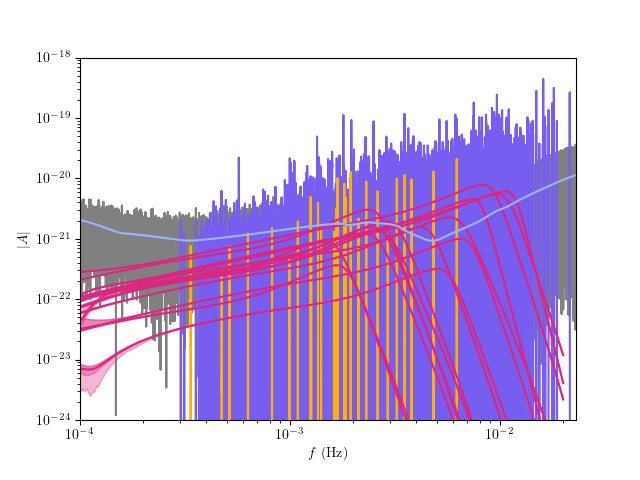
Experimental results
Research questions
- RQ1Can a global fitting framework simultaneously and robustly model multiple gravitational wave source types in LISA data?
- RQ2How well can a modular, blocked Metropolis-Hastings algorithm recover source parameters and noise levels in the presence of signal confusion?
- RQ3What is the performance of the GLASS pipeline in reconstructing UCB, VGB, and MBHB populations from simulated LISA Data Challenge 2a-v2 data?
- RQ4How does the wavelet-domain approach compare to Fourier-based methods in handling data gaps and non-stationary noise?
- RQ5What are the key challenges and future extensions needed to scale the global fit to full LISA mission data?
Key findings
- The GLASS pipeline successfully reconstructs the amplitude spectral density of the A-channel TDI data, with posterior distributions of UCB waveforms closely matching the injected signals.
- The analysis recovers the parameters of the 35 verification binaries (VGBs) with high fidelity, confirming the robustness of the global fitting approach.
- The unresolved galactic binary foreground is effectively modeled as a stochastic component, though future work will refine this using physical priors on source distribution.
- The modular design enables seamless integration of new components, such as glitch models and self-calibration modules, with no need to rearchitect the core framework.
- The wavelet-domain approach demonstrates superior handling of data gaps compared to traditional Fourier methods, reducing spectral leakage without additional data conditioning.
- The pipeline is already being extended to include the TDI T channel and time-varying noise models, with plans to incorporate physical instrument models and phase-stabilization effects.
Read this paper
Open the full text in the Nubint reader and ask about any passage as you read.
Read this paper on NubintThis review was generated by AI from the original paper. Please check the paper before citing it.