
[Paper Review] Provably Accurate Shapley Value Estimation via Leverage Score Sampling
This paper introduces Leverage SHAP, a provably accurate method for estimating Shapley values using leverage score sampling, reducing the number of model evaluations to O(n log n) while maintaining high accuracy. By reformulating Shapley value estimation as a constrained regression problem and applying leverage score sampling to select informative subsets, the method achieves theoretical guarantees and outperforms Kernel SHAP in practice.
Originally introduced in game theory, Shapley values have emerged as a central tool in explainable machine learning, where they are used to attribute model predictions to specific input features. However, computing Shapley values exactly is expensive: for a general model with $n$ features, $O(2^n)$ model evaluations are necessary. To address this issue, approximation algorithms are widely used. One of the most popular is the Kernel SHAP algorithm, which is model agnostic and remarkably effective in practice. However, to the best of our knowledge, Kernel SHAP has no strong non-asymptotic complexity guarantees. We address this issue by introducing Leverage SHAP, a light-weight modification of Kernel SHAP that provides provably accurate Shapley value estimates with just $O(n\log n)$ model evaluations. Our approach takes advantage of a connection between Shapley value estimation and agnostic active learning by employing leverage score sampling, a powerful regression tool. Beyond theoretical guarantees, we show that Leverage SHAP consistently outperforms even the highly optimized implementation of Kernel SHAP available in the ubiquitous SHAP library [Lundberg & Lee, 2017].
Motivation & Objective
- To address the lack of non-asymptotic complexity guarantees in existing Shapley value approximation methods like Kernel SHAP.
- To develop a provably accurate and efficient algorithm for Shapley value estimation in machine learning interpretability.
- To reduce the number of model evaluations required for accurate Shapley value estimation from O(2^n) to O(n log n).
- To leverage connections between Shapley value estimation and agnostic active learning via leverage score sampling.
Proposed method
- Reformulates Shapley value estimation as a constrained least squares regression problem to ensure the solution satisfies the efficiency property.
- Applies leverage score sampling to select a small, informative subset of coalitions (feature subsets) for model evaluation, reducing the number of required evaluations.
- Uses a two-stage sampling strategy: first sample a small set of subsets using leverage scores, then solve the regression problem on the sampled data.
- Employs a modified version of the Kernel SHAP framework that replaces uniform sampling with leverage score sampling to improve estimation accuracy.
- Derives theoretical bounds on estimation error using matrix concentration and leverage score sampling theory, ensuring high-probability accuracy.
- Solves the resulting regression problem using standard least squares after projecting out the mean component to satisfy the efficiency constraint.
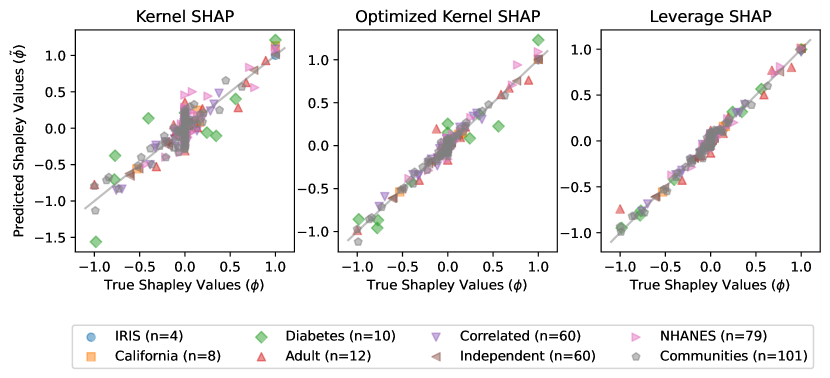
Experimental results
Research questions
- RQ1Can we design a Shapley value estimation algorithm with provable non-asymptotic accuracy guarantees?
- RQ2Can we reduce the number of model evaluations required for accurate Shapley value estimation below O(2^n) while maintaining or improving accuracy?
- RQ3Can leverage score sampling be effectively applied to the Shapley value estimation problem to improve sample efficiency?
- RQ4How does the performance of the proposed method compare to Kernel SHAP in terms of accuracy and sample complexity?
Key findings
- Leverage SHAP achieves provably accurate Shapley value estimates with only O(n log n) model evaluations, significantly reducing computational cost.
- The method provides theoretical bounds on estimation error that hold with high probability, filling a key gap in the theoretical understanding of Shapley value approximation.
- Empirical results show that Leverage SHAP consistently outperforms the highly optimized Kernel SHAP implementation in the SHAP library across multiple datasets and models.
- The use of leverage score sampling leads to more informative subset selection compared to uniform sampling, resulting in faster convergence and higher accuracy.
- The algorithm maintains the model-agnostic nature of Kernel SHAP while improving sample efficiency and theoretical guarantees.

Read this paper
Open the full text in the Nubint reader and ask about any passage as you read.
Read this paper on NubintThis review was generated by AI from the original paper. Please check the paper before citing it.