
[Paper Review] Proximal Policy Gradient Arborescence for Quality Diversity Reinforcement Learning
This paper introduces Proximal Policy Gradient Arborescence (PPGA), the first Quality Diversity Reinforcement Learning algorithm to successfully integrate on-policy PPO with Differentiable Quality Diversity (DQD), enabling efficient discovery of diverse, high-performing policies in challenging locomotion tasks. PPGA achieves a 4x improvement in best reward over baselines on the Humanoid environment while matching standard PPO performance and maintaining strong behavioral diversity.
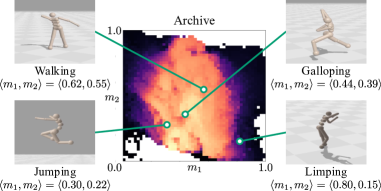
Training generally capable agents that thoroughly explore their environment and learn new and diverse skills is a long-term goal of robot learning. Quality Diversity Reinforcement Learning (QD-RL) is an emerging research area that blends the best aspects of both fields -- Quality Diversity (QD) provides a principled form of exploration and produces collections of behaviorally diverse agents, while Reinforcement Learning (RL) provides a powerful performance improvement operator enabling generalization across tasks and dynamic environments. Existing QD-RL approaches have been constrained to sample efficient, deterministic off-policy RL algorithms and/or evolution strategies, and struggle with highly stochastic environments. In this work, we, for the first time, adapt on-policy RL, specifically Proximal Policy Optimization (PPO), to the Differentiable Quality Diversity (DQD) framework and propose additional improvements over prior work that enable efficient optimization and discovery of novel skills on challenging locomotion tasks. Our new algorithm, Proximal Policy Gradient Arborescence (PPGA), achieves state-of-the-art results, including a 4x improvement in best reward over baselines on the challenging humanoid domain.
Motivation & Objective
- To close the performance gap between standard reinforcement learning and Quality Diversity RL in high-dimensional, dynamic control tasks.
- To enable effective use of on-policy RL algorithms like PPO within the DQD framework, which traditionally favored off-policy or evolutionary methods.
- To address the challenge of optimizing non-Markovian behavioral diversity measures in RL-compatible ways.
- To improve training stability and exploration efficiency in DQD by integrating modern Natural Evolution Strategies such as xNES.
- To develop a scalable, vectorized implementation of PPO that jointly optimizes performance and diversity gradients across multiple tasks.
Proposed method
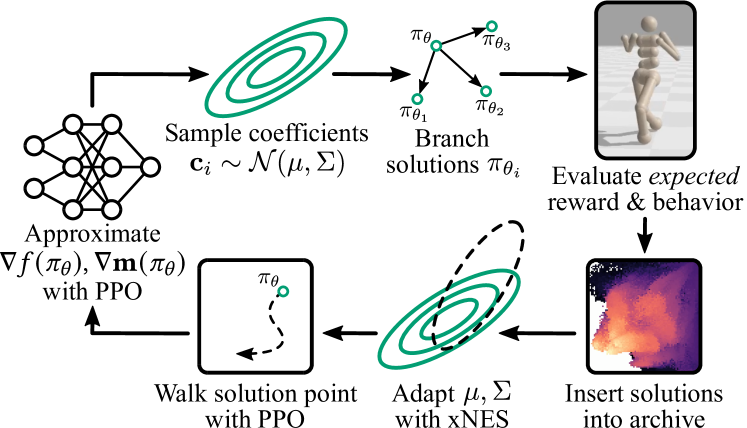
- Proposes a vectorized PPO (VPPO) implementation that computes both objective and measure gradients in a single forward pass, reducing computational overhead.
- Reformulates CMA-based DQD algorithms as instances of Natural Evolution Strategies (NES), enabling use of advanced NES methods like xNES for improved stability and convergence.
- Introduces Markovian Measure Proxies (MMPs) to transform non-Markovian behavioral diversity measures into differentiable, RL-compatible forms.
- Employs an iterative 'walking' strategy to move the current search policy through the behavior space using online PPO gradients, enabling targeted exploration of unexplored regions.
- Uses a hybrid optimization loop combining PPO policy updates with xNES-based covariance matrix adaptation to guide search toward high-quality, diverse behaviors.
- Introduces a novel search policy update mechanism that leverages online data and gradient information to balance performance and diversity in a unified optimization process.
Experimental results
Research questions
- RQ1Can on-policy reinforcement learning, specifically PPO, be effectively integrated into the Differentiable Quality Diversity (DQD) framework to improve policy performance and diversity?
- RQ2How can non-Markovian behavioral diversity measures—common in QD-RL—be made compatible with gradient-based RL optimization?
- RQ3Does the synergy between PPO and DQD lead to better sample efficiency, performance, and robustness compared to off-policy QD-RL baselines?
- RQ4Can modern NES methods like xNES improve training stability and convergence in DQD-based QD-RL compared to traditional CMA-MAEGA?
- RQ5To what extent does PPGA maintain diversity while matching or exceeding the performance of standard PPO in challenging locomotion tasks?
Key findings
- PPGA achieves a 4x improvement in best reward over baselines on the challenging Humanoid locomotion task, setting a new state-of-the-art.
- PPGA maintains a QD-score of 1.02×10⁵ and 52% coverage on Humanoid, outperforming all baselines in both diversity and performance.
- After post-hoc re-evaluation in stochastic environments, PPGA maintains the highest corrected QD-score and best reward across all tasks, indicating robustness to environmental noise.
- PPGA produces a more favorable distribution of policies than baselines, as shown by corrected CCDF plots, with better performance on all tasks except Ant.
- The use of xNES in PPGA leads to more stable training and better convergence compared to prior CMA-MAEGA-based methods, especially in high-dimensional spaces.
- Despite higher sample complexity, PPGA matches standard PPO performance on all domains while preserving behavioral diversity, demonstrating effective synergy between on-policy RL and DQD.
Read this paper
Open the full text in the Nubint reader and ask about any passage as you read.
Read this paper on NubintThis review was generated by AI from the original paper. Please check the paper before citing it.