
[Paper Review] Pushing Mixture of Experts to the Limit: Extremely Parameter Efficient MoE for Instruction Tuning
This work introduces extremely parameter-efficient Mixture of Experts (MoE) by replacing full experts with lightweight adapters (MoV and MoLORA) and shows they can match or exceed full fine-tuning performance while updating under 1% of parameters on 11B-scale models and unseen tasks.
The Mixture of Experts (MoE) is a widely known neural architecture where an ensemble of specialized sub-models optimizes overall performance with a constant computational cost. However, conventional MoEs pose challenges at scale due to the need to store all experts in memory. In this paper, we push MoE to the limit. We propose extremely parameter-efficient MoE by uniquely combining MoE architecture with lightweight experts.Our MoE architecture outperforms standard parameter-efficient fine-tuning (PEFT) methods and is on par with full fine-tuning by only updating the lightweight experts -- less than 1% of an 11B parameters model. Furthermore, our method generalizes to unseen tasks as it does not depend on any prior task knowledge. Our research underscores the versatility of the mixture of experts architecture, showcasing its ability to deliver robust performance even when subjected to rigorous parameter constraints. Our code used in all the experiments is publicly available here: https://github.com/for-ai/parameter-efficient-moe.
Motivation & Objective
- Motivate and enable instruction fine-tuning with Mixture of Experts under extreme parameter constraints.
- Develop lightweight MoE architectures that use minimal trainable parameters.
- Show that parameter-efficient MoEs can match or surpass full fine-tuning on unseen tasks across multiple model sizes.
- Demonstrate robustness and scalability of MoV/MoLORA across 770M–11B base models across 12 datasets.
Proposed method
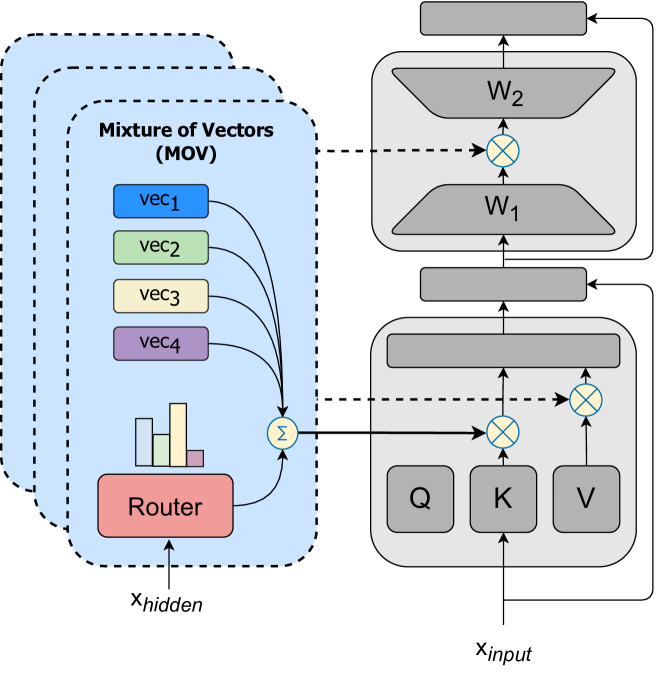
- Propose Mixture of Vectors (MoV) and Mixture of LORA (MoLORA) by replacing each MoE expert with lightweight PEFT adapters.
- Use a router to compute soft merging of expert outputs, followed by a PEFT transformation.
- Experiment with (IA)3 vectors and LORA adapters as the lightweight experts.
- Compare against full fine-tuning and standard PEFT baselines (IA)3 and LORA across 3B–11B T5 models.
- Perform extensive ablations on routing inputs (token vs sentence embeddings), routing strategy (soft vs discrete), number of experts, and hyperparameters.
- Adopt extremely parameter-efficient fine-tuning on instruction-tuning with P3 prompts and 8 unseen tasks, using Adafactor optimizer and specific training settings.
- Report zero-shot results and analyze how performance scales with model size and number of experts.

Experimental results
Research questions
- RQ1Can extremely parameter-efficient MoEs (MoV/MoLORA) achieve competitive zero-shot performance on unseen tasks compared to full fine-tuning?
- RQ2How does the number of experts and routing strategy affect performance under strict parameter budgets?
- RQ3Do token-based routing and soft merging provide better generalization than sentence embeddings or discrete routing in this setting?
- RQ4How does model size (770M–11B) influence the effectiveness of MoV/MoLORA compared to standard PEFT methods?
Key findings
- MoV and MoLORA achieve performance parity with full fine-tuning while updating less than 1% of the parameters on 3B–11B models.
- MoV with 30 experts improves unseen task performance by 14.57% over (IA)3 at 3B, and by 8.39% at 11B model sizes.
- MoV-60 (60 experts) with ~1.3% updated parameters closely approaches full fine-tuning performance across 3B and 11B scales.
- Soft merging routing outperforms discrete top-k routing in extremely parameter-efficient MoEs.
- Token routing (using token embeddings) generally outperforms sentence-embedding routing, suggesting that less task-specific priors can be advantageous.
- Increasing the number of experts generally boosts performance, with MoV achieving best results around 60 experts for 770M and 11B models, and around 30 for 3B models.
- MoV tends to outperform MoLORA at larger model sizes, while MoLORA with fewer experts can rival full fine-tuning at smaller scales.
- Across sizes, MoVs consistently surpass standard PEFT baselines (IA)3 and LORA in unseen-task performance.
Read this paper
Open the full text in the Nubint reader and ask about any passage as you read.
Read this paper on NubintThis review was generated by AI from the original paper. Please check the paper before citing it.