
[Paper Review] Py-Tetrad and RPy-Tetrad: A New Python Interface with R Support for Tetrad Causal Search
This paper introduces Py-Tetrad and RPy-Tetrad, new Python and R interfaces that enable seamless access to the Tetrad causal discovery framework via JPype and Reticulate. By leveraging modern, stable interfaces, the tools overcome limitations of outdated libraries like javabridge and rjava, offering full access to Tetrad’s latest algorithms—including GRaSP, FGES, and FCI—with improved installation, cross-language compatibility, and up-to-date support for Python and R users.
We give novel Python and R interfaces for the (Java) Tetrad project for causal modeling, search, and estimation. The Tetrad project is a mainstay in the literature, having been under consistent development for over 30 years. Some of its algorithms are now classics, like PC and FCI; others are recent developments. It is increasingly the case, however, that researchers need to access the underlying Java code from Python or R. Existing methods for doing this are inadequate. We provide new, up-to-date methods using the JPype Python-Java interface and the Reticulate Python-R interface, directly solving these issues. With the addition of some simple tools and the provision of working examples for both Python and R, using JPype and Reticulate to interface Python and R with Tetrad is straightforward and intuitive.
Motivation & Objective
- To address the growing need for researchers to access Tetrad’s advanced causal discovery algorithms from Python and R, which are now dominant in data science and statistical research.
- To overcome the limitations of legacy interfaces like javabridge and rjava, which are outdated, unstable (especially on macOS), and restrict access to only a subset of Tetrad’s functionality.
- To provide a modern, maintainable, and extensible interface that allows full access to Tetrad’s entire Java codebase through Python and R, enabling broader adoption and reproducibility.
- To streamline integration of Tetrad into data science workflows by enabling direct data and graph translation between Python/R and Tetrad, with built-in tools and examples.
Proposed method
- The authors developed Py-Tetrad using the JPype library to enable direct, Python-native access to Tetrad’s Java-based causal search algorithms.
- They implemented a high-level TetradSearch class that abstracts low-level JPype calls, allowing users to perform common tasks like graph construction, score selection, and algorithm execution without writing Java interop code.
- For R users, the RPy-Tetrad package leverages Reticulate to interface with Py-Tetrad, enabling bidirectional data sharing between R and Python and routing connections through Python to reduce complexity and ensure consistency.
- The tools include prepackaged utilities for translating datasets and graphical models between Python/R and Tetrad, including support for graph visualization via Graphviz and DiagrammeR.
- The authors provide up-to-date, working examples in both Python and R that demonstrate the use of key algorithms such as GRaSP, FGES, and FCI, with support for bootstrapping and score-based structure learning.
- The system is designed for extensibility and maintainability, with plans to support pip and CRAN installation, and feedback is encouraged via GitHub issue tracking.
Experimental results
Research questions
- RQ1How can researchers in Python and R gain reliable, full access to Tetrad’s causal discovery algorithms, which are implemented in Java?
- RQ2What are the limitations of existing interfaces like py-causal and r-causal, particularly regarding outdated dependencies and restricted access to Tetrad’s full codebase?
- RQ3Can JPype and Reticulate be effectively used to create a stable, maintainable, and user-friendly interface to Tetrad’s Java-based framework in both Python and R?
- RQ4How can data and graphical models be efficiently and reliably translated between Python/R and Tetrad’s Java representation in practice?
- RQ5What improvements in usability, reliability, and feature access can be achieved by replacing legacy interfaces like javabridge and rjava with modern alternatives?
Key findings
- Py-Tetrad and RPy-Tetrad provide full access to Tetrad’s latest algorithms, including GRaSP, FGES, and FCI, which were previously inaccessible through older tools like py-causal and r-causal.
- The use of JPype eliminates installation issues common with javabridge—especially on macOS—making the interface significantly more reliable and easier to deploy.
- R users can now access Tetrad’s full functionality through Reticulate, with data and graphs shared directly between R and Python, reducing complexity and ensuring consistency across updates.
- The TetradSearch class enables high-level, user-friendly access to Tetrad’s core features without requiring users to write low-level JPype code, improving accessibility for non-expert users.
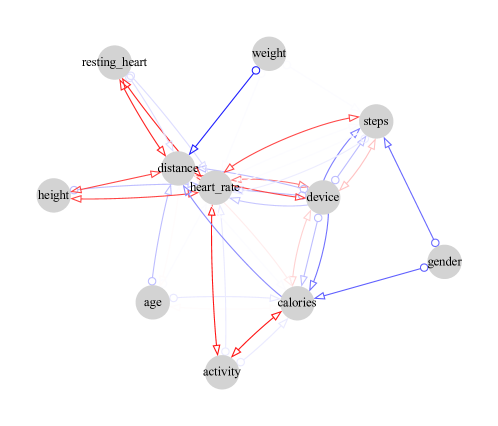
- The tools support advanced features such as bootstrapping (e.g., 30-fold resampling) and visualization of edge frequencies, with results displayed via Graphviz and DiagrammeR in R.
- The authors report overwhelmingly positive initial feedback, with plans to simplify installation via pip and CRAN, indicating strong potential for widespread adoption.
Better researchstarts right now
From reading papers to final review, dramatically reduce your research time.
No credit card · Free plan available
This review was created by AI and reviewed by human editors.