
[Paper Review] Qualitative Insights Tool (QualIT): LLM Enhanced Topic Modeling
QualIT integrates large language models with clustering-based topic modeling to produce more coherent and diverse topics than LDA and BERTopic, evaluated on 20 NewsGroups with ground-truth topics. It uses key-phrase extraction, hallucination checks, and two-layer clustering to generate main and sub-topics.
Topic modeling is a widely used technique for uncovering thematic structures from large text corpora. However, most topic modeling approaches e.g. Latent Dirichlet Allocation (LDA) struggle to capture nuanced semantics and contextual understanding required to accurately model complex narratives. Recent advancements in this area include methods like BERTopic, which have demonstrated significantly improved topic coherence and thus established a new standard for benchmarking. In this paper, we present a novel approach, the Qualitative Insights Tool (QualIT) that integrates large language models (LLMs) with existing clustering-based topic modeling approaches. Our method leverages the deep contextual understanding and powerful language generation capabilities of LLMs to enrich the topic modeling process using clustering. We evaluate our approach on a large corpus of news articles and demonstrate substantial improvements in topic coherence and topic diversity compared to baseline topic modeling techniques. On the 20 ground-truth topics, our method shows 70% topic coherence (vs 65% & 57% benchmarks) and 95.5% topic diversity (vs 85% & 72% benchmarks). Our findings suggest that the integration of LLMs can unlock new opportunities for topic modeling of dynamic and complex text data, as is common in talent management research contexts.
Motivation & Objective
- Motivate improved topic modeling that captures nuanced semantics in complex narratives.
- Propose a framework that combines LLMs with clustering to generate multi-topic representations per document.
- Reduce noise and improve interpretability of topics through key-phrase extraction and coherence filtering.
- Evaluate performance against standard baselines on a benchmark dataset to demonstrate gains in coherence and diversity.
Proposed method
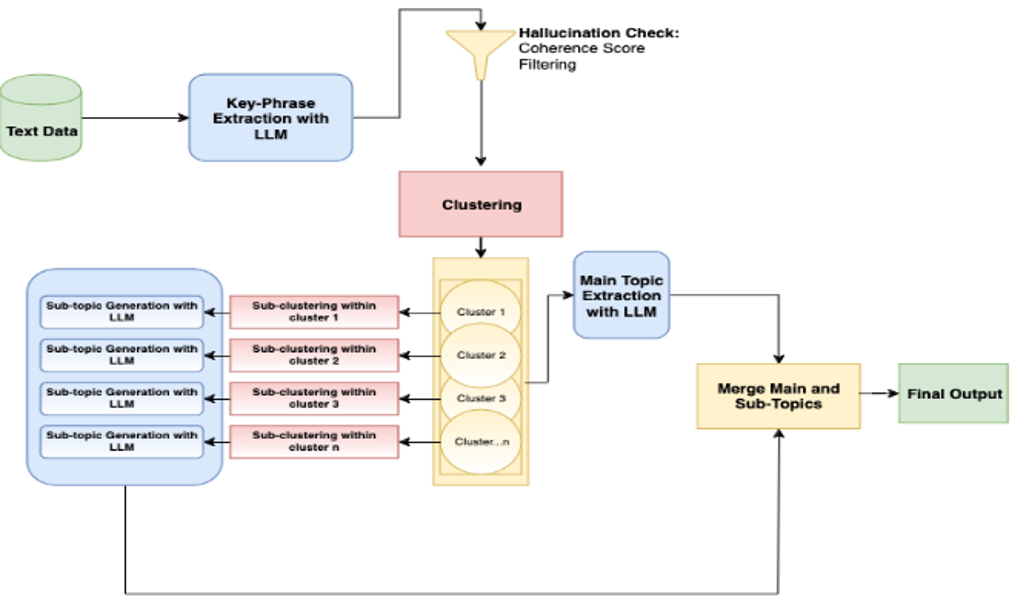
- Extract key-phrases per document using an LLM to capture multiple topics within a document.
- Compute a coherence-based hallucination check using cosine similarity of embeddings to filter unreliable key-phrases.
- Apply K-Means clustering on key-phrases to form main topic clusters and sub-clusters for sub-topics.
- For each main cluster, prompt the LLM to distill a main theme from the grouped documents.
- Within each main cluster, re-cluster to uncover sub-topics and extract sub-topics via LLM prompts.
- Determine the number of clusters automatically using Silhouette score to select an appropriate topic count.
Experimental results
Research questions
- RQ1Does QualIT improve topic coherence (TC) and topic diversity (TD) compared to LDA and BERTopic on the 20 NewsGroups dataset?
- RQ2Can LLM-assisted key-phrase extraction and dual-layer clustering produce more interpretable topics aligned with ground-truth categories?
- RQ3What is the impact of topic count (10, 20, 30, 40, 50) on TC and TD across methods?
- RQ4Is human evaluators’ agreement higher for QualIT outputs when mapping to ground-truth topics?
- RQ5What are the limitations in runtime and clustering approach, and how might alternative clustering (e.g., HDBSCAN) affect results?
Key findings
- QualIT yields higher average topic coherence (TC) and topic diversity (TD) than LDA and BERTopic on 20 NewsGroups, especially in 10–30 topic ranges.
- For 20 topics, QualIT achieves TC of 57.0% and TD of 72.0%, outperforming LDA and BERTopic in these metrics.
- QualIT’s average TC and TD across evaluated topic counts (10–50) are 64.4% and 93.7%, respectively, higher than both baselines.
- Human evaluators showed greater agreement mapping QualIT outputs to ground-truth topics than for benchmark methods.
- QualIT’s outputs were less ambiguous to humans, evidenced by higher agreement in topic categorization across evaluators.
Read this paper
Open the full text in the Nubint reader and ask about any passage as you read.
Read this paper on NubintThis review was generated by AI from the original paper. Please check the paper before citing it.