
[Paper Review] Quality-aware Pre-trained Models for Blind Image Quality Assessment
This paper proposes Quality-aware Pre-trained (QPT) models for blind image quality assessment (BIQA) using a self-supervised contrastive learning framework that learns quality-sensitive representations from ImageNet without labeled quality data. By designing a complex degradation space with 2×10⁷ possible distortions and a quality-aware contrastive loss, QPT significantly improves downstream BIQA performance across five benchmarks, outperforming prior methods by up to 8.75% in SRCC.
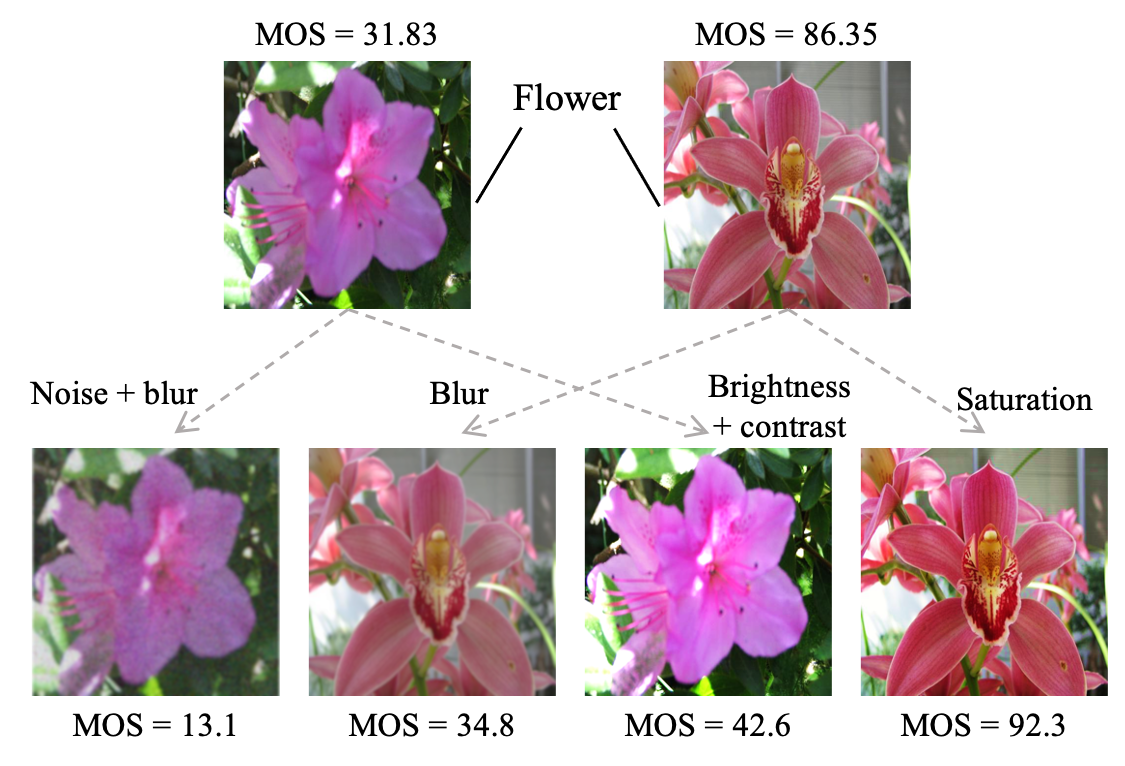
Blind image quality assessment (BIQA) aims to automatically evaluate the perceived quality of a single image, whose performance has been improved by deep learning-based methods in recent years. However, the paucity of labeled data somewhat restrains deep learning-based BIQA methods from unleashing their full potential. In this paper, we propose to solve the problem by a pretext task customized for BIQA in a self-supervised learning manner, which enables learning representations from orders of magnitude more data. To constrain the learning process, we propose a quality-aware contrastive loss based on a simple assumption: the quality of patches from a distorted image should be similar, but vary from patches from the same image with different degradations and patches from different images. Further, we improve the existing degradation process and form a degradation space with the size of roughly $2 imes10^7$. After pre-trained on ImageNet using our method, models are more sensitive to image quality and perform significantly better on downstream BIQA tasks. Experimental results show that our method obtains remarkable improvements on popular BIQA datasets.
Motivation & Objective
- Address the limited availability of labeled data in blind image quality assessment (BIQA), which hinders deep learning performance.
- Overcome the suboptimal transferability of existing pre-trained models (e.g., ImageNet) that focus on semantics, not image quality.
- Develop a self-supervised pretext task tailored for BIQA that captures sensitivity to low-level distortions and content-quality interactions.
- Construct a large, realistic degradation space to simulate authentic image distortions and improve representation learning.
Proposed method
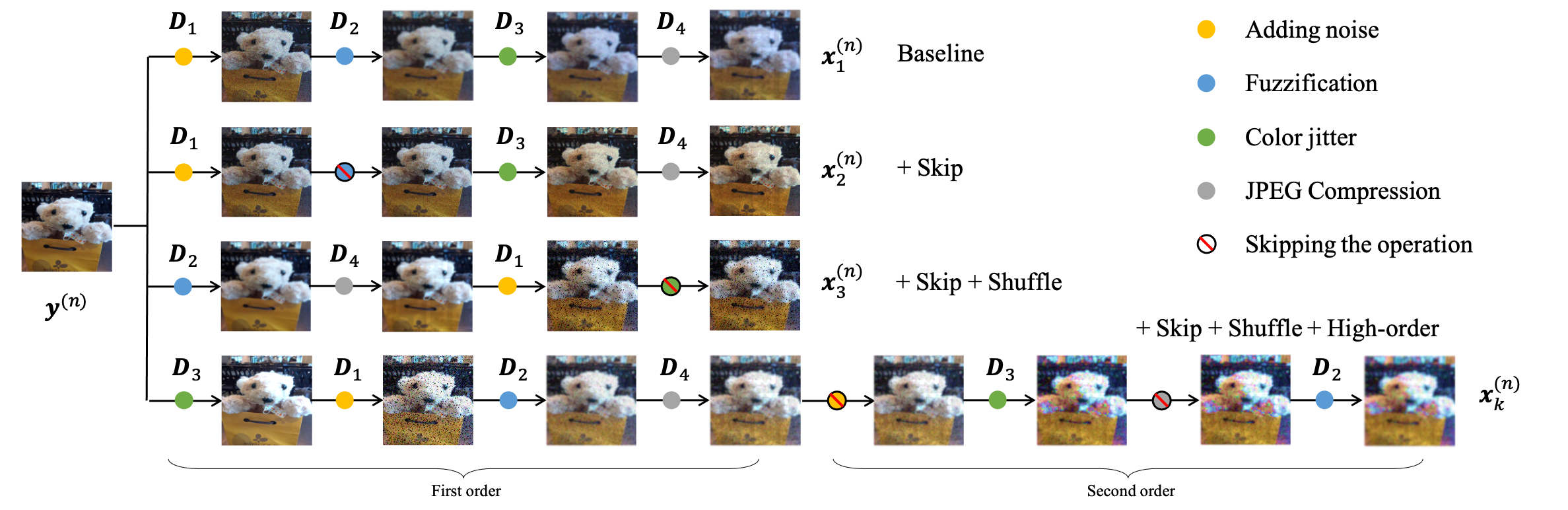
- Design a novel degradation process incorporating shuffle order, high-order operations, and skip connections to simulate complex real-world distortions.
- Create a degradation space of approximately 2×10⁷ distinct degradation types, enabling diverse data augmentation for contrastive learning.
- Propose a quality-aware contrastive loss (QC-Loss) that treats patches from the same distorted image as positive pairs, while distinguishing patches across different images (content-based negatives) and different degradations (degradation-based negatives).
- Adapt the MoCoV2 framework for self-supervised pre-training, using the QC-Loss to train models to be sensitive to image quality rather than semantic content.
- Pre-train on ImageNet using the proposed QC-Loss and degradation augmentation, then fine-tune or linear-probe on downstream BIQA datasets.
- Ensure generalization by reusing the same pre-trained weights across multiple BIQA benchmarks without task-specific adaptation.
Experimental results
Research questions
- RQ1Can a self-supervised pretext task that emphasizes image quality differences improve representation learning for blind image quality assessment?
- RQ2How does a large, diverse degradation space affect the quality-awareness of pre-trained features in BIQA?
- RQ3What is the relative contribution of content-based vs. degradation-based negative samples in the contrastive learning objective for BIQA?
- RQ4To what extent does the proposed QC-Loss improve downstream BIQA performance compared to standard contrastive learning or supervised pre-training?
Key findings
- The proposed QPT method achieves state-of-the-art performance on five standard BIQA benchmarks, with SRCC of 0.8875 and PLCC of 0.9109 on the BID dataset.
- On the CLIVE dataset, QPT achieves SRCC of 0.8947 and PLCC of 0.9141, outperforming MoCo by 8.75% in SRCC and 8.17% in PLCC in linear probing evaluation.
- The ablation study confirms that including both inter-sample (content-based) and intra-sample (degradation-based) negative pairs yields the best performance, with a significant drop when inter-sample negatives are removed.
- The combination of shuffle, high-order, and skip operations in the degradation process yields the highest performance, with SRCC of 0.8875 and PLCC of 0.9109 on BID.
- End-to-end fine-tuning with QPT weights achieves the highest results (SRCC: 0.8875, PLCC: 0.9109 on BID), confirming the effectiveness of the learned features beyond linear probing.
- The QPT pre-trained model generalizes well across datasets, demonstrating strong transferability without retraining or adaptation.
Read this paper
Open the full text in the Nubint reader and ask about any passage as you read.
Read this paper on NubintThis review was generated by AI from the original paper. Please check the paper before citing it.