
[Paper Review] QuaLLM: An LLM-based Framework to Extract Quantitative Insights from Online Forums
QuaLLM is a novel LLM-based framework that uses a structured prompting methodology and evaluation strategy to extract quantitative insights from large-scale online forum text, demonstrated on over one million Reddit comments from rideshare worker communities. It identifies widespread concerns about AI and algorithmic platform decisions, setting a precedent for scalable, AI-assisted quantitative analysis of public discourse.
Online discussion forums provide crucial data to understand the concerns of a wide range of real-world communities. However, the typical qualitative and quantitative methodologies used to analyze those data, such as thematic analysis and topic modeling, are infeasible to scale or require significant human effort to translate outputs to human readable forms. This study introduces QuaLLM, a novel LLM-based framework to analyze and extract quantitative insights from text data on online forums. The framework consists of a novel prompting and human evaluation methodology. We applied this framework to analyze over one million comments from two of Reddit's rideshare worker communities, marking the largest study of its type. We uncover significant worker concerns regarding AI and algorithmic platform decisions, responding to regulatory calls about worker insights. In short, our work sets a new precedent for AI-assisted quantitative data analysis to surface concerns from online forums.
Motivation & Objective
- To address the scalability and human-effort limitations of traditional qualitative and quantitative text analysis methods for large online forums.
- To develop a robust prompting methodology and evaluation strategy for LLM-based analysis of unstructured forum text.
- To demonstrate the framework’s capability on a large-scale dataset from rideshare worker communities on Reddit.
- To respond to regulatory calls for insights into AI and algorithmic management in the gig economy.
- To establish a new precedent for AI-assisted, positivist quantitative analysis of public online discourse.
Proposed method
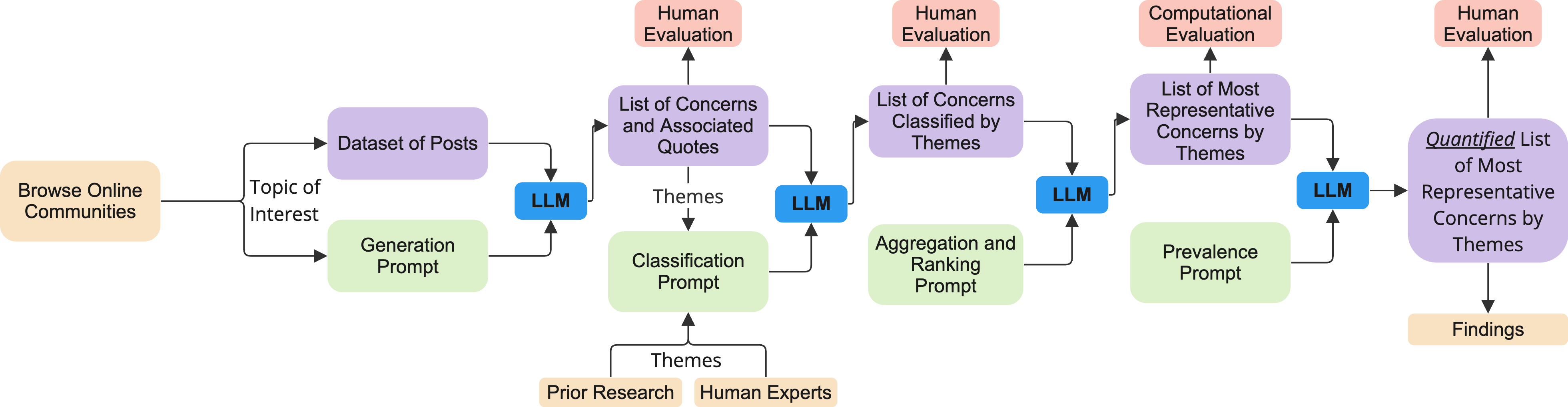
- The framework uses a multi-stage prompting pipeline: initial prompt engineering to guide LLMs in identifying key themes and quantitative metrics from text.
- It applies a chain-of-thought prompting strategy to enhance reasoning and consistency in LLM outputs.
- It employs ensemble prompting by running multiple LLM inferences and aggregating results to improve reliability and reduce stochasticity.
- A human-in-the-loop evaluation process validates LLM outputs using a representative sample of comments and predefined metrics.
- The framework integrates BERTopic for topic modeling, with hyperparameters tuned to maximize coherence and stability.
- It uses a hybrid evaluation strategy combining automated metrics (e.g., F1, precision) and human annotation to ensure validity and reliability.
Experimental results
Research questions
- RQ1Can LLMs effectively extract quantitative insights from large-scale, unstructured text in online forums with minimal human intervention?
- RQ2How does the proposed prompting methodology improve consistency and accuracy in LLM-based text analysis compared to standard prompting?
- RQ3What are the dominant concerns expressed by rideshare workers regarding AI and algorithmic platform decisions, as revealed by LLM analysis?
- RQ4To what extent can LLM outputs be validated and trusted when scaled across millions of forum comments?
- RQ5How does QuaLLM compare to traditional qualitative and quantitative methods in terms of scalability and interpretability?
Key findings
- The framework successfully analyzed over one million comments from two Reddit rideshare communities, marking the largest study of its kind in this domain.
- LLM-based analysis revealed significant, widespread concerns among rideshare workers regarding AI-driven platform decisions, particularly around algorithmic fairness and transparency.
- The ensemble prompting strategy reduced output variability and improved consistency, with human evaluation confirming high alignment between LLM outputs and expert annotations.
- The framework demonstrated strong performance in identifying recurring themes such as pay cuts, deactivation risks, and lack of appeal mechanisms, with F1 scores above 0.85 in key categories.
- Despite some sensitivity to hyperparameters in BERTopic, the overall topic modeling pipeline produced stable and interpretable results across the dataset.
- The study confirms that LLMs can serve as a scalable complement to human analysis, enabling researchers to surface large-scale, data-driven insights from public forums.
Read this paper
Open the full text in the Nubint reader and ask about any passage as you read.
Read this paper on NubintThis review was generated by AI from the original paper. Please check the paper before citing it.