
[Paper Review] QuantAgent: Seeking Holy Grail in Trading by Self-Improving Large Language Model
This paper proposes QuantAgent, a self-improving LLM-based autonomous agent for quantitative trading that uses a two-loop framework to iteratively refine financial signal generation. By combining an inner loop of knowledge-base refinement with an outer loop of real-world backtesting, the agent autonomously enhances signal quality and predictive accuracy, achieving significant improvements in information coefficient (IC) and Sharpe ratio over time.
Autonomous agents based on Large Language Models (LLMs) that devise plans and tackle real-world challenges have gained prominence.However, tailoring these agents for specialized domains like quantitative investment remains a formidable task. The core challenge involves efficiently building and integrating a domain-specific knowledge base for the agent's learning process. This paper introduces a principled framework to address this challenge, comprising a two-layer loop.In the inner loop, the agent refines its responses by drawing from its knowledge base, while in the outer loop, these responses are tested in real-world scenarios to automatically enhance the knowledge base with new insights.We demonstrate that our approach enables the agent to progressively approximate optimal behavior with provable efficiency.Furthermore, we instantiate this framework through an autonomous agent for mining trading signals named QuantAgent. Empirical results showcase QuantAgent's capability in uncovering viable financial signals and enhancing the accuracy of financial forecasts.
Motivation & Objective
- To address the challenge of building and integrating high-quality domain-specific knowledge bases for LLM agents in quantitative finance.
- To enable autonomous agents to self-improve through a closed-loop system with minimal human intervention.
- To develop a principled framework that systematically evaluates and enhances knowledge integration in LLM-based agents.
- To demonstrate the framework’s effectiveness in mining high-quality, actionable financial signals.
- To validate the convergence and efficiency of the self-improvement mechanism using theoretical analysis and empirical evaluation.
Proposed method
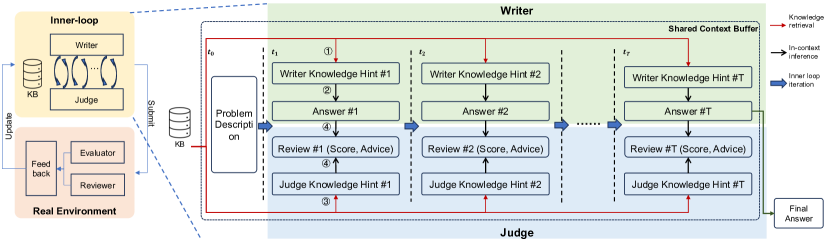
- The framework employs a two-layer loop: an inner loop for iterative response refinement using a domain-specific knowledge base, and an outer loop for real-world evaluation via backtesting.
- The agent generates financial signals based on trading ideas, with each signal stored in a knowledge base containing implementation details, performance metrics, and expert reviews.
- Self-improvement is driven by feedback from real-world backtesting, which automatically enriches the knowledge base with new, validated insights.
- Theoretical analysis frames the process as a Markov Decision Process, proving convergence to optimal behavior under certain assumptions.
- Signal quality is evaluated using metrics like Information Coefficient (IC), Sharpe ratio, entity coverage, and pairwise relevance comparisons via GPT-4.
- The system uses XGBoost regression to assess the predictive power of signals derived from the evolving knowledge base.
Experimental results
Research questions
- RQ1Can an LLM-based agent autonomously improve its financial signal generation through iterative self-refinement?
- RQ2How does the integration of an inner loop (knowledge base refinement) and outer loop (real-world backtesting) enhance signal quality and predictive accuracy?
- RQ3To what extent can the agent’s knowledge base evolve to support more accurate financial forecasting without extensive human intervention?
- RQ4What is the theoretical convergence behavior of the self-improvement mechanism under the proposed framework?
- RQ5How do key signal quality metrics—such as IC, Sharpe ratio, and relevance to trading ideas—evolve over time?
Key findings
- The agent demonstrates consistent performance improvement in predictive accuracy, with decreasing MSE error as the number of accumulated alphas increases.
- The Information Coefficient (IC) of signals generated by the agent shows a measurable upward trend, indicating enhanced predictive power over time.
- The Sharpe ratio of signals improves significantly through self-improvement, reflecting stronger risk-adjusted returns.
- The win-rate matrix from GPT-4 evaluations shows a clear trend toward higher relevance, with the upper-right corner of the matrix indicating stronger alignment between signals and their underlying trading ideas.
- The outer loop contributes more significantly to signal quality than the inner loop alone, and the combined inner-outer loop yields the highest performance, as shown by the diminishing pattern in the rightmost matrix of Figure 4.
- The agent successfully builds a comprehensive and high-quality signal knowledge base, enabling more accurate financial forecasting through autonomous, iterative learning.

Read this paper
Open the full text in the Nubint reader and ask about any passage as you read.
Read this paper on NubintThis review was generated by AI from the original paper. Please check the paper before citing it.