
[Paper Review] Quantification of Uncertainty with Adversarial Models
This paper introduces Quantification of Uncertainty with Adversarial Models (QUAM), a novel framework that improves epistemic uncertainty estimation in deep learning by identifying adversarial models—models with high posterior probability but significantly different predictions from a reference model. QUAM reduces approximation error in the integral defining epistemic uncertainty by focusing on regions where both posterior and divergence are high, outperforming Deep Ensembles and MC dropout on vision benchmarks.
Quantifying uncertainty is important for actionable predictions in real-world applications. A crucial part of predictive uncertainty quantification is the estimation of epistemic uncertainty, which is defined as an integral of the product between a divergence function and the posterior. Current methods such as Deep Ensembles or MC dropout underperform at estimating the epistemic uncertainty, since they primarily consider the posterior when sampling models. We suggest Quantification of Uncertainty with Adversarial Models (QUAM) to better estimate the epistemic uncertainty. QUAM identifies regions where the whole product under the integral is large, not just the posterior. Consequently, QUAM has lower approximation error of the epistemic uncertainty compared to previous methods. Models for which the product is large correspond to adversarial models (not adversarial examples!). Adversarial models have both a high posterior as well as a high divergence between their predictions and that of a reference model. Our experiments show that QUAM excels in capturing epistemic uncertainty for deep learning models and outperforms previous methods on challenging tasks in the vision domain.
Motivation & Objective
- To improve the quantification of epistemic uncertainty in deep learning models for high-stakes applications.
- To address the limitation of existing methods like Deep Ensembles and MC dropout, which poorly estimate epistemic uncertainty by focusing only on posterior sampling.
- To introduce a new concept of adversarial models—models with high posterior but divergent predictions from a reference model—that capture regions of high integrand in epistemic uncertainty estimation.
- To enable uncertainty quantification for pre-selected, external models, especially in real-world deployment scenarios.
Proposed method
- QUAM identifies adversarial models as those with high posterior probability and large divergence from a reference model’s predictions at a given test point.
- It formulates epistemic uncertainty as an integral involving a divergence function and the posterior, and targets regions where the integrand is large.
- Adversarial models are discovered via optimization that maximizes the product of divergence and posterior, using gradient-based search.
- The method uses these adversarial models as key samples to reduce the approximation error of the integral estimator.
- It applies a reference model and searches for models that explain training data equally well but predict differently on test inputs.
- The framework is evaluated on vision tasks using MNIST and ImageNet, comparing against Deep Ensembles, MC dropout, and SG-HMC.
Experimental results
Research questions
- RQ1How can epistemic uncertainty be more accurately estimated in deep neural networks, especially when existing methods like Deep Ensembles and MC dropout fail?
- RQ2What defines a model that contributes significantly to the epistemic uncertainty integral, and how can such models be systematically identified?
- RQ3Can adversarial models—defined as those with high posterior and high divergence—improve the approximation of the epistemic uncertainty integral?
- RQ4How does QUAM compare to established uncertainty quantification baselines in terms of uncertainty calibration and OOD detection?
Key findings
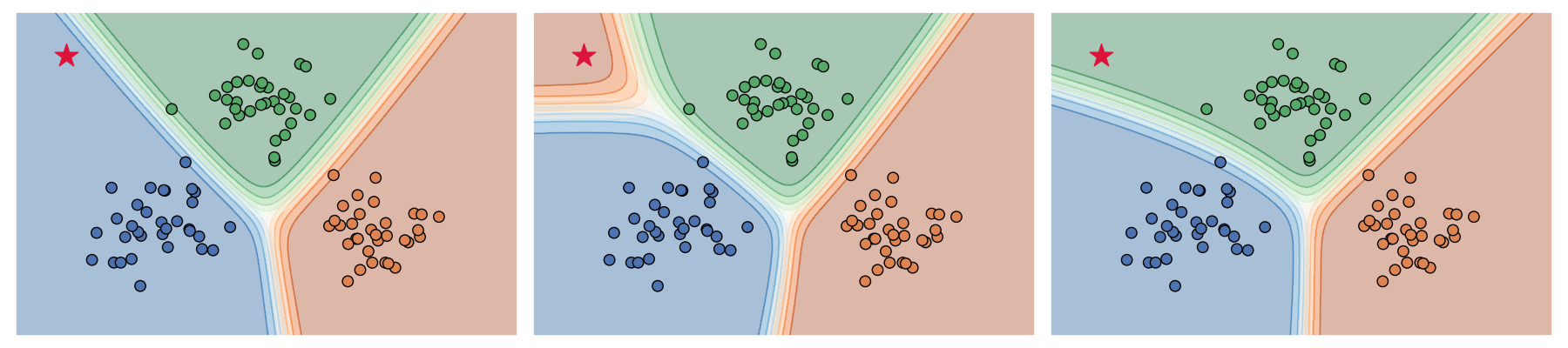
- QUAM significantly reduces the approximation error in estimating epistemic uncertainty by focusing on high-integrand regions, not just high-posterior modes.
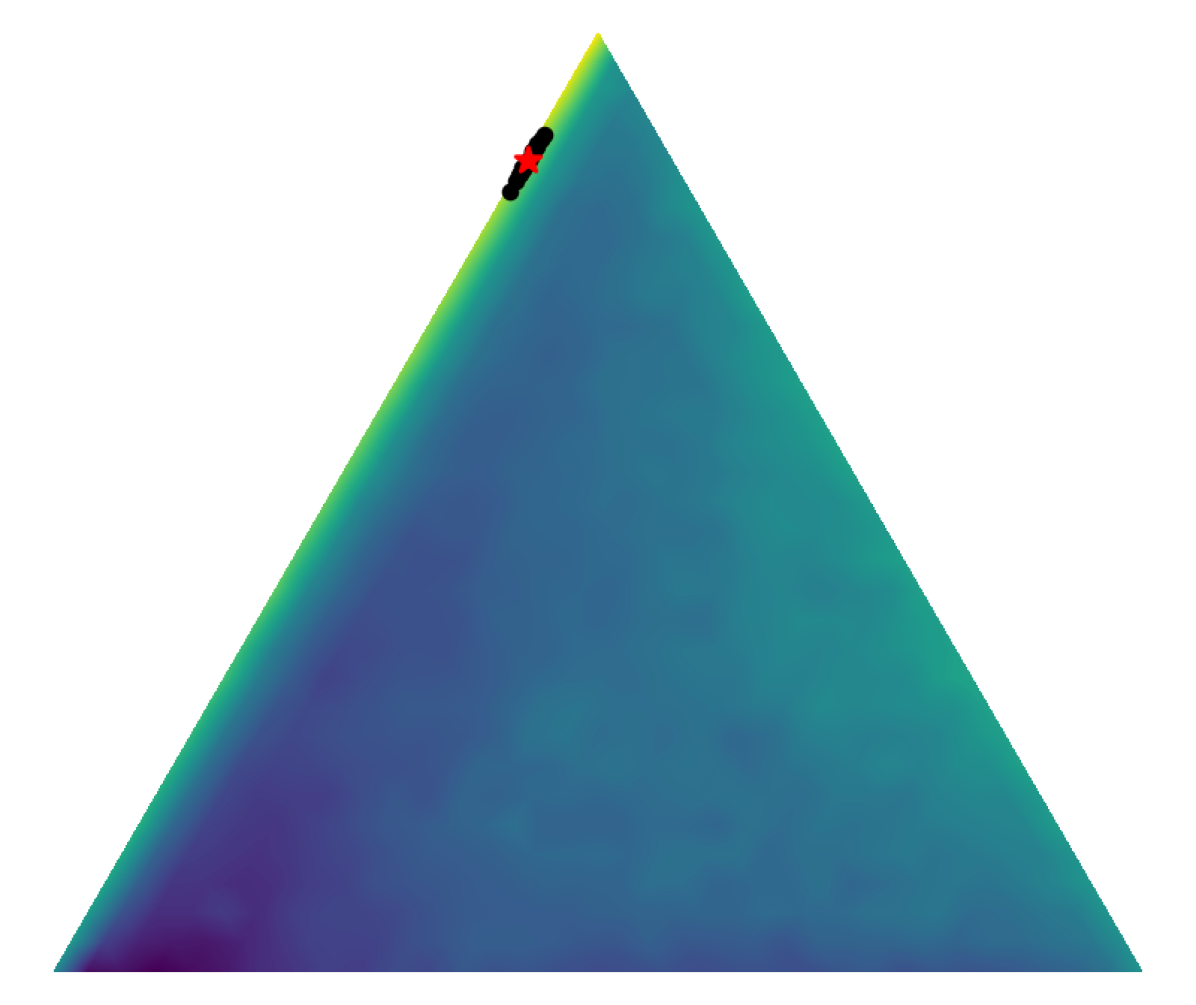
- Adversarial models identified by QUAM exhibit high diversity in feature usage and prediction space, as shown by PCA analysis of softmax outputs.
- Ensembles of adversarial models show broader convex hulls in prediction space compared to Deep Ensembles, indicating greater predictive diversity.
- On MNIST, QUAM required approximately 120 GPU-hours (~4 GPU-seconds per sample), while on ImageNet it took about 100 GPU-hours (~45 GPU-seconds per sample).
- QUAM outperforms Deep Ensembles and MC dropout on challenging vision tasks, particularly in detecting out-of-distribution samples.
- The method demonstrates superior performance in capturing uncertainty for pre-selected models, making it suitable for real-world deployment with external foundation models.
Read this paper
Open the full text in the Nubint reader and ask about any passage as you read.
Read this paper on NubintThis review was generated by AI from the original paper. Please check the paper before citing it.