
[Paper Review] Quantifying the Knowledge in GNNs for Reliable Distillation into MLPs
This paper proposes Knowledge-inspired Reliable Distillation (KRD), a method that quantifies knowledge reliability in Graph Neural Networks (GNNs) via perturbation invariance of information entropy to identify and prioritize reliable nodes for distilling knowledge into Multi-Layer Perceptrons (MLPs). KRD improves student MLP performance by 12.62% over vanilla MLPs and outperforms teacher GNNs by 2.16% on average across 7 datasets and 3 GNN architectures.
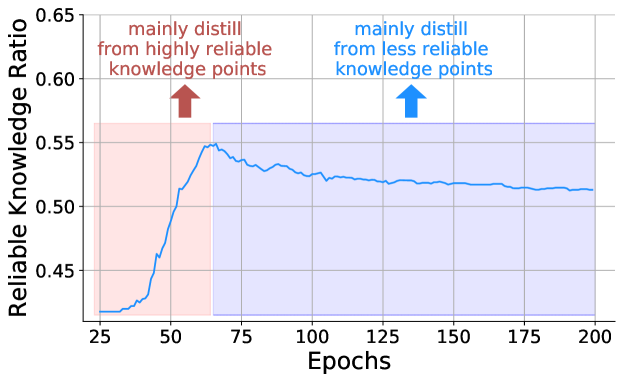
To bridge the gaps between topology-aware Graph Neural Networks (GNNs) and inference-efficient Multi-Layer Perceptron (MLPs), GLNN proposes to distill knowledge from a well-trained teacher GNN into a student MLP. Despite their great progress, comparatively little work has been done to explore the reliability of different knowledge points (nodes) in GNNs, especially their roles played during distillation. In this paper, we first quantify the knowledge reliability in GNN by measuring the invariance of their information entropy to noise perturbations, from which we observe that different knowledge points (1) show different distillation speeds (temporally); (2) are differentially distributed in the graph (spatially). To achieve reliable distillation, we propose an effective approach, namely Knowledge-inspired Reliable Distillation (KRD), that models the probability of each node being an informative and reliable knowledge point, based on which we sample a set of additional reliable knowledge points as supervision for training student MLPs. Extensive experiments show that KRD improves over the vanilla MLPs by 12.62% and outperforms its corresponding teacher GNNs by 2.16% averaged over 7 datasets and 3 GNN architectures.
Motivation & Objective
- Address the under-confidence problem in GNN-to-MLP distillation, where distilled MLPs fail to match the predictive confidence of teacher GNNs.
- Investigate the reliability of individual knowledge points (nodes) in GNNs, as existing methods treat all nodes equally without assessing their informativeness or robustness.
- Develop a method to identify and leverage only the most reliable knowledge points from GNNs to improve distillation quality and student model performance.
- Bridge the performance gap between topology-aware GNNs and efficient, latency-friendly MLPs by enhancing knowledge distillation with reliable supervision.
- Provide a principled, quantifiable metric for node reliability in GNNs that accounts for both temporal (distillation speed) and spatial (graph distribution) characteristics.
Proposed method
- Propose a perturbation invariance-based metric to quantify knowledge reliability by measuring how stable a node's information entropy is under noise perturbations.
- Model the probability of each node being an informative and reliable knowledge point using the perturbation invariance score, enabling probabilistic sampling of reliable nodes.
- Introduce a knowledge-inspired sampling strategy that selects additional reliable knowledge points from the GNN's output for use as self-supervision during MLP training.
- Design a dual-loss training objective for the student MLP: one for standard distillation from the teacher GNN and another for self-supervision using the selected reliable knowledge points.
- Use a momentum-based update mechanism to stabilize the estimation of node reliability probabilities during training.
- Apply the framework across multiple GNN architectures (GCN, GAT, GraphSAGE) and datasets (Cora, Citeseer, PubMed, Photo, CS, Physics) to validate generalization.

Experimental results
Research questions
- RQ1How does the reliability of individual knowledge points in GNNs vary in terms of their invariance to noise perturbations?
- RQ2What is the impact of using unreliable versus reliable knowledge points on the performance and confidence of distilled MLPs?
- RQ3Can modeling node reliability through perturbation invariance improve distillation performance and generalization in GNN-to-MLP distillation?
- RQ4How do the temporal (distillation speed) and spatial (graph distribution) characteristics of reliable knowledge points affect distillation outcomes?
- RQ5Does incorporating additional self-supervision from reliable nodes reduce the under-confidence issue in distilled MLPs compared to standard distillation?
Key findings
- KRD improves performance by 12.62% on average over vanilla MLPs and 2.16% over corresponding teacher GNNs across 7 datasets and 3 GNN architectures.
- The confidence distribution of MLPs trained with KRD is significantly higher and more consistent than that of GLNN, which suffers from under-confidence due to lack of reliable supervision.
- Knowledge-based sampling outperforms non-sampling, random sampling, and entropy-based sampling, with the best performance achieved using the proposed reliability metric.
- The proposed perturbation invariance metric reveals that reliable knowledge points are not uniformly distributed across the graph and vary in their distillation speed over time.
- Hyperparameter sensitivity analysis shows that loss weight λ and momentum rate η must be carefully tuned, with η = 0.9 or 0.99 yielding optimal results.
- The method generalizes well across different GNN architectures (GCN, GAT, GraphSAGE) and datasets, demonstrating robustness and scalability.
Read this paper
Open the full text in the Nubint reader and ask about any passage as you read.
Read this paper on NubintThis review was generated by AI from the original paper. Please check the paper before citing it.