
[Paper Review] Quantum communication networks with defects in silicon carbide
The paper surveys silicon carbide defects as spin-photon interfaces for quantum networks and models memory-enhanced MA-MDI-QKD using state-of-the-art SiC devices, outlining steps toward large-scale deployment.
Quantum communication promises unprecedented communication capabilities enabled by the transmission of quantum states of light. However, current implementations face severe limitations in communication distance due to photon loss. Silicon carbide (SiC) defects have emerged as a promising quantum device platform, offering strong optical transitions, long spin coherence lifetimes and the opportunity for integration with semiconductor devices. Some defects with optical transitions in the telecom range have been identified, allowing to interface with fiber networks without the need for wavelength conversion. These unique properties make SiC an attractive platform for the implementation of quantum nodes for quantum communication networks. We provide an overview of the most prominent defects in SiC and their implementation in spin-photon interfaces. Furthermore, we model a memory-enhanced quantum communication protocol in order to extract the parameters required to surpass a direct point-to-point link performance. Based on these insights, we summarize the key steps required towards the deployment of SiC devices in large-scale quantum communication networks.
Motivation & Objective
- Motivate quantum networks and the role of quantum memories in extending communication distance.
- Identify and characterize prominent SiC defects suitable for spin-photon interfaces.
- Assess integration of SiC-based quantum nodes with photonic devices and telecom-compatible transitions.
- Model memory-assisted quantum key distribution using SiC memories and extract deployment-required parameters.
- Outline a roadmap for implementing SiC devices in large-scale quantum communication networks.
Proposed method
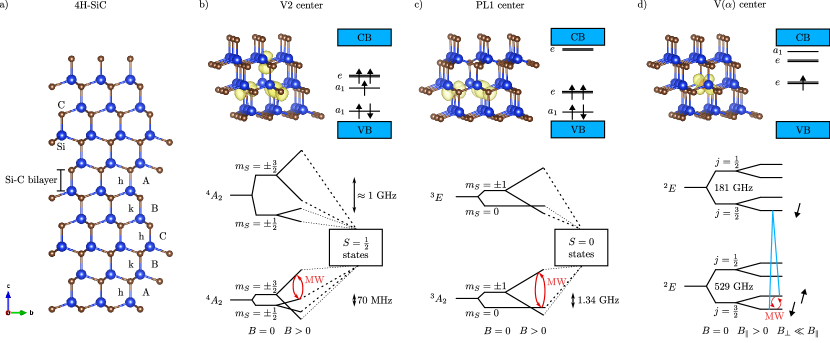
- Describe and compare deep-level defects in 4H-SiC (Si-vacancy, divacancy, vanadium) and their ground/excited spin states.
- Explain spin-photon interface mechanisms via spin-selective optical transitions and spin initialization/readout.
- Discuss spin-to-photon entanglement and heralded entanglement via Bell state measurements in SiC-based nodes.
- Present a cavity-enhancement framework with the spontaneous emission factor F_SE and cooperativity C for SiC defects.
- Outline device architectures for SPI in SiC, including time-bin qubits and Mach-Zehnder interferometer-based measurements.
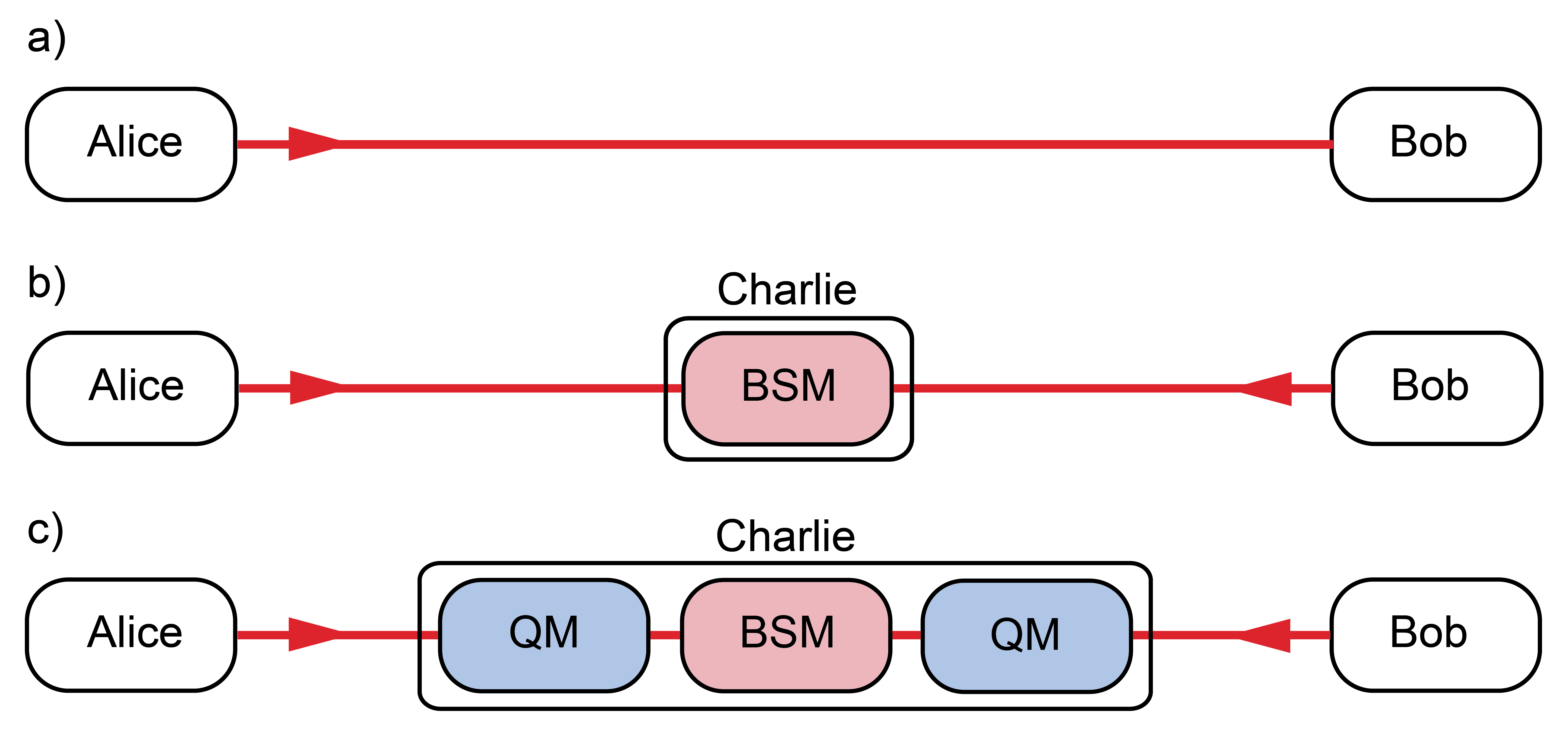
- Model memory-assisted MA-MDI-QKD using parameters from state-of-the-art SiC devices and discuss performance implications.
Experimental results
Research questions
- RQ1Which defects in 4H-SiC provide robust spin-photon interfaces suitable for quantum networks?
- RQ2How can SiC-based spin memories be integrated with photonic circuits to enable heralded entanglement and BSMs?
- RQ3What performance improvements (coherence, coupling, and cavity enhancement) are needed for SiC devices to outperform direct fiber transmission in QKD?
- RQ4Can memory-assisted QKD protocols using SiC memories surpass direct point-to-point links under realistic device parameters?
- RQ5What roadmap steps are required to deploy SiC quantum nodes in large-scale quantum communication networks?
Key findings
- SiC defects such as Si-vacancy, divacancy, and vanadium centers offer spin states and optical transitions suitable for spin-photon interfaces in the telecom-relevant or near-telecom range (e.g., vanadium α-center emitting at 1278 nm).
- The α-vanadium center in 4H-SiC exhibits long spin coherence properties and a favorable zero-phonon-line structure, with T1 times reaching 25 s at 100 mK and ensemble T2* around 7.2 μs at 2 K, indicating potential as a programmable nuclear-spin memory.
- ZPLs and spin-selective intersystem crossing enable spin pumping and readout, enabling coherent SPI operation and spin-state control via microwaves and optical transitions.
- Optical enhancement in cavities can dramatically modify emission into desired modes, with theoretical expressions for F_SE and cooperativity C guiding design of SiC-based microcavities and their impact on spin-photon interfacing.
- SiC-based MA-MDI-QKD simulations using state-of-the-art device parameters suggest a pathway for memory-assisted QKD to outperform direct transmission under certain conditions, informing a practical deployment roadmap.
- The paper discusses practical integration considerations, including microcavities, membranes, and photonic crystal cavities achieving high quality factors and small mode volumes, and the need for isotopic engineering and device stabilization to realize scalable quantum networks.
Read this paper
Open the full text in the Nubint reader and ask about any passage as you read.
Read this paper on NubintThis review was generated by AI from the original paper. Please check the paper before citing it.