
[Paper Review] Quantum Data Center Infrastructures: A Scalable Architectural Design Perspective
This paper designs scalable quantum data center networks using optical switches to interconnect multiple QPUs, introducing switch-centric and server-centric topologies, entanglement generation protocols, and a network-aware orchestrator with simulation benchmarks.
This paper presents the design of scalable quantum networks that utilize optical switches to interconnect multiple quantum processors, facilitating large-scale quantum computing. By leveraging these novel architectures, we aim to address the limitations of current quantum processors and explore the potential of quantum data centers. We provide an in-depth analysis of these architectures through the development of simulation tools and performance metrics, offering a detailed comparison of their advantages and trade-offs. We hope this work serves as a foundation for the development of efficient and resilient quantum networks, designed to meet the evolving demands of future quantum computing applications.
Motivation & Objective
- Motivate the need for scalable, networked quantum data centers to overcome the qubit count limits of individual QPUs.
- Propose scalable network architectures (switch-centric and server-centric) inspired by classical data center designs.
- Develop physical-layer models and entanglement generation protocols compatible with QDCs.
- Introduce a network-aware quantum orchestrator to translate circuit-level jobs into optical-switch configurations.
- Provide simulation benchmarks to evaluate latency and fidelity across architectures.
Proposed method
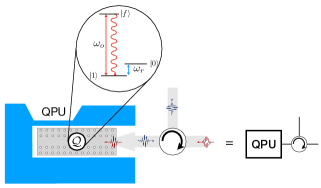
- Develop physical-layer models for entanglement generation protocols (emitter-emitter, emitter-scatterer, scatterer-scatterer) with spin-photon interfaces.
- Analyze three entanglement protocols under different encodings (Fock-space, polarization, time-bin) and quantify fidelity and generation rate.
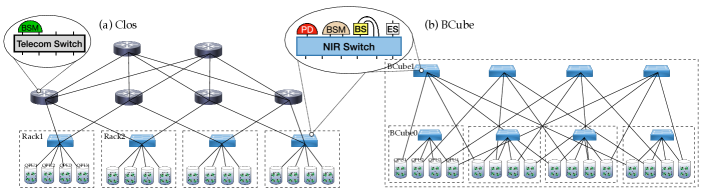
- Propose switch-centric (e.g., Clos) and server-centric (e.g., BCube) QDC network topologies and map intra-rack vs inter-rack operation to NIR and telecom wavelengths.
- Introduce a network-aware quantum orchestrator that precompiles instructions for optical switches and quantum hardware based on circuit descriptions and topology.
- Incorporate simulation and benchmarking of random quantum circuits on a Clos topology to assess end-to-end performance.
Experimental results
Research questions
- RQ1How can quantum data centers achieve on-demand, all-to-all connectivity while minimizing expensive quantum hardware?
- RQ2What network architectures (switch-centric vs server-centric) best balance scalability, fidelity, and entanglement distribution efficiency for large QDCs?
- RQ3How do different ebit generation protocols and encodings impact end-to-end entanglement rates and fidelities in practice?
- RQ4What role does a network-aware orchestrator play in translating quantum circuits into network configurations?
- RQ5How do architectural choices affect end-to-end latency and fidelity in simulated quantum workloads?
Key findings
- The paper proposes two architectural categories—switch-centric and server-centric—based on classical data-center networking principles to enable scalable QDC interconnects.
- It analyzes three entanglement generation protocols (emitter-emitter, emitter-scatterer, scatterer-scatterer) across encodings, deriving expressions for end-to-end generation rates and fidelities under loss.
- Switch-centric layouts use non-blocking photonic interconnects with optical switches to enable near all-to-all connectivity, while server-centric designs rely on modular entanglement distribution with dedicated hardware.
- Intra-rack communications operate at near-infrared frequencies while inter-rack communications use telecom wavelengths, with non-degenerate entanglement sources and quantum frequency conversion as needed.
- A network-aware orchestrator is introduced to translate circuit-level quantum jobs and topology into precompiled control instructions for optical switches and hardware, enabling coordinated distributed quantum computation.
- Performance benchmarking on a Clos topology with random quantum circuits is conducted to evaluate average network latency and quantum fidelity.
Read this paper
Open the full text in the Nubint reader and ask about any passage as you read.
Read this paper on NubintThis review was generated by AI from the original paper. Please check the paper before citing it.