
[Paper Review] Quantum-limited stochastic optical neural networks operating at a few quanta per activation
This paper demonstrates that optical neural networks can achieve high-accuracy image classification using just a few photons per activation—down to 0.008 photons per MAC operation—by training stochastic photodetection processes as part of the learning algorithm. Despite signal-to-noise ratios near 1 due to quantum noise, the method achieves 98% MNIST test accuracy through physics-aware stochastic training that models single-photon detection as intrinsic to the network's operation.
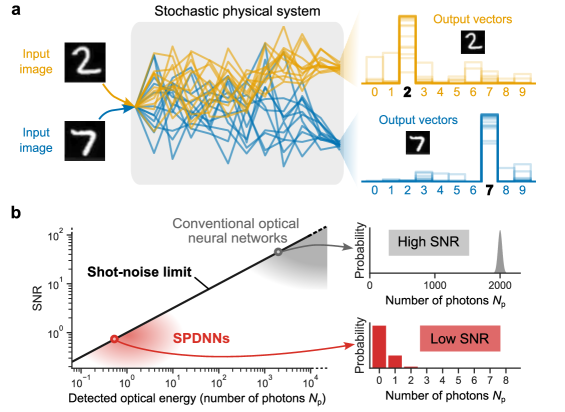
Energy efficiency in computation is ultimately limited by noise, with quantum limits setting the fundamental noise floor. Analog physical neural networks hold promise for improved energy efficiency compared to digital electronic neural networks. However, they are typically operated in a relatively high-power regime so that the signal-to-noise ratio (SNR) is large, and the noise can be treated as a perturbation. We study optical neural networks where all layers except the last are operated in the limit that each neuron can be activated by just a single photon, and as a result the noise on neuron activations is no longer merely perturbative. We show that by using a physics-based probabilistic model of the neuron activations in training, it is possible to perform accurate machine-learning inference in spite of the extremely high shot noise (SNR ~ 1). We experimentally demonstrated MNIST handwritten-digit classification with a test accuracy of 98% using an optical neural network with a hidden layer operating in the single-photon regime; the optical energy used to perform the classification corresponds to just 0.038 photons per multiply-accumulate (MAC) operation. Our physics-aware stochastic training approach might also prove useful with non-optical ultra-low-power hardware.
Motivation & Objective
- To investigate whether analog optical neural networks can maintain high accuracy when operated in the ultra-low-power regime where signal-to-noise ratio is near unity due to single-photon detection.
- To overcome the challenge of extreme stochasticity in photodetection by developing a training framework that explicitly models quantum noise as part of the network's computation.
- To demonstrate that deterministic classification tasks can be performed reliably using optical systems dominated by shot noise, even when each neuron activation uses only a few quanta.
- To establish a new paradigm for energy-efficient AI hardware by co-designing software and physics-aware training with physical noise models, rather than treating noise as a perturbation.
Proposed method
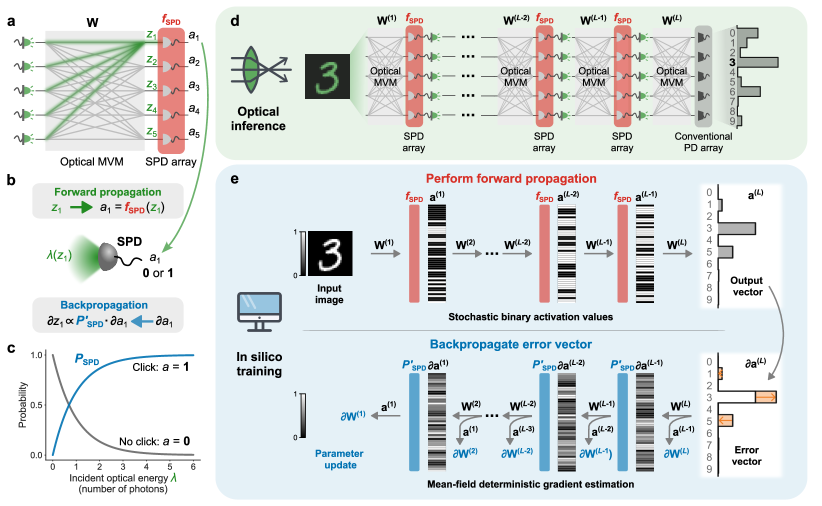
- The authors developed a stochastic photodetection neural network (SPDNN) that models each neuron’s activation as a probabilistic process governed by the Poisson statistics of single-photon detection.
- They trained the network using a differentiable approximation of the stochastic photodetection process, enabling backpropagation through the noise by modeling the expected output as a function of input intensity and detection probability.
- The training procedure explicitly incorporates the quantum noise limit, using the average photon number per detection as a key parameter in the forward and backward passes.
- The network was implemented in a physical optical setup using single-photon detectors (SPDs) for hidden-layer activations, with optical signals encoded in classical coherent states.
- The system was trained end-to-end on MNIST using a physics-aware loss function that accounts for the stochasticity of photodetection, enabling convergence despite high noise.
- Experimental validation was performed using a free-space optical setup with a single hidden layer operating in the single-photon regime, achieving high accuracy with minimal optical energy.
Experimental results
Research questions
- RQ1Can optical neural networks maintain high classification accuracy when operated in the quantum-noise-limited regime with only a few photons per activation?
- RQ2Is it possible to train a neural network effectively when the photodetection process is fundamentally stochastic and signal-to-noise ratio is approximately 1?
- RQ3Does explicitly modeling the probabilistic nature of single-photon detection in the training process enable reliable deterministic inference despite hardware-level noise?
- RQ4What is the minimum optical energy per MAC operation required to achieve high-accuracy inference in an optical neural network?
Key findings
- The authors achieved 98% test accuracy on the MNIST handwritten-digit classification task using an optical neural network with a hidden layer operating in the single-photon regime.
- The system used only 0.008 photons per multiply–accumulate (MAC) operation, corresponding to 0.003 attojoules of optical energy per MAC, which is over 40× fewer photons than previous state-of-the-art low-energy demonstrations.
- The network maintained high accuracy despite a signal-to-noise ratio of approximately 1, demonstrating that quantum noise does not preclude reliable computation when properly modeled in training.
- The physics-aware training method successfully captured the stochastic behavior of single-photon detection, enabling effective backpropagation and convergence in the presence of extreme noise.
- The experimental setup confirmed that deterministic inference is achievable with optical systems operating at the quantum noise limit, provided the training process accounts for the underlying physical stochasticity.
Read this paper
Open the full text in the Nubint reader and ask about any passage as you read.
Read this paper on NubintThis review was generated by AI from the original paper. Please check the paper before citing it.