
[Paper Review] Quantum-Noise-Driven Generative Diffusion Models
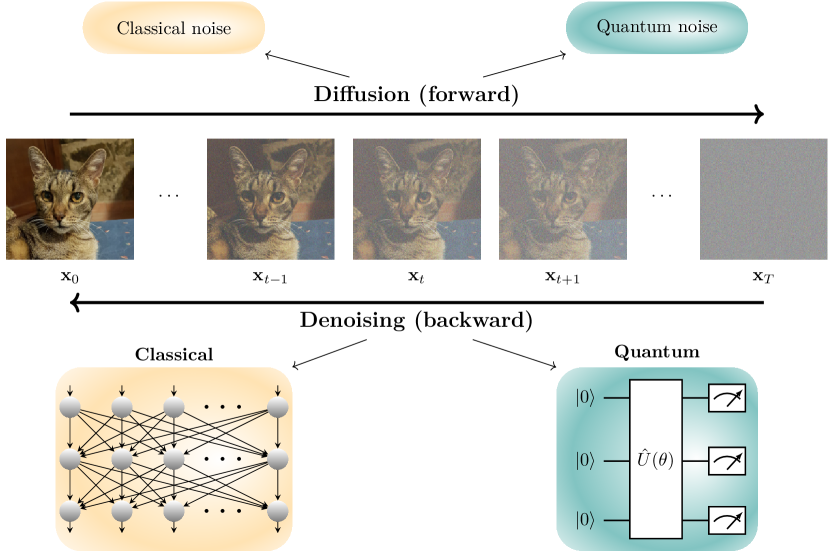
This paper proposes three quantum-noise-driven generative diffusion models (CQGDM, QCGDM, QQGDM) that leverage quantum noise, coherence, and entanglement as computational advantages rather than errors. By replacing classical diffusion or denoising with quantum stochastic dynamics, the models enable more efficient sampling of complex probability distributions, with numerical simulations showing successful training of a hybrid classical-quantum model on a 1D dataset using a parameterized quantum circuit.
Generative models realized with machine learning techniques are powerful tools to infer complex and unknown data distributions from a finite number of training samples in order to produce new synthetic data. Diffusion models are an emerging framework that have recently overcome the performance of the generative adversarial networks in creating synthetic text and high-quality images. Here, we propose and discuss the quantum generalization of diffusion models, i.e., three quantum-noise-driven generative diffusion models that could be experimentally tested on real quantum systems. The idea is to harness unique quantum features, in particular the non-trivial interplay among coherence, entanglement and noise that the currently available noisy quantum processors do unavoidably suffer from, in order to overcome the main computational burdens of classical diffusion models during inference. Hence, we suggest to exploit quantum noise not as an issue to be detected and solved but instead as a very remarkably beneficial key ingredient to generate much more complex probability distributions that would be difficult or even impossible to express classically, and from which a quantum processor might sample more efficiently than a classical one. An example of numerical simulations for an hybrid classical-quantum generative diffusion model is also included. Therefore, our results are expected to pave the way for new quantum-inspired or quantum-based generative diffusion algorithms addressing more powerfully classical tasks as data generation/prediction with widespread real-world applications ranging from climate forecasting to neuroscience, from traffic flow analysis to financial forecasting.
Motivation & Objective
- To explore the use of quantum noise not as a hindrance but as a computational resource in generative modeling.
- To develop quantum generalizations of classical diffusion models that exploit quantum features like entanglement and coherence.
- To enable more efficient sampling of complex probability distributions by replacing classical dynamics with quantum stochastic processes.
- To demonstrate the feasibility of hybrid classical-quantum diffusion models through numerical simulations.
- To open new pathways for quantum-enhanced generative modeling in applications like climate forecasting, neuroscience, and financial modeling.
Proposed method
- Proposes three variants: classical diffusion with quantum denoising (CQGDM), quantum diffusion with classical denoising (QCGDM), and fully quantum diffusion and denoising (QQGDM).
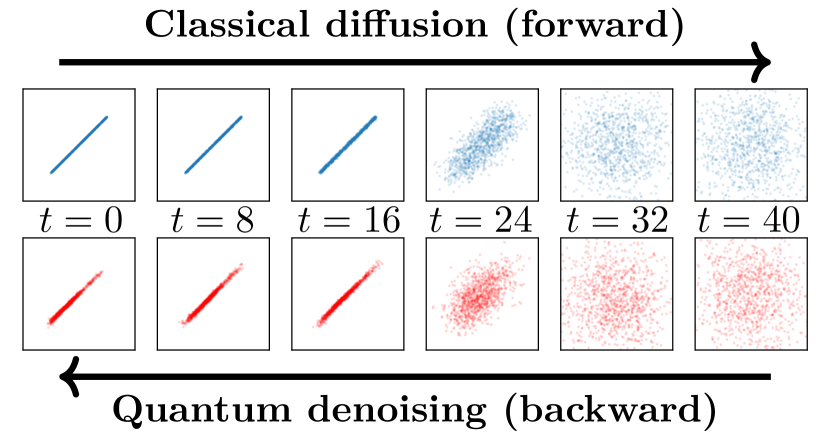
- Uses a classical Markov chain with Gaussian transition kernels to implement the forward diffusion process, mapping data to an isotropic Gaussian at time T=40.
- Employs a parameterized quantum circuit (PQC) with angle embedding and entangling CNOT gates to model the denoising process, estimating mean and diagonal covariance.
- Designs a two-part quantum circuit: 'head' for feature encoding and 'tail' for time-dependent parameterization, with shared and specific parameters respectively.
- Trains the PQC using stochastic gradient descent with Adam optimizer and Kullback-Leibler divergence loss over 40,000 epochs on batches of 1,000 points.
- Uses Pennylane and PyTorch for simulation, measuring expectation values of σz to extract predictions for mean and variance.
Experimental results
Research questions
- RQ1Can quantum noise be harnessed as a beneficial resource in generative modeling rather than a source of error?
- RQ2How can quantum stochastic dynamics improve the efficiency of sampling complex probability distributions compared to classical diffusion models?
- RQ3What are the performance characteristics of hybrid classical-quantum diffusion models in generating synthetic data?
- RQ4Can parameterized quantum circuits effectively approximate the reverse denoising process in a diffusion framework?
- RQ5What role do quantum features like entanglement and coherence play in enhancing the expressivity of generative models?
Key findings
- The hybrid classical-quantum generative diffusion model (CQGDM) successfully learned to denoise data from a 1D line segment distribution into a target Gaussian distribution.
- The model was trained over 40,000 epochs using Adam optimizer with a learning rate of 10−4, minimizing Kullback-Leibler divergence between predicted and target distributions.
- The PQC architecture, with a four-qubit circuit and 256 layers of parametric rotations and CNOT gates, enabled effective estimation of mean and variance parameters.
- The head of the circuit shared parameters across time steps, while the tail used time-specific parameters, improving generalization across the denoising sequence.
- The model output was scaled by a factor of 3 for mean predictions and increased by 1 for variance to ensure positivity and expand the range of generated samples.
- Numerical results demonstrate the feasibility of using quantum processors to implement the denoising step more efficiently than classical models for complex distributions.
Better researchstarts right now
From reading papers to final review, dramatically reduce your research time.
No credit card · Free plan available
This review was created by AI and reviewed by human editors.