
[论文解读] QuantumNAS: Noise-Adaptive Search for Robust Quantum Circuits
QuantumNAS 提出了一种基于 SuperCircuit 的噪声自适应联合搜索框架,用于变分量子线路与量子比特映射的协同优化,通过将训练与搜索解耦,实现了高效、噪声感知的优化。该方法在真实量子硬件上实现了最先进性能,在量子机器学习任务中分类准确率超过 95%(2 类)、85%(4 类)和 32%(10 类),并在多种分子的变分量子蒙特卡洛能量(VQE)计算中实现了最低基态能量。
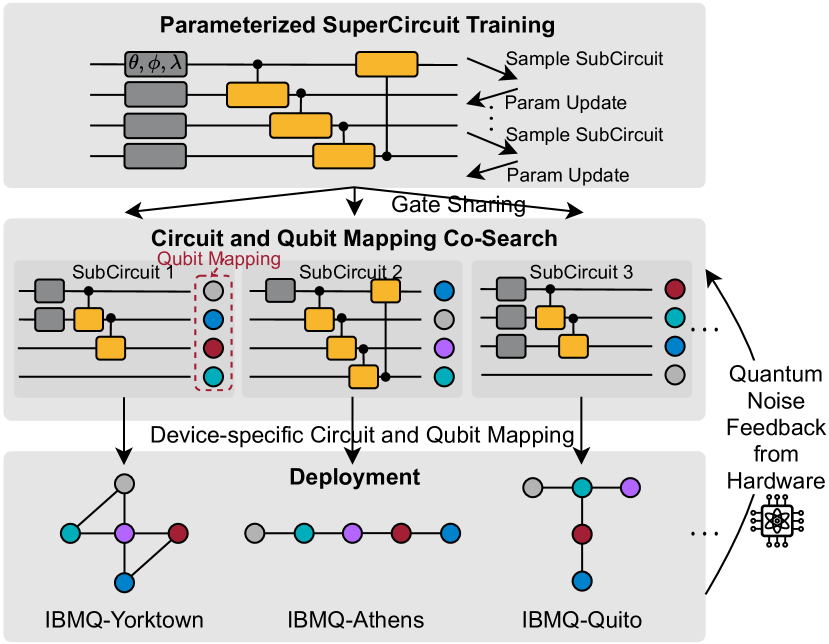
Quantum noise is the key challenge in Noisy Intermediate-Scale Quantum (NISQ) computers. Previous work for mitigating noise has primarily focused on gate-level or pulse-level noise-adaptive compilation. However, limited research efforts have explored a higher level of optimization by making the quantum circuits themselves resilient to noise. We propose QuantumNAS, a comprehensive framework for noise-adaptive co-search of the variational circuit and qubit mapping. Variational quantum circuits are a promising approach for constructing QML and quantum simulation. However, finding the best variational circuit and its optimal parameters is challenging due to the large design space and parameter training cost. We propose to decouple the circuit search and parameter training by introducing a novel SuperCircuit. The SuperCircuit is constructed with multiple layers of pre-defined parameterized gates and trained by iteratively sampling and updating the parameter subsets (SubCircuits) of it. It provides an accurate estimation of SubCircuits performance trained from scratch. Then we perform an evolutionary co-search of SubCircuit and its qubit mapping. The SubCircuit performance is estimated with parameters inherited from SuperCircuit and simulated with real device noise models. Finally, we perform iterative gate pruning and finetuning to remove redundant gates. Extensively evaluated with 12 QML and VQE benchmarks on 14 quantum computers, QuantumNAS significantly outperforms baselines. For QML, QuantumNAS is the first to demonstrate over 95% 2-class, 85% 4-class, and 32% 10-class classification accuracy on real QC. It also achieves the lowest eigenvalue for VQE tasks on H2, H2O, LiH, CH4, BeH2 compared with UCCSD. We also open-source TorchQuantum (https://github.com/mit-han-lab/torchquantum) for fast training of parameterized quantum circuits to facilitate future research.
研究动机与目标
- 通过联合优化量子线路结构与量子比特映射以提升鲁棒性,应对噪声中等规模量子(NISQ)设备中的量子噪声挑战。
- 通过将搜索与完整训练解耦,克服在大规模设计空间中迭代线路搜索与参数训练带来的可扩展性瓶颈。
- 通过寻找对真实设备噪声具有鲁棒性的线路,提升在量子机器学习与变分量子特征态求解器(VQE)任务中的性能。
- 在真实量子硬件上证明,噪声感知搜索显著优于噪声无关、随机搜索及人工设计的基线方法。
- 通过开源工具链(包括 TorchQuantum 库)实现鲁棒量子线路的实际部署。
提出的方法
- 引入一种由多个参数化门层(如 U3、CU3)组成的 SuperCircuit,以封装大量潜在的子线路(SubCircuits)。
- 通过迭代采样与参数子集的更新对 SuperCircuit 进行训练,实现无需完整重训即可获得准确的性能估计。
- 利用真实设备噪声模型,在子线路结构与量子比特映射之间执行进化联合搜索,引导搜索向鲁棒配置收敛。
- 在搜索过程中继承 SuperCircuit 的优化参数,以加速子线路评估,降低训练成本。
- 应用迭代门剪枝与微调技术,去除冗余门,进一步提升效率与鲁棒性。
- 利用真实的 IBMQ 量子设备进行评估,采用反映实际硬件误差特性的噪声模型。
实验结果
研究问题
- RQ1与噪声无关或人工设计的方法相比,噪声自适应的量子线路与量子比特映射联合搜索框架是否能在真实 NISQ 设备上显著提升性能?
- RQ2基于 SuperCircuit 的方法在无需完整重训的情况下,能否准确估计子线路性能,从而实现可扩展的搜索?
- RQ3在搜索过程中集成真实设备噪声模型,对最终量子线路的鲁棒性与准确性有何影响?
- RQ4所提出的方法是否能在真实硬件上实现量子机器学习任务(如 MNIST)的高分类准确率,以及在 VQE 基准测试中实现低基态能量?
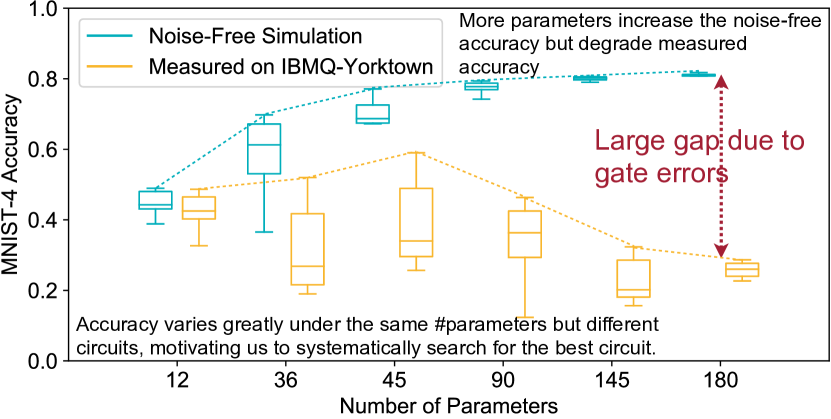
- RQ5线路结构与量子比特映射对噪声下的性能方差有何影响?该方法能否系统性地降低这一方差?
主要发现
- QuantumNAS 在真实量子计算机上实现了超过 95%(2 类)、85%(4 类)和 32%(10 类)的分类准确率,这是该类基准测试中的首次突破。
- 在变分量子特征态求解器(VQE)任务中,与 UCCSD 基线相比,QuantumNAS 在 H₂、H₂O、LiH、CH₄ 和 BeH₂ 分子上均实现了最低的基态能量。
- 该方法在 14 台真实量子设备上的 12 个量子机器学习与 VQE 基准测试中,显著优于噪声无关搜索、随机搜索及人工设计的线路。
- SuperCircuit 实现了对子线路性能的准确估计,并大幅降低了训练成本,使大规模搜索成为可能。
- 迭代门剪枝与微调技术有效减少了冗余,进一步提升了最终线路的鲁棒性与效率。
- 开源的 TorchQuantum 库为未来研究提供了支持,兼容 PyTorch 与 Qiskit,且以 MIT 许可证发布。
更好的研究,从现在开始
从阅读论文到最终审阅,大幅缩短您的研究时间。
无需绑定信用卡
本解读由 AI 生成,并经人工编辑审核。