
[Paper Review] Query-Dependent Video Representation for Moment Retrieval and Highlight Detection
The paper introduces QD-DETR, a query-dependent DETR that injects text query context into video representations for moment retrieval and highlight detection, using negative pair learning and an input-adaptive saliency predictor; it achieves state-of-the-art results on QVHighlights, TVSum, and Charades-STA.
Recently, video moment retrieval and highlight detection (MR/HD) are being spotlighted as the demand for video understanding is drastically increased. The key objective of MR/HD is to localize the moment and estimate clip-wise accordance level, i.e., saliency score, to the given text query. Although the recent transformer-based models brought some advances, we found that these methods do not fully exploit the information of a given query. For example, the relevance between text query and video contents is sometimes neglected when predicting the moment and its saliency. To tackle this issue, we introduce Query-Dependent DETR (QD-DETR), a detection transformer tailored for MR/HD. As we observe the insignificant role of a given query in transformer architectures, our encoding module starts with cross-attention layers to explicitly inject the context of text query into video representation. Then, to enhance the model's capability of exploiting the query information, we manipulate the video-query pairs to produce irrelevant pairs. Such negative (irrelevant) video-query pairs are trained to yield low saliency scores, which in turn, encourages the model to estimate precise accordance between query-video pairs. Lastly, we present an input-adaptive saliency predictor which adaptively defines the criterion of saliency scores for the given video-query pairs. Our extensive studies verify the importance of building the query-dependent representation for MR/HD. Specifically, QD-DETR outperforms state-of-the-art methods on QVHighlights, TVSum, and Charades-STA datasets. Codes are available at github.com/wjun0830/QD-DETR.
Motivation & Objective
- Motivate the need for truly query-driven video representations in MR/HD tasks.
- Develop a detection-transformer-based model that heavily integrates the text query into video encoding.
- Encourage discriminative learning by constructing and leveraging negative video-query pairs.
- Introduce an input-adaptive saliency predictor to tailor saliency criteria per query-video pair.
Proposed method
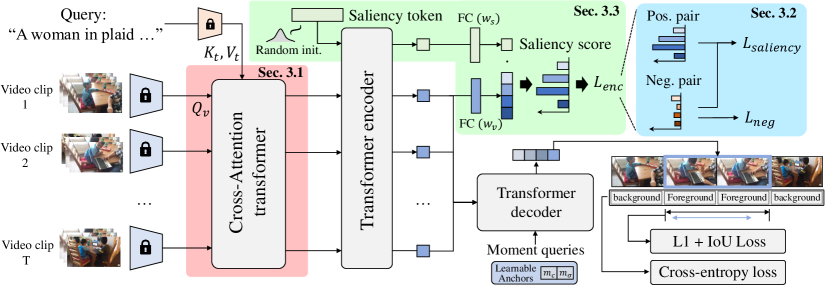
- Insert cross-attention at the encoder input to fuse video clips with text query features.
- Train with negative video-query pairs to suppress saliency for irrelevant pairs.
- Use a saliency token as an input-adaptive predictor to compute clip saliency.
- Implement a DETR-like decoder with dynamic anchor moments as queries for temporal localization.
- Optimize MR with L1 and generalized IoU losses, and HD with margin ranking and rank-aware contrastive losses.
- Evaluate MR/HD jointly and individually on MR/HD benchmarks.

Experimental results
Research questions
- RQ1Does a query-dependent video representation improve moment retrieval and highlight detection compared to query-agnostic baselines?
- RQ2What is the impact of negative video-query pair learning on saliency estimation and moment localization?
- RQ3How does an input-adaptive saliency predictor affect saliency regression across diverse queries?
- RQ4Do the proposed components yield state-of-the-art performance on standard MR/HD datasets?
Key findings
- QD-DETR outperforms state-of-the-art methods on QVHighlights with video-only and video+audio inputs.
- On QVHighlights, QD-DETR with V achieves 62.40 MR mAP at various metrics and 62.40 mAP for HIT@1; with V+A it reaches 63.06 MR mR and 62.87 HIT@1 variants.
- On TVSum and Charades-STA, QD-DETR demonstrates strong improvements over baselines, achieving higher RS metrics across multiple feature backbones.
- Ablation studies show that cross-attentive encoding, negative-pair learning, and the adaptive saliency predictor substantially contribute to MR/HD performance, more so than deeper self-attention alone.
Read this paper
Open the full text in the Nubint reader and ask about any passage as you read.
Read this paper on NubintThis review was generated by AI from the original paper. Please check the paper before citing it.