
[Paper Review] QUEST-DMC superfluid $^3$He detector for sub-GeV dark matter
This paper proposes QUEST-DMC, a novel dark matter detector using superfluid $^3$He to search for sub-GeV/$c^2$ dark matter via quasiparticle detection in a nanomechanical resonator-based bolometer. It projects sub-eV nuclear recoil energy sensitivity, enabling competitive reach for both spin-independent and spin-dependent interactions of light dark matter, with potential for further improvement via multi-wire NEMS and advanced thermometry.
The focus of dark matter searches to date has been on Weakly Interacting Massive Particles (WIMPs) in the GeV/$c^2$-TeV/$c^2$ mass range. The direct, indirect and collider searches in this mass range have been extensive but ultimately unsuccessful, providing a strong motivation for widening the search outside this range. Here we describe a new concept for a dark matter experiment, employing superfluid $^3$He as a detector for dark matter that is close to the mass of the proton, of order 1 GeV/$c^2$. The QUEST-DMC detector concept is based on quasiparticle detection in a bolometer cell by a nanomechanical resonator. In this paper we develop the energy measurement methodology and detector response model, simulate candidate dark matter signals and expected background interactions, and calculate the sensitivity of such a detector. We project that such a detector can reach sub-eV nuclear recoil energy threshold, opening up new windows on the parameter space of both spin-dependent and spin-independent interactions of light dark matter candidates.
Motivation & Objective
- To develop a new detection concept for sub-GeV/$c^2$ dark matter, particularly focusing on spin-dependent and spin-independent interactions.
- To address the gap in sensitivity for light dark matter candidates, which remain unprobed by traditional WIMP-focused experiments.
- To leverage the unique properties of superfluid $^3$He—such as low-temperature stability and high quasiparticle sensitivity—for ultra-low energy threshold detection.
- To simulate and model detector response, signal, and background interactions to project sensitivity in the sub-eV regime.
- To establish a foundation for future experimental realization and fundamental studies of superfluid phase transitions.
Proposed method
- The detector uses a $\sim$1 cm$^3$ superfluid $^3$He bolometer cell cooled to $\sim$100 $\mu$K using a dilution refrigerator and a copper magnetic cooldown stage.
- A nanomechanical resonator (NEMS) made of sub-micron diameter nanowires detects thermal energy from quasiparticle excitations produced in dark matter-$^3$He scattering events.
- SQUID-based readout is implemented for the first time at these temperatures to achieve high-resolution energy measurement of quasiparticle production.
- The energy deposition from nuclear recoils is modeled using a detailed detector response function, accounting for quasiparticle creation and thermalization.
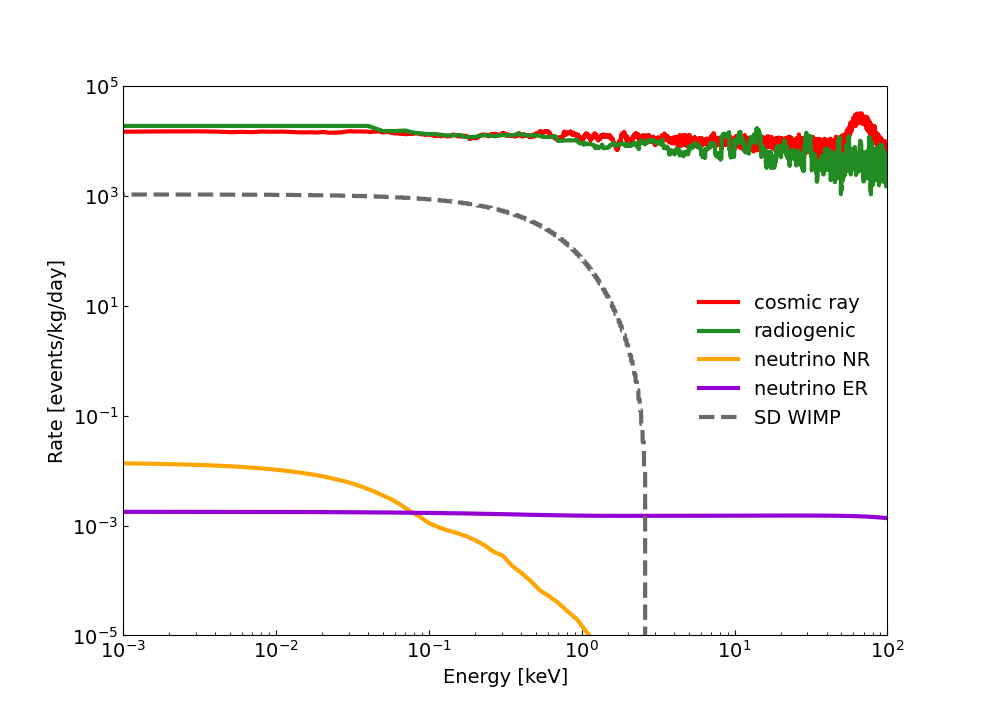
- Monte Carlo simulations are used to model candidate dark matter signals and background interactions, including electron recoils and cosmic rays.
- The sensitivity is projected using a full simulation framework that includes energy threshold, signal efficiency, and background rejection.
Experimental results
Research questions
- RQ1Can a superfluid $^3$He-based bolometer with a nanomechanical resonator achieve sub-eV energy resolution for nuclear recoils?
- RQ2What is the projected sensitivity of such a detector to spin-independent and spin-dependent interactions of sub-GeV/$c^2$ dark matter?
- RQ3How do quasiparticle shot noise and resonator design affect the energy threshold and sensitivity?
- RQ4What are the dominant background sources in the sub-eV regime, and how can they be mitigated?
- RQ5Can the detector concept be extended to probe fundamental superfluid phenomena, such as homogeneous first-order phase transitions?
Key findings
- The QUEST-DMC detector concept projects a sub-eV nuclear recoil energy threshold, enabling access to previously unexplored regions of the parameter space for light dark matter.
- The detector is sensitive to both spin-independent and spin-dependent interactions of dark matter with $^3$He nuclei, offering a complementary approach to existing noble gas-based experiments.
- Sensitivity projections show competitive reach in the sub-GeV/$c^2$ mass range, particularly for spin-dependent interactions, which are less explored in current experiments.
- The use of multiple independent nanowire oscillators could enhance energy resolution by a factor of $\sqrt{N}$, significantly improving sensitivity.
- Alternative strategies such as using membrane-attached resonators or non-local thermometry (e.g., magnon BEC relaxation) could further reduce noise and extend sensitivity below 1 eV.
- The simulation framework demonstrates that background suppression is feasible through energy thresholding and event topology, supporting a viable path to discovery.
Read this paper
Open the full text in the Nubint reader and ask about any passage as you read.
Read this paper on NubintThis review was generated by AI from the original paper. Please check the paper before citing it.