
[Paper Review] Question-Instructed Visual Descriptions for Zero-Shot Video Question Answering
Q-ViD proposes a simple, gradient-free framework for zero-shot video question answering by generating question-instructed visual descriptions using an instruction-aware vision-language model (InstructBLIP), then leveraging a large language model (LLM) for reasoning. It achieves competitive or superior performance to complex architectures and GPT-based methods on multiple benchmarks, demonstrating that question-specific frame captions significantly improve zero-shot video QA.
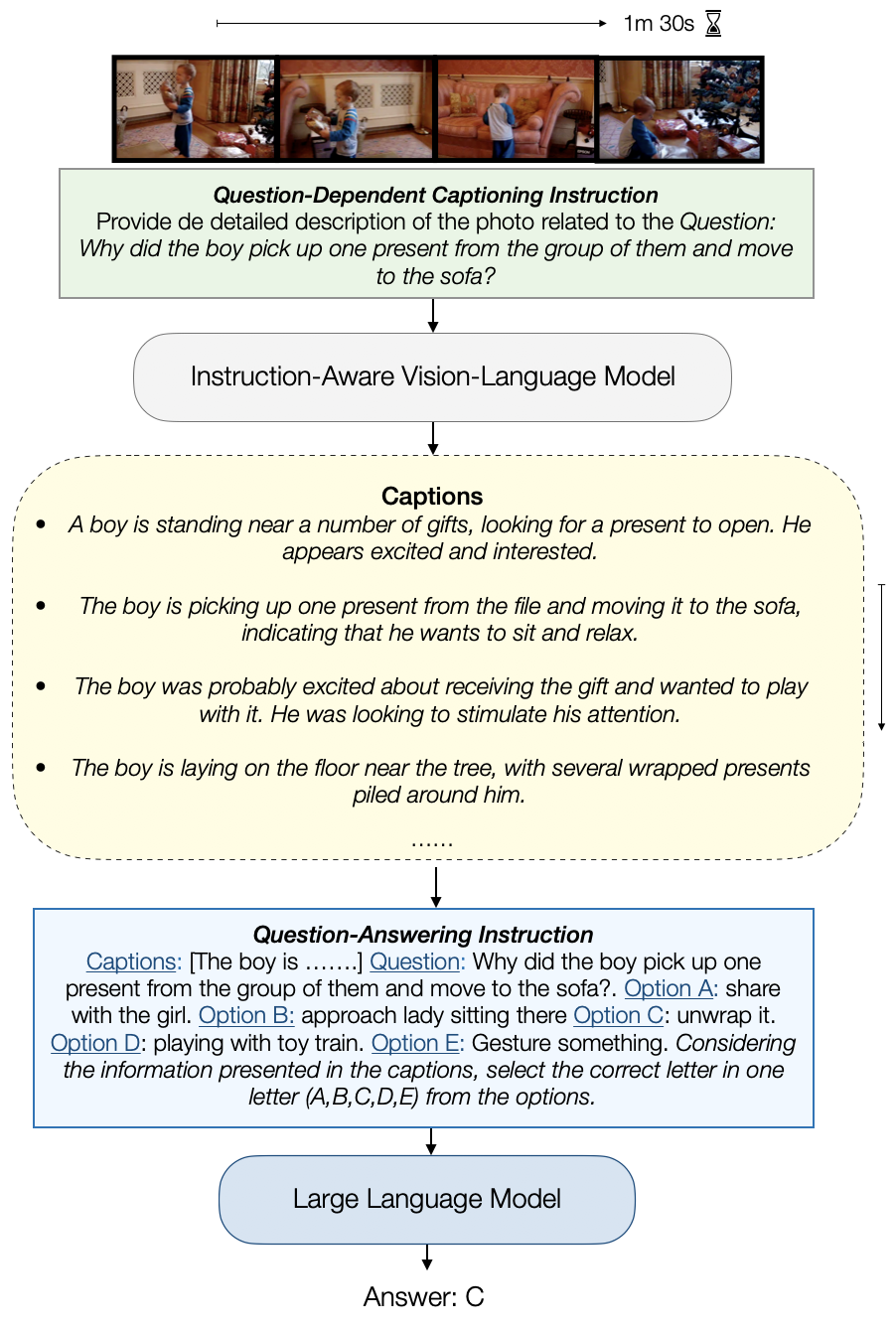
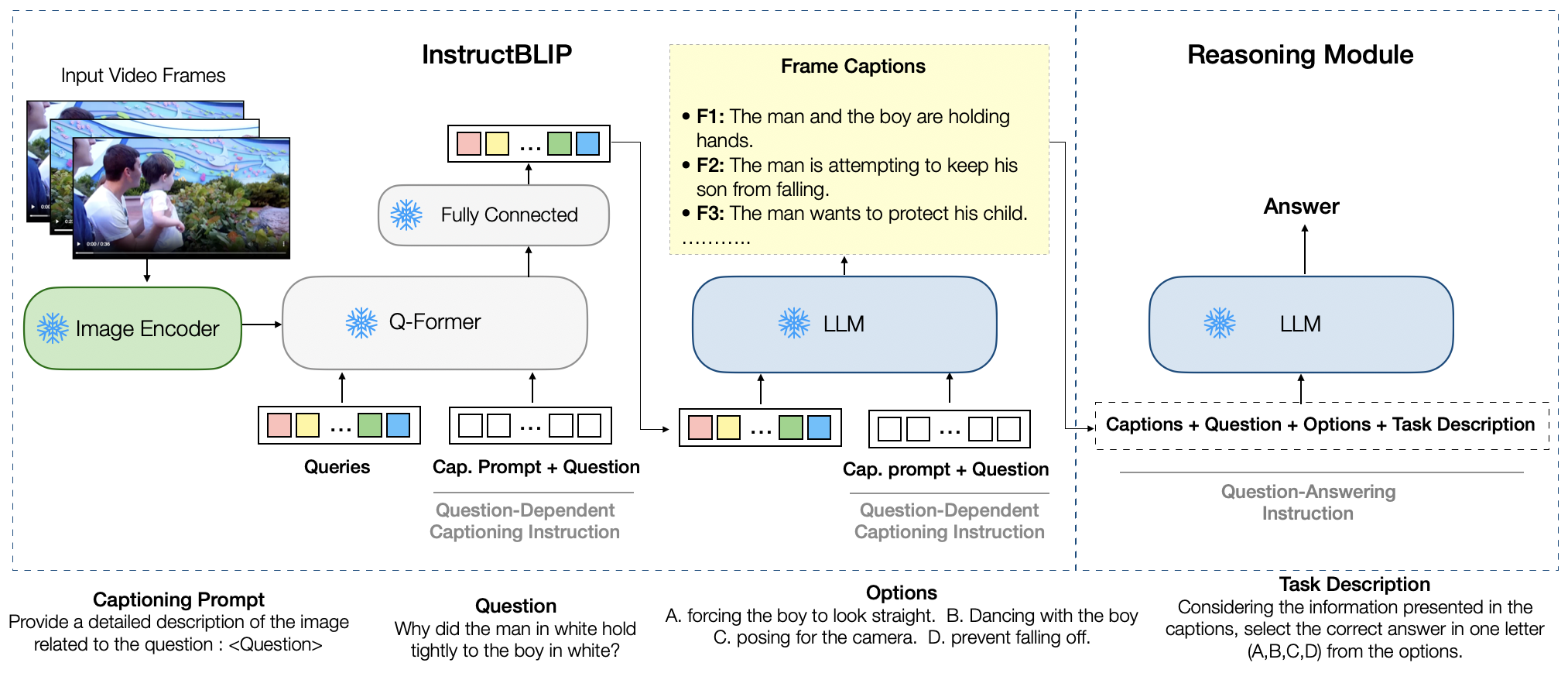
We present Q-ViD, a simple approach for video question answering (video QA), that unlike prior methods, which are based on complex architectures, computationally expensive pipelines or use closed models like GPTs, Q-ViD relies on a single instruction-aware open vision-language model (InstructBLIP) to tackle videoQA using frame descriptions. Specifically, we create captioning instruction prompts that rely on the target questions about the videos and leverage InstructBLIP to obtain video frame captions that are useful to the task at hand. Subsequently, we form descriptions of the whole video using the question-dependent frame captions, and feed that information, along with a question-answering prompt, to a large language model (LLM). The LLM is our reasoning module, and performs the final step of multiple-choice QA. Our simple Q-ViD framework achieves competitive or even higher performances than current state of the art models on a diverse range of videoQA benchmarks, including NExT-QA, STAR, How2QA, TVQA and IntentQA.
Motivation & Objective
- To address the challenge of zero-shot video question answering with a simple, efficient, and open-source approach that avoids complex architectures or closed-source models.
- To investigate whether question-specific visual descriptions from a single instruction-tuned vision-language model can effectively replace multi-module or fine-tuned pipelines in video QA.
- To evaluate the impact of instruction design on frame captioning quality and downstream QA performance, particularly in comparison to general or generic captioning prompts.
- To determine whether elaborate question-answering prompts are necessary when the input frame descriptions are already question-informed.
- To demonstrate that a minimal, modular pipeline using open models can achieve state-of-the-art performance in zero-shot video QA without fine-tuning or external APIs.
Proposed method
- Sample a fixed number of frames from the input video to reduce computational load and maintain temporal coherence.
- Generate question-specific captioning instructions by prompting the InstructBLIP model with the target question, using it to produce detailed, task-relevant frame descriptions.
- Concatenate the question-instructed frame captions into a unified video description that captures temporal and semantic context relevant to the question.
- Feed the video description, the original question, multiple-choice options, and a standard QA instruction prompt into a large language model (Flan-T5) for final answer generation.
- Use a two-stage prompting strategy: first to generate contextually relevant visual descriptions, second to guide the LLM in reasoning and selecting the correct answer.
- Optimize performance through ablation studies on captioning prompt templates and QA instruction templates, identifying the most effective configurations.
Experimental results
Research questions
- RQ1Can a single instruction-aware vision-language model generate question-specific visual descriptions that outperform general frame captions in zero-shot video QA?
- RQ2Does a simple two-stage pipeline—using frame captions as context for an LLM—achieve competitive performance compared to complex, multi-module, or fine-tuned video QA systems?
- RQ3How does the design of the captioning instruction (general vs. question-dependent) affect the quality of visual descriptions and downstream QA accuracy?
- RQ4Is it necessary to use complex or detailed question-answering prompts when the input visual descriptions are already tailored to the question?
- RQ5Can open-source, instruction-tuned models replace closed-source LLMs (e.g., GPT-3.5) in zero-shot video QA without sacrificing performance?
Key findings
- Q-ViD achieves state-of-the-art or competitive performance on five diverse video QA benchmarks: NExT-QA (60.1%), STAR (44.9%), How2QA (66.3%), TVQA (45.7%), and IntentQA (45.8%) using the Q-ViD XXL variant.
- Using question-dependent captioning prompts (e.g., 'Describe the scene in frame X as it relates to the question: ...') significantly outperforms general captioning prompts, improving accuracy by up to 4.5% on NExT-QA.
- The Q-ViD XL model with general captioning prompts achieves 60.2% average accuracy on NExT-QA, while the Q-ViD XXL model with dependent prompts reaches 66.3%, showing the benefit of tailored visual descriptions.
- Ablation studies show that more complex QA instruction templates do not improve performance over the base template, indicating that the quality of input captions is more critical than the QA prompt complexity.
- The method outperforms complex architectures like SeViLa, InternVideo, and Flamingo, and even matches or exceeds GPT-based methods like LloVi and ViperGPT, despite using only open-source models and no fine-tuning.
- Despite strong performance, the approach faces limitations: hallucinations in captions and high memory usage for long videos due to storing detailed frame descriptions, which may exceed LLM context length constraints.
Read this paper
Open the full text in the Nubint reader and ask about any passage as you read.
Read this paper on NubintThis review was generated by AI from the original paper. Please check the paper before citing it.