
[Paper Review] Quick-Tune: Quickly Learning Which Pretrained Model to Finetune and How
Quick-Tune proposes a Bayesian optimization framework that jointly selects the optimal pretrained vision model and its finetuning hyperparameters using meta-learned performance predictors. By leveraging multi-fidelity learning curves from 20,000 model-hyperparameter configurations across 24 models and 87 datasets, it outperforms state-of-the-art methods and even large all-purpose models like DINOv2 in accuracy while reducing search time.
With the ever-increasing number of pretrained models, machine learning practitioners are continuously faced with which pretrained model to use, and how to finetune it for a new dataset. In this paper, we propose a methodology that jointly searches for the optimal pretrained model and the hyperparameters for finetuning it. Our method transfers knowledge about the performance of many pretrained models with multiple hyperparameter configurations on a series of datasets. To this aim, we evaluated over 20k hyperparameter configurations for finetuning 24 pretrained image classification models on 87 datasets to generate a large-scale meta-dataset. We meta-learn a multi-fidelity performance predictor on the learning curves of this meta-dataset and use it for fast hyperparameter optimization on new datasets. We empirically demonstrate that our resulting approach can quickly select an accurate pretrained model for a new dataset together with its optimal hyperparameters.
Motivation & Objective
- To address the growing challenge of selecting the best pretrained model and its hyperparameters from a large pool of models.
- To reduce the time and cost of finetuning by jointly optimizing model choice and hyperparameters using meta-learning and multi-fidelity evaluation.
- To outperform conventional finetuning strategies, single-model baselines, and state-of-the-art hyperparameter optimization methods.
- To demonstrate that model hub diversity and joint optimization yield better performance than relying on a single large feature extractor like DINOv2.
- To release a large-scale meta-dataset and code to enable reproducibility and future research.
Proposed method
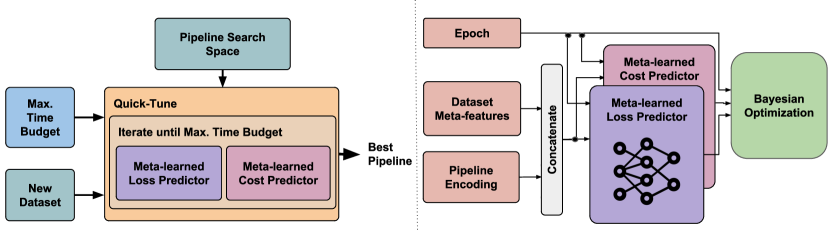
- The method uses a large-scale meta-dataset of 20,000 finetuning runs across 24 vision models and 87 datasets to train a meta-learned deep kernel Gaussian process surrogate.
- It applies multi-fidelity Bayesian optimization, evaluating models for one epoch at a time and allocating more compute to promising configurations based on early performance.
- The performance predictor is trained on full learning curves and used to guide search on new datasets with cost-aware trade-offs between time and accuracy.
- The search space includes diverse finetuning strategies such as layer-wise unfreezing, learning rate schedules, and weight decay, enabling comprehensive exploration.
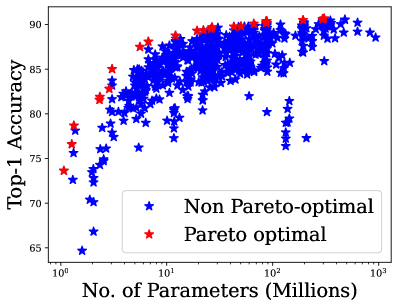
- A Pareto front-based selection identifies top-performing models across datasets, which are then re-optimized using Quick-Tune to refine hyperparameters.
- The approach is evaluated using normalized regret over wall-clock time, comparing against grid search on DINOv2 and other baselines.
Experimental results
Research questions
- RQ1Can a meta-learned performance predictor trained on diverse model-hyperparameter combinations improve the efficiency and accuracy of finetuning pipeline selection?
- RQ2Does jointly optimizing model choice and hyperparameters outperform using a single pretrained model or a large all-purpose backbone like DINOv2?
- RQ3How does the size and diversity of the model hub impact the final performance and search efficiency?
- RQ4Can multi-fidelity Bayesian optimization with early stopping significantly reduce search time while maintaining high accuracy?
- RQ5Is the proposed method more effective than standard hyperparameter optimization baselines in selecting high-performing finetuning configurations?
Key findings
- Quick-Tune outperforms finetuning a single pretrained model—even when its hyperparameters are tuned—across all datasets, demonstrating the benefit of model diversity.
- Using a model hub of 24 models (24-M) or 15 models (15-M) leads to significantly better performance than using only 5 or 10 models, validating the importance of model diversity.
- On small datasets, using a single model can be advantageous due to faster exploration, but larger hubs are essential for larger datasets to achieve high performance.
- Quick-Tune achieves better final accuracy than DINOv2 finetuned with a 104-configuration grid search, while using less wall-clock time, demonstrating superior search efficiency.
- The method finds high-performing configurations faster than state-of-the-art HPO methods, with normalized regret decreasing more rapidly over time.
- The open-sourced meta-dataset and code enable reproducibility and future benchmarking of model selection and hyperparameter optimization techniques.
Read this paper
Open the full text in the Nubint reader and ask about any passage as you read.
Read this paper on NubintThis review was generated by AI from the original paper. Please check the paper before citing it.