
[Paper Review] Qwen-Audio: Advancing Universal Audio Understanding via Unified Large-Scale Audio-Language Models
Qwen-Audio develops a unified, multi-task audio-language model trained on 30+ tasks and audio types, achieving strong zero-shot performance across diverse benchmarks without task-specific fine-tuning, and introduces Qwen-Audio-Chat for interactive dialogue.
Recently, instruction-following audio-language models have received broad attention for audio interaction with humans. However, the absence of pre-trained audio models capable of handling diverse audio types and tasks has hindered progress in this field. Consequently, most existing works have only been able to support a limited range of interaction capabilities. In this paper, we develop the Qwen-Audio model and address this limitation by scaling up audio-language pre-training to cover over 30 tasks and various audio types, such as human speech, natural sounds, music, and songs, to facilitate universal audio understanding abilities. However, directly co-training all tasks and datasets can lead to interference issues, as the textual labels associated with different datasets exhibit considerable variations due to differences in task focus, language, granularity of annotation, and text structure. To overcome the one-to-many interference, we carefully design a multi-task training framework by conditioning on a sequence of hierarchical tags to the decoder for encouraging knowledge sharing and avoiding interference through shared and specified tags respectively. Remarkably, Qwen-Audio achieves impressive performance across diverse benchmark tasks without requiring any task-specific fine-tuning, surpassing its counterparts. Building upon the capabilities of Qwen-Audio, we further develop Qwen-Audio-Chat, which allows for input from various audios and text inputs, enabling multi-turn dialogues and supporting various audio-central scenarios.
Motivation & Objective
- Motivate universal audio understanding by enabling a single model to handle diverse audio types (speech, natural sounds, music, songs) and tasks.
- Scale pre-training to 30+ tasks and 8 languages to promote cross-task knowledge sharing.
- Address the one-to-many label interference across datasets with a hierarchical tag conditioning framework.
- Show that multi-task pretraining plus SRWT improves grounding and ASR and QA capabilities.
- Provide an open-source foundation and an instruction-tuned chat variant (Qwen-Audio-Chat) for multi-turn dialogue.
Proposed method
- Use a single audio encoder ( Whisper-large-v2 initialized, 640M params) to process multiple audio types and feed representations to a decoder-based LLM (Qwen-7B) for text generation.
- Adopt a multitask pretraining strategy that conditions the decoder on a sequence of hierarchical tags to enable knowledge sharing and reduce label interference.
- Introduce a Speech Recognition with Word-level Timestamps (SRWT) task to improve alignment and grounding across tasks.
- Design a multi-task training format with transcription, language, task, output language, timestamps, and output instructions tags to unify diverse datasets.
- Perform supervised fine-tuning to obtain Qwen-Audio-Chat, enabling audio/text inputs and multi-turn dialogues via ChatML-style formatting.

Experimental results
Research questions
- RQ1Can a single multi-task audio-language model effectively learn 30+ tasks across diverse audio types without task-specific fine-tuning?
- RQ2Does hierarchical tagging mitigate one-to-many label interference during multi-task pretraining?
- RQ3Does incorporating SRWT improve grounding and performance on ASR and grounding-based QA tasks?
- RQ4Can instruction-tuned fine-tuning yield a robust interactive chat model (Qwen-Audio-Chat) for mixed audio/text dialogues?
Key findings
- Qwen-Audio achieves state-of-the-art results on several datasets (e.g., Aishell1, cochlscene, ClothoAQA, VocalSound) without task-specific fine-tuning.
- On ASR benchmarks, Qwen-Audio achieves 2.0% WER on Librispeech test-clean and 4.2% on test-other, and 1.8/4.0 on Mandarin datasets, outperforming prior multi-task models.
- In S2TT, CoVoST2 directions show substantial BLEU improvements over baselines across multiple language pairs.
- SRWT integration improves ASR grounding and QA performance on audio tasks, and enhances AQA results for natural sounds and music.
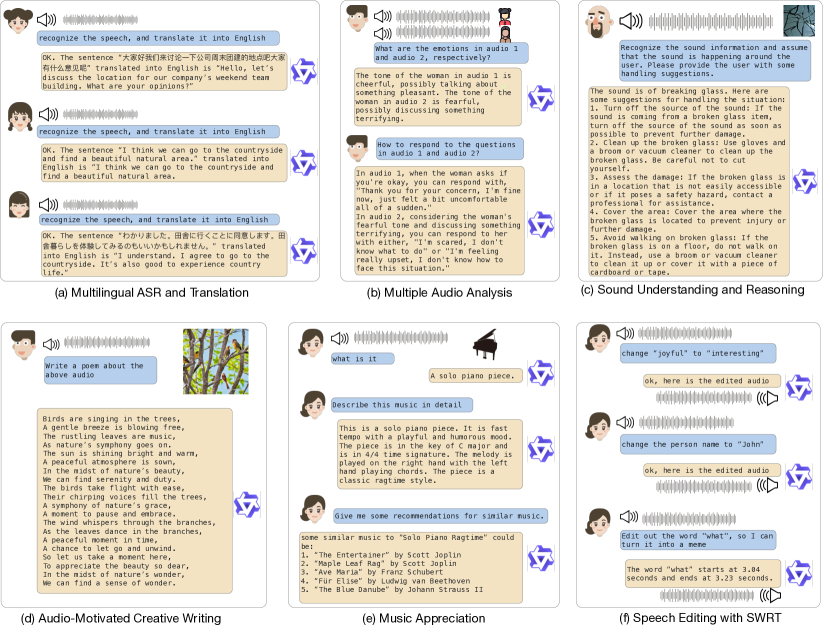
- Qwen-Audio-Chat enables multi-turn dialogues with audio and text inputs, demonstrated through interactive cases and open-source demos.
Read this paper
Open the full text in the Nubint reader and ask about any passage as you read.
Read this paper on NubintThis review was generated by AI from the original paper. Please check the paper before citing it.