
[Paper Review] Qwen2 Technical Report
Qwen2 introduces a family of open-weight LLMs (0.5B to 72B dense models plus a 57B MoE) with long-context capability, multilingual support, and instruction-tuning, achieving competitive performance against proprietary models and open baselines across language, coding, math, and reasoning benchmarks.
This report introduces the Qwen2 series, the latest addition to our large language models and large multimodal models. We release a comprehensive suite of foundational and instruction-tuned language models, encompassing a parameter range from 0.5 to 72 billion, featuring dense models and a Mixture-of-Experts model. Qwen2 surpasses most prior open-weight models, including its predecessor Qwen1.5, and exhibits competitive performance relative to proprietary models across diverse benchmarks on language understanding, generation, multilingual proficiency, coding, mathematics, and reasoning. The flagship model, Qwen2-72B, showcases remarkable performance: 84.2 on MMLU, 37.9 on GPQA, 64.6 on HumanEval, 89.5 on GSM8K, and 82.4 on BBH as a base language model. The instruction-tuned variant, Qwen2-72B-Instruct, attains 9.1 on MT-Bench, 48.1 on Arena-Hard, and 35.7 on LiveCodeBench. Moreover, Qwen2 demonstrates robust multilingual capabilities, proficient in approximately 30 languages, spanning English, Chinese, Spanish, French, German, Arabic, Russian, Korean, Japanese, Thai, Vietnamese, and more, underscoring its versatility and global reach. To foster community innovation and accessibility, we have made the Qwen2 model weights openly available on Hugging Face and ModelScope, and the supplementary materials including example code on GitHub. These platforms also include resources for quantization, fine-tuning, and deployment, facilitating a wide range of applications and research endeavors.
Motivation & Objective
- Advance open-weight LLMs with a broad size spectrum (0.5B–72B dense, 57B MoE).
- Improve long-context processing and multilingual capabilities through architectural and data enhancements.
- Align models with human preferences via supervised fine-tuning and RLHF using scalable data strategies.
- Demonstrate competitive performance against proprietary models on language, coding, mathematics, and reasoning benchmarks.
- Provide open access to weights and tooling to foster community research and deployment.
Proposed method
- Use Transformer-based dense and mixture-of-experts architectures with Grouped Query Attention (GQA) and Dual Chunk Attention (DCA) for long context.
- Adopt Rotary Position Embeddings (RoPE) and SwiGLU activations with RMSNorm and pre-normalization for stability.
- Train on a large multilingual corpus (>7 trillion tokens for dense models; MoE receives extra upcycling data).
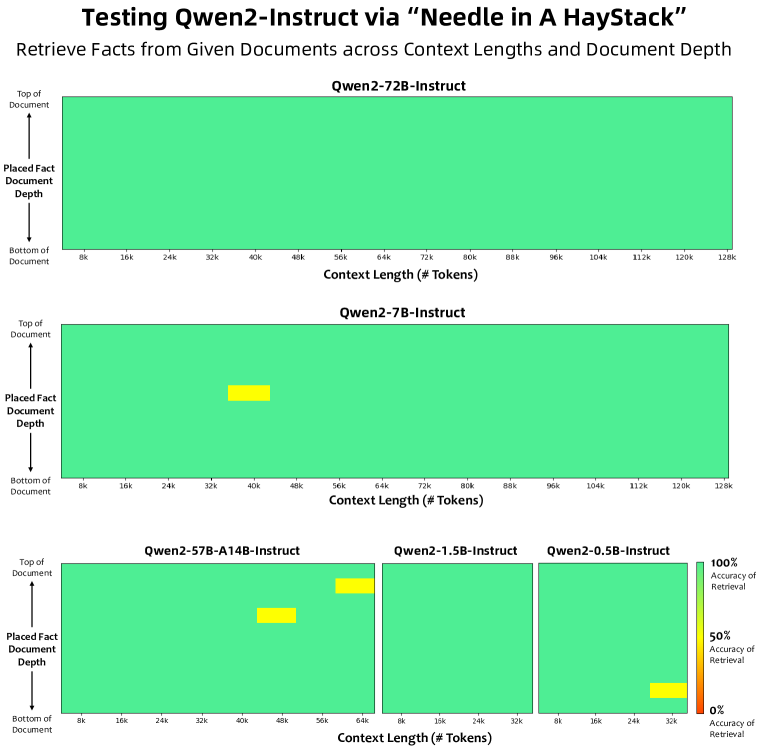
- Extend context length to 32,768 tokens and enable sequences up to 131,072 tokens via YARN and Dual Chunk Attention.
- Post-train with supervised fine-tuning and Direct Preference Optimization (DPO) for RLHF, plus Online Merging Optimizer to reduce alignment cost.
- Leverage collaborative data annotation and automated data synthesis to build high-quality demonstration and preference datasets.
Experimental results
Research questions
- RQ1How do Qwen2 dense and MoE models perform across knowledge, coding, mathematics, reasoning, and multilingual benchmarks compared to open and proprietary baselines?
- RQ2What are the impacts of long-context training and data scaling on model capabilities and reliability?
- RQ3Can scalable alignment (SFT + RLHF with DPO and online optimization) produce instruction-following models that are safe, honest, and helpful across languages?
- RQ4What are the trade-offs and efficiencies of fine-grained MoE routing and expert initialization in Qwen2-MoE?
- RQ5To what extent does open-sourcing weights and tooling accelerate research and deployment in multilingual, code, and reasoning tasks?
Key findings
- Qwen2-72B achieves 84.2 on MMLU, 37.9 on GPQA, 64.6 on HumanEval, 89.5 on GSM8K, and 82.4 on BBH as a base model.
- Qwen2-72B-Instruct attains 9.1 on MT-Bench, 48.1 on Arena-Hard, and 35.7 on LiveCodeBench.
- Qwen2-57B-A14B MoE matches or exceeds performance of a 30B dense model while activating 14B parameters per token, with strong coding and mathematics results.
- Qwen2 demonstrates robust multilingual capabilities across ~30 languages, including English, Chinese, Spanish, French, German, Arabic, Russian, Korean, Japanese, Thai, and Vietnamese.
- Smaller 0.5B and 1.5B models show competitive performance, with 1.5B surpassing several baselines in mathematics and Chinese understanding.
- Open weights and supplementary materials are publicly available on Hugging Face, ModelScope, and GitHub to support research and deployment.
Read this paper
Open the full text in the Nubint reader and ask about any passage as you read.
Read this paper on NubintThis review was generated by AI from the original paper. Please check the paper before citing it.