
[Paper Review] Rack-Aware Regenerating Codes with Fewer Helper Racks
This paper proposes rack-aware regenerating codes that achieve a novel tradeoff between storage overhead and cross-rack repair bandwidth for distributed storage systems, particularly in the regime where the repair degree $\bar{d} < \bar{k}$, enabling lower sub-packetization and improved efficiency. It presents explicit constructions of MSRR and MBRR codes that combine the benefits of regenerating codes and locally repairable codes, operating over small finite fields with practical parameters.
We consider the rack-aware storage system where \(n\) nodes are organized in \(\bar{n}\) racks each containing \(u\) nodes, and any \(k\) nodes can retrieve the stored file. Moreover, any single node erasure can be recovered by downloading data from \(\bar{d}\) helper racks as well as the remaining \(u\!-\!1\) nodes in the same rack. Previous work mostly focuses on minimizing the cross-rack repair bandwidth under the condition \(\bar{d}\geq \bar{k}\), where \(\bar{k}=\lfloor\frac{k}{u} floor\). However, \(\bar{d}\geq \bar{k}\) is not an intrinsic condition for the rack-aware storage model. In this paper, we establish a tradeoff between the storage overhead and cross-rack repair bandwidth for the particularly interesting case \(\bar{d}\!
Motivation & Objective
- To establish a new tradeoff between storage overhead and cross-rack repair bandwidth in rack-aware storage systems, especially when $\bar{d} < \bar{k}$, which is not constrained by prior work.
- To construct explicit MSRR and MBRR codes that operate efficiently under the $\bar{d} < \bar{k}$ regime, avoiding the high sub-packetization of traditional MSR/MBR codes.
- To minimize repair bandwidth while reducing repair degree by leveraging intra-rack repair and optimizing cross-rack helper rack selection.
- To demonstrate that codes with $\bar{d} < \bar{k}$ can achieve low storage overhead and practical field sizes, making them suitable for real-world deployment.
Proposed method
- Derives a cut-set bound applicable to all parameters $n = \bar{n}u$, $k = \bar{k}u + u_0$, establishing theoretical limits on file size under storage and cross-rack bandwidth constraints.
- Proposes a scalar code construction using product-matrix-like structure, where each rack's data is encoded via an $(\bar{n}, \bar{d}, \bar{d})$ MBR code over a finite field.
- Employs a symmetric matrix $S$ and Vandermonde-like structure to generate helper rack coefficients, enabling recovery of any failed node from $\bar{d}$ helper racks and $u-1$ intra-rack nodes.
- Uses linear combinations of punctured rack codes $C_e$ to reconstruct the failed node, ensuring repair feasibility under the $\bar{d} < \bar{k}$ condition.
- Constructs MSRR and MBRR codes via explicit parameterization, with $\beta = 1$ for MBRR and optimized $\alpha$ for MSRR, achieving minimal storage or bandwidth.
- Operates over finite fields of size comparable to $n$, such as $\mathrm{GF}(2^8)$, enabling practical implementation with low sub-packetization.
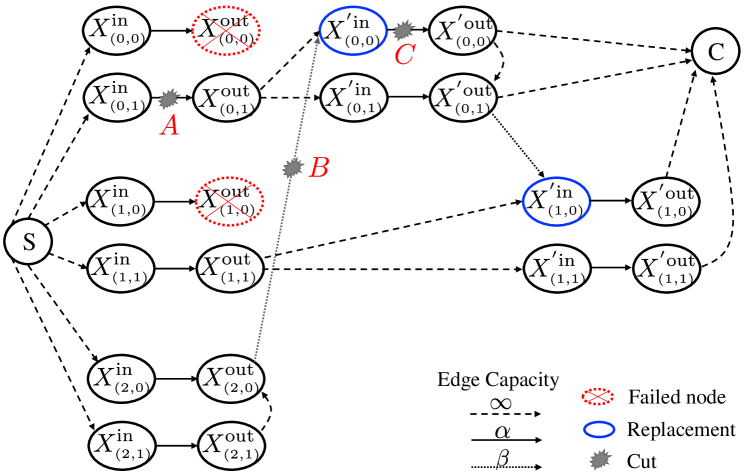
Experimental results
Research questions
- RQ1Can a meaningful tradeoff between storage overhead and cross-rack repair bandwidth be established when $\bar{d} < \bar{k}$ in rack-aware storage systems?
- RQ2Can explicit constructions of MSRR and MBRR codes be designed for the $\bar{d} < \bar{k}$ regime with low sub-packetization and small field size?
- RQ3How does the repair degree $\bar{d}$ affect the balance between storage efficiency and cross-rack communication cost in rack-aware systems?
- RQ4Can the proposed codes outperform existing MSR/MBR and LRC codes in terms of both storage overhead and repair degree?
Key findings
- The proposed MSRR codes achieve a storage overhead of approximately 1.25 when $\bar{d} = 4$, with $\bar{n} = 10$, $u = 5$, and $n-k=6$, significantly reducing overhead compared to $\bar{d} = 0$.
- For $\bar{n} = 10$, the storage overhead of MSRR codes drops from 1.389 ($\bar{d} = 0$) to 1.136 ($\bar{d} = 8$), a reduction of 18.2%.
- MBRR codes maintain a cross-rack repair bandwidth overhead of 1 across all tested $\bar{d}$ values, demonstrating consistent bandwidth efficiency.
- The storage overhead of MBRR codes decreases by 11.1% from $\bar{d} = 0$ to $\bar{d} = 8$ under the same parameters, indicating improved efficiency with moderate $\bar{d}$.
- The codes are constructed over $\mathrm{GF}(2^8)$, enabling practical deployment with sub-packetization levels comparable to $n$, unlike exponential-level constructions in prior MSR codes.
- The $\bar{d} < \bar{k}$ regime is shown to be feasible and beneficial, as it avoids the high repair degree and exponential sub-packetization of $\bar{d} \geq \bar{k}$ constructions.
Read this paper
Open the full text in the Nubint reader and ask about any passage as you read.
Read this paper on NubintThis review was generated by AI from the original paper. Please check the paper before citing it.