
[Paper Review] RAG based Question-Answering for Contextual Response Prediction System
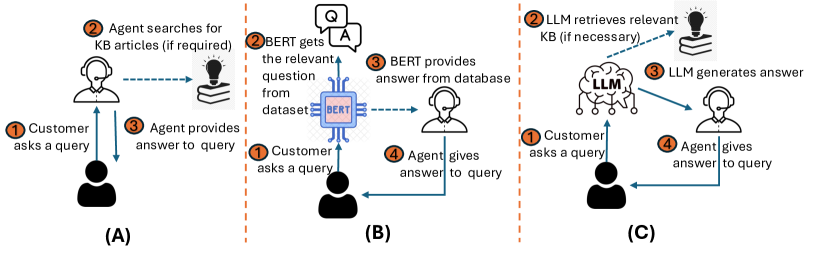
The paper presents an end-to-end Retrieval-Augmented Generation (RAG) framework for a knowledge-grounded Response Prediction System in a retail contact center, showing improved accuracy and reduced hallucinations versus a BERT-based system.
Large Language Models (LLMs) have shown versatility in various Natural Language Processing (NLP) tasks, including their potential as effective question-answering systems. However, to provide precise and relevant information in response to specific customer queries in industry settings, LLMs require access to a comprehensive knowledge base to avoid hallucinations. Retrieval Augmented Generation (RAG) emerges as a promising technique to address this challenge. Yet, developing an accurate question-answering framework for real-world applications using RAG entails several challenges: 1) data availability issues, 2) evaluating the quality of generated content, and 3) the costly nature of human evaluation. In this paper, we introduce an end-to-end framework that employs LLMs with RAG capabilities for industry use cases. Given a customer query, the proposed system retrieves relevant knowledge documents and leverages them, along with previous chat history, to generate response suggestions for customer service agents in the contact centers of a major retail company. Through comprehensive automated and human evaluations, we show that this solution outperforms the current BERT-based algorithms in accuracy and relevance. Our findings suggest that RAG-based LLMs can be an excellent support to human customer service representatives by lightening their workload.
Motivation & Objective
- Demonstrate a production-ready RAG framework for industry use cases in customer service.
- Identify optimal embedding, retrieval, and prompting configurations for accurate, grounded responses.
- Evaluate RAG against an existing BERT-based system using human and automated metrics.
- Assess feasibility and latency of ReAct and prompting techniques in real-time settings.
Proposed method
- Construct a domain-specific dataset with KB articles, in-domain Q/A, and out-domain Q/A.
- Systematically evaluate embedding strategies (USE, Vertex AI, SBERT) and retrieval methods (ScaNN, KNN HNSW).
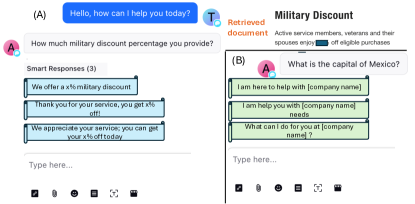
- Use PaLM2 generators for response production and ground outputs with retrieved KB articles.
- Tune a retrieval threshold to filter unnecessary retrievals and optimize efficiency.
- Assess performance with automated metrics and human evaluation, including AlignScore and semantic similarity.
- Deploy a production endpoint and integrate with an agent UI for real-time suggestions.
Experimental results
Research questions
- RQ1RQ1: How do embedding techniques, retrieval strategies, and prompting methods affect RAG performance in this domain?
- RQ2RQ2: Do RAG-based responses outperform the existing BERT-based system in helping human agents?
- RQ3RQ3: Can ReAct prompting improve factual accuracy and reduce hallucinations in real-time settings?
Key findings
- Vertex AI embeddings with ScaNN retrieval outperform other embeddings for Recall@K in this data.
- Retrieval threshold around 0.7 effectively distinguishes when retrieval is needed, improving efficiency.
- RAG-based responses increase accuracy by 10.15% and reduce hallucinations by 4.76% versus the BERT-based system in automated evaluation.
- Human evaluators preferred RAG-generated responses 75% of the time over the existing model.
- RAG improves AlignScore by 5.6% and semantic similarity by 20% on average, compared to the BERT-based system.
- ReAct and chain prompting offered limited latency-feasible gains; prompting techniques like CoVe/CoTP did not yield benefits in this setting.
Read this paper
Open the full text in the Nubint reader and ask about any passage as you read.
Read this paper on NubintThis review was generated by AI from the original paper. Please check the paper before citing it.