
[Paper Review] Rail-only: A Low-Cost High-Performance Network for Training LLMs with Trillion Parameters
This paper proposes Rail-Only, a low-cost, high-performance network architecture for training trillion-parameter LLMs by exploiting their unique communication patterns. Instead of full any-to-any connectivity, it partitions GPUs into high-bandwidth (HB) domains and connects only cross-domain pairs with non-zero traffic, reducing network cost by 37% to 75% without performance loss.
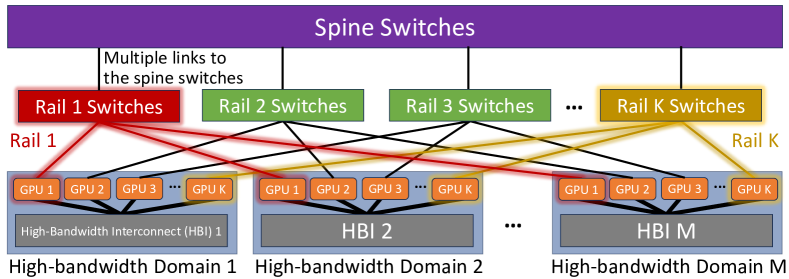
This paper presents a low-cost network architecture for training large language models (LLMs) at hyperscale. We study the optimal parallelization strategy of LLMs and propose a novel datacenter network design tailored to LLM's unique communication pattern. We show that LLM training generates sparse communication patterns in the network and, therefore, does not require any-to-any full-bisection network to complete efficiently. As a result, our design eliminates the spine layer in traditional GPU clusters. We name this design a Rail-only network and demonstrate that it achieves the same training performance while reducing the network cost by 38% to 77% and network power consumption by 37% to 75% compared to a conventional GPU datacenter. Our architecture also supports Mixture-of-Expert (MoE) models with all-to-all communication through forwarding, with only 8.2% to 11.2% completion time overhead for all-to-all traffic. We study the failure robustness of Rail-only networks and provide insights into the performance impact of different network and training parameters.
Motivation & Objective
- Address the escalating cost and complexity of large-scale GPU clusters for training trillion-parameter LLMs.
- Challenge the assumption that full any-to-any network connectivity is necessary for LLM training.
- Design a cost-efficient network that aligns with actual LLM communication patterns to reduce infrastructure overhead.
- Maintain training performance while minimizing network hardware by removing idle interconnects.
- Provide an analytical framework to estimate training iteration time based on LLM hyperparameters and infrastructure.
Proposed method
- Analyze LLM training traffic patterns to identify that high-bandwidth communication is confined to small, localized GPU groups (HB domains).
- Propose a new network architecture, Rail-Only, which partitions the cluster into HB domains connected only by necessary inter-domain links.
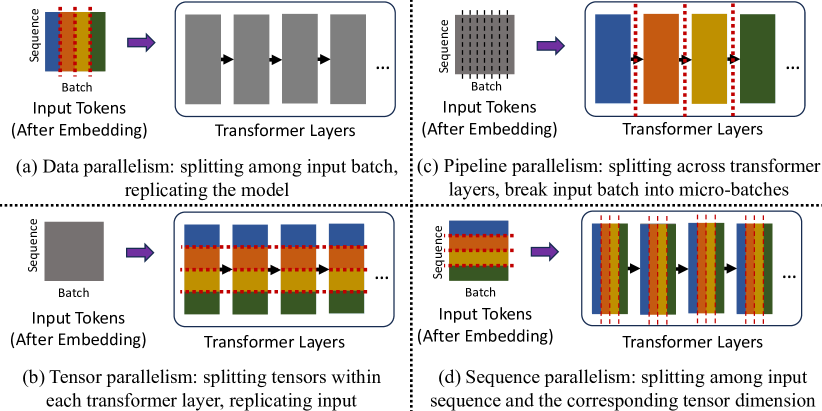
- Use an analytical model to estimate training iteration time, factoring in computation, communication, and parallelization strategy.
- Formulate the network cost reduction by eliminating non-utilized links in traditional Clos topologies.
- Implement fault-tolerance mechanisms and recovery strategies for failure resilience in the Rail-Only design.
- Validate the analytical model against ground truth from prior studies, achieving <0.15% error in floating-point utilization estimation.
Experimental results
Research questions
- RQ1Does LLM training truly require any-to-any network connectivity across all GPUs in a cluster?
- RQ2Can a network architecture be designed that matches the actual communication demands of LLM training to reduce cost?
- RQ3How can training iteration time be accurately modeled to guide network design for LLMs?
- RQ4What is the performance and cost trade-off of removing non-essential interconnects in large-scale GPU clusters?
- RQ5Can the proposed Rail-Only architecture maintain performance while significantly reducing network hardware?
Key findings
- LLM training exhibits a communication pattern where only small, localized GPU groups require high-bandwidth any-to-any connectivity, while cross-group communication is minimal and homogeneous.
- The Rail-Only architecture reduces network cost by 37% to 75% compared to state-of-the-art Clos networks, with no performance degradation.
- The analytical model for training iteration time estimates hardware floating-point utilization within 0.15% of ground truth from prior studies.
- For a 32,768-GPU cluster, Rail-Only reduces switch count from 2,560 (SOTA Clos) to 1,536, achieving a 37% cost reduction.
- For a 128,000-GPU cluster, the cost reduction reaches 75% by reducing switch count from 1,280 to 256 in the top-tier configuration.
- The design remains compatible with multi-job training and inference workloads by enabling logical partitioning of the cluster into independent domains.
Read this paper
Open the full text in the Nubint reader and ask about any passage as you read.
Read this paper on NubintThis review was generated by AI from the original paper. Please check the paper before citing it.