
[Paper Review] RAMM: Retrieval-augmented Biomedical Visual Question Answering with Multi-modal Pre-training
This paper proposes RAMM, a retrieval-augmented biomedical visual question answering framework that leverages a new patient-based image-text dataset (PMCPM) and a retrieval-attention mechanism to enhance performance on limited biomedical VQA data. By retrieving semantically similar image-text pairs from PubMed using contrastive representation learning and fusing them via a novel attention module, RAMM achieves state-of-the-art results on Med-VQA2019, Med-VQA2021, VQARAD, and SLAKE, with scores of 82.13, 39.20, 78.27, and 86.05, respectively.
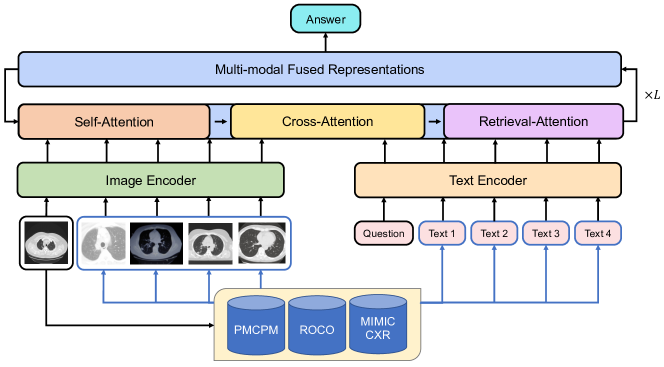
Vision-and-language multi-modal pretraining and fine-tuning have shown great success in visual question answering (VQA). Compared to general domain VQA, the performance of biomedical VQA suffers from limited data. In this paper, we propose a retrieval-augmented pretrain-and-finetune paradigm named RAMM for biomedical VQA to overcome the data limitation issue. Specifically, we collect a new biomedical dataset named PMCPM which offers patient-based image-text pairs containing diverse patient situations from PubMed. Then, we pretrain the biomedical multi-modal model to learn visual and textual representation for image-text pairs and align these representations with image-text contrastive objective (ITC). Finally, we propose a retrieval-augmented method to better use the limited data. We propose to retrieve similar image-text pairs based on ITC from pretraining datasets and introduce a novel retrieval-attention module to fuse the representation of the image and the question with the retrieved images and texts. Experiments demonstrate that our retrieval-augmented pretrain-and-finetune paradigm obtains state-of-the-art performance on Med-VQA2019, Med-VQA2021, VQARAD, and SLAKE datasets. Further analysis shows that the proposed RAMM and PMCPM can enhance biomedical VQA performance compared with previous resources and methods. We will open-source our dataset, codes, and pretrained model.
Motivation & Objective
- To address the data scarcity challenge in biomedical visual question answering (VQA), which limits model generalization and increases overfitting risk.
- To develop a retrieval-augmented pretrain-and-finetune paradigm that leverages external biomedical literature to enrich training signals.
- To construct a high-quality, patient-centric image-text dataset (PMCPM) from PubMed to support biomedical multi-modal pretraining and retrieval.
- To design a novel retrieval-attention module that effectively fuses retrieved image-text pairs with input images and questions during fine-tuning.
- To demonstrate that retrieval from diverse, high-quality literature sources improves VQA performance beyond standard fine-tuning on existing datasets.
Proposed method
- Proposes PMCPM, a large-scale, patient-based image-text dataset collected from PubMed Central, containing diverse radiological images and their corresponding clinical descriptions.
- Pretrains a multi-modal model using three objectives: masked language modeling, image-text matching, and image-text contrastive learning (ITC) to align visual and textual representations.
- Uses ITC embeddings from pretraining to retrieve semantically similar image-text pairs from PMCPM, ROCO, and MIMIC-CXR for each input VQA sample.
- Introduces a retrieval-attention module that attends to both the input image and question and the representations of retrieved image-text pairs to generate enriched context representations.
- Fine-tunes the model with the fused representations to predict answers, enabling knowledge transfer from retrieved literature.
- Employs a dynamic retrieval count strategy, with ablation showing optimal performance at 2–4 retrieved pairs, avoiding noise from excessive retrieval.
Experimental results
Research questions
- RQ1Can leveraging external biomedical literature through retrieval improve performance on low-resource biomedical VQA datasets?
- RQ2How effective is a newly constructed, patient-focused image-text dataset (PMCPM) compared to existing datasets like ROCO and MIMIC-CXR in supporting biomedical VQA?
- RQ3Does the integration of retrieved image-text pairs via a retrieval-attention mechanism lead to better answer accuracy than standard fine-tuning?
- RQ4What is the optimal number of retrieved image-text pairs for boosting VQA performance without introducing noise?
- RQ5To what extent do retrieved texts contain answers to biomedical VQA questions, and how does this vary across different datasets?
Key findings
- RAMM achieves state-of-the-art performance on Med-VQA2019 with a score of 82.13, surpassing previous methods.
- On Med-VQA2021, RAMM achieves a score of 39.20, demonstrating strong performance on challenging, open-ended biomedical VQA.
- For the VQARAD dataset, RAMM obtains a score of 78.27, indicating effective handling of radiology-specific VQA tasks.
- On the SLAKE dataset, RAMM achieves 86.05, with a notable 91.59 on closed-ended questions, showing strong generalization.
- Ablation studies confirm that both the PMCPM dataset and the retrieval-augmented fine-tuning mechanism significantly improve performance.
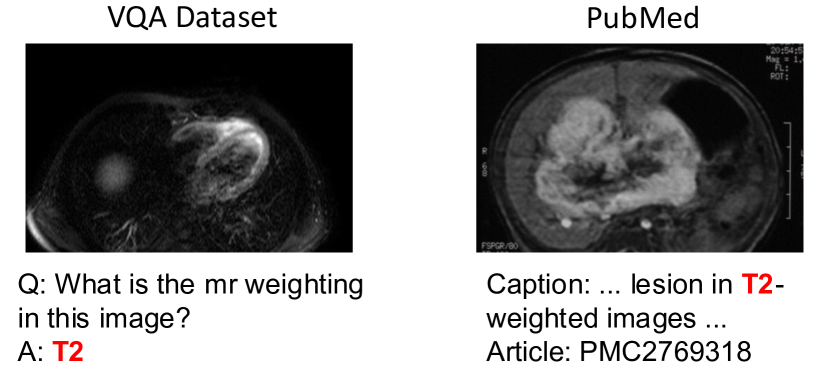
- Retrieval from PMCPM contributes to 29.6% to 38.7% of answers being directly found in retrieved texts, validating the utility of the retrieval strategy.
Better researchstarts right now
From reading papers to final review, dramatically reduce your research time.
No credit card · Free plan available
This review was created by AI and reviewed by human editors.