
[Paper Review] Random unitaries in extremely low depth
This paper demonstrates that random quantum unitaries—specifically approximate unitary $k$-designs and pseudorandom unitaries (PRUs)—can be constructed in extremely shallow circuit depths: $\log n$ for designs and $\text{poly}\log n$ or $\text{poly}\log\log n$ for PRUs, regardless of geometry, including 1D. The construction uses local random unitaries on $\log n$- or $\text{poly}\log n$-sized patches, achieving optimal $n$-scaling and enabling efficient, low-depth alternatives to exponentially deep Haar-random circuits.
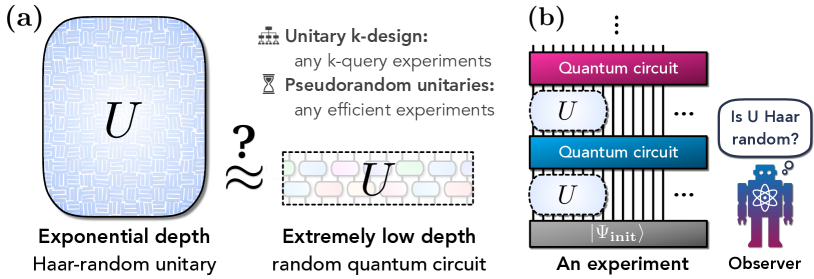
We prove that random quantum circuits on any geometry, including a 1D line, can form approximate unitary designs over $n$ qubits in $\log n$ depth. In a similar manner, we construct pseudorandom unitaries (PRUs) in 1D circuits in $ ext{poly}(\log n)$ depth, and in all-to-all-connected circuits in $ ext{poly}(\log \log n)$ depth. In all three cases, the $n$ dependence is optimal and improves exponentially over known results. These shallow quantum circuits have low complexity and create only short-range entanglement, yet are indistinguishable from unitaries with exponential complexity. Our construction glues local random unitaries on $\log n$-sized or $ ext{poly}(\log n)$-sized patches of qubits to form a global random unitary on all $n$ qubits. In the case of designs, the local unitaries are drawn from existing constructions of approximate unitary $k$-designs, and hence also inherit an optimal scaling in $k$. In the case of PRUs, the local unitaries are drawn from existing PRU constructions. Applications of our results include proving that classical shadows with 1D log-depth Clifford circuits are as powerful as those with deep circuits, demonstrating superpolynomial quantum advantage in learning low-complexity physical systems, and establishing quantum hardness for recognizing phases of matter with topological order.
Motivation & Objective
- To construct approximate unitary $k$-designs and pseudorandom unitaries (PRUs) in circuit depths that are exponentially lower than previous constructions.
- To achieve optimal $n$-scaling in depth for random unitary generation across all geometries, including 1D and all-to-all-connected networks.
- To demonstrate that shallow circuits with only short-range entanglement can mimic the statistical behavior of exponentially complex Haar-random unitaries.
- To enable practical applications in quantum information by reducing resource requirements for classical shadows, quantum advantage protocols, and topological phase recognition.
Proposed method
- Construct global random unitaries by tiling local random unitaries on small patches of $\log n$ or $\text{poly}\log n$ qubits.
- Use existing approximate unitary $k$-designs on $\log n$-sized patches to build global $\varepsilon$-approximate $k$-designs in $\tilde{\mathcal{O}}(k)\cdot\log(n/\varepsilon)$ depth.
- Leverage conjectured pseudorandom unitary ensembles (e.g., $PFC$) on $\text{poly}\log n$-sized patches to construct PRUs in $\text{poly}\log n$ depth on any geometry.
- Achieve $\text{poly}\log\log n$ depth for PRUs in all-to-all-connected circuits using the same patch-based gluing approach.
- Prove optimal $n$-dependence in depth by showing that no shallower construction can achieve the same approximation fidelity.
- Apply concentration inequalities and moment calculations (e.g., Chebyshev’s inequality) to bound the deviation of output distributions from uniformity and Haar measure.
Experimental results
Research questions
- RQ1Can approximate unitary $k$-designs be constructed in $\log n$ depth on any quantum circuit geometry, including 1D?
- RQ2Can pseudorandom unitaries (PRUs) be implemented in $\text{poly}\log n$ depth on arbitrary geometries, and in $\text{poly}\log\log n$ depth on all-to-all-connected networks?
- RQ3Is the $n$-dependence in circuit depth for these constructions optimal, and can it be improved beyond $\log n$?
- RQ4Can shallow circuits with only short-range entanglement simulate the statistical properties of exponentially complex Haar-random unitaries?
- RQ5What are the implications of such shallow constructions for quantum advantage in learning physical systems and recognizing topological order?
Key findings
- Approximate unitary $k$-designs can be constructed in $\tilde{\mathcal{O}}(k)\cdot\log(n/\varepsilon)$ depth on any geometry, achieving optimal $n$-scaling.
- Pseudorandom unitaries (PRUs) can be constructed in $\text{poly}\log n$ depth on any connected bounded-degree geometry, and in $\text{poly}\log\log n$ depth on all-to-all-connected circuits.
- The $n$-dependence in depth is optimal for both designs and PRUs, improving exponentially over prior constructions that required polynomial depth.
- The output distributions of the constructed ensembles are far from uniform with high probability, confirming they do not collapse to trivial distributions.
- The method enables classical shadows with log-depth Clifford circuits to achieve the same fidelity guarantees as linear-depth circuits, drastically reducing experimental overhead.
- The construction establishes that recognizing topological order in quantum states is super-polynomially hard for any quantum experiment, due to the pseudorandomness of the generated unitaries.

Read this paper
Open the full text in the Nubint reader and ask about any passage as you read.
Read this paper on NubintThis review was generated by AI from the original paper. Please check the paper before citing it.