
[Paper Review] RANS-PINN based Simulation Surrogates for Predicting Turbulent Flows
The paper introduces RANS-PINN, a physics-informed neural network framework using a 2-equation k-epsilon turbulence model to simulate turbulent flows, with a staged training regime and a parametric extension for unseen Reynolds numbers.
Physics-informed neural networks (PINNs) provide a framework to build surrogate models for dynamical systems governed by differential equations. During the learning process, PINNs incorporate a physics-based regularization term within the loss function to enhance generalization performance. Since simulating dynamics controlled by partial differential equations (PDEs) can be computationally expensive, PINNs have gained popularity in learning parametric surrogates for fluid flow problems governed by Navier-Stokes equations. In this work, we introduce RANS-PINN, a modified PINN framework, to predict flow fields (i.e., velocity and pressure) in high Reynolds number turbulent flow regimes. To account for the additional complexity introduced by turbulence, RANS-PINN employs a 2-equation eddy viscosity model based on a Reynolds-averaged Navier-Stokes (RANS) formulation. Furthermore, we adopt a novel training approach that ensures effective initialization and balance among the various components of the loss function. The effectiveness of the RANS-PINN framework is then demonstrated using a parametric PINN.
Motivation & Objective
- Motivate fast surrogate modeling for turbulent flows where DNS/LES are too costly.
- Integrate a two-equation RANS turbulence model (k-epsilon) into a PINN framework.
- Develop a robust training regime that stabilizes data and physics losses for turbulence.
- Demonstrate surrogate capability on multiple geometries and extend to parametric PINNs over Reynolds number.
Proposed method
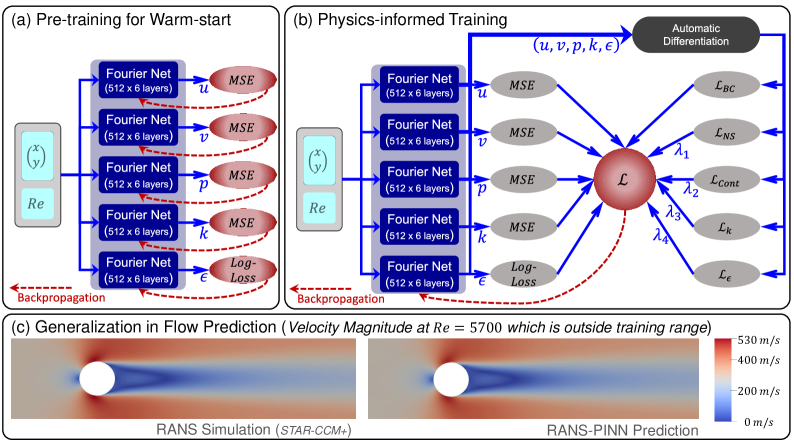
- Use Fourier neural operators as the backbone for velocity, pressure, k, and epsilon surrogates.
- Pre-train networks with data loss, then incorporate PDE-based physics losses with normalization by residuals.
- Employ a logarithmic loss for the dissipation term epsilon to handle near-wall and shear regions.
- Supervise with CFD data from STAR-CCM+ and enforce continuity, NS, and k-epsilon equations in the loss.
- Train a parametric PINN by including Reynolds number as input to generalize across Re values.
- Leverage a decaying Adam optimizer with a specific loss weighting scheme to balance components.
Experimental results
Research questions
- RQ1Can RANS-PINN accurately predict velocity and pressure fields in turbulent flows using a k-epsilon RANS model?
- RQ2Does a staged training regime improve data-plus-physics loss balance and convergence for turbulent PINNs?
- RQ3Can a parametric PINN generalize flow predictions to unseen Reynolds numbers without new CFD data?
Key findings
- RANS-PINN achieves lower validation losses and superior predictive performance compared to data-only or data-plus-physics without log-loss for epsilon in flow over a cylinder.
- For NACA 2412 and backward-facing step at given Re, the method yields low validation errors in velocity and pressure fields.
- A parametric PINN with Re as input can predict flow fields for unseen Reynolds numbers with reduced CFD data requirements and faster inference.
- Training with a log-loss for epsilon improves stability and reduces discontinuities in the predicted fields near walls and shear layers.
- The approach demonstrates accurate predictions across three geometries (cylinder, backward-facing step, NACA 2412) and enables real-time-like predictions for new Re cases.
Read this paper
Open the full text in the Nubint reader and ask about any passage as you read.
Read this paper on NubintThis review was generated by AI from the original paper. Please check the paper before citing it.