
[Paper Review] Rapid Chemical Enrichment by Intermittent Star Formation in GN-z11
The paper proposes that intermittent star formation—specifically two strong bursts separated by a 100 Myr quiescent phase—explains the super-solar nitrogen-to-oxygen ratio in GN-z11 (z=10.6), as observed by JWST. Wolf–Rayet stars from the second burst (up to 120 M☉) temporarily enhance N, F, Na, Al, and isotopes like 13C and 18O, successfully reproducing the observed CNO ratios without requiring very massive stars or pre-enrichment.
We interpret the peculiar super-solar nitrogen abundance recently reported by the James Webb Space Telescope observations for GN-z11 ($z=10.6$) using our state-of-the-art chemical evolution models. The observed CNO ratios can be successfully reproduced -- independently of the adopted initial mass function, nucleosynthesis yields, and presence of supermassive ($>$1000$M_\odot$) stars -- if the galaxy has undergone an intermittent star formation history with a quiescent phase lasting $\sim$100 Myr, separating two strong starbursts. Immediately after the second burst, Wolf--Rayet stars (up to $120M_\odot$) become the dominant enrichment source, also temporarily ($<$1 Myr) enhancing particular elements (N, F, Na, and Al) and isotopes ($^{13}$C and $^{18}$O). Alternative explanations involving (i) single burst models, also including very massive stars and/or pair-instability supernovae, or (ii) pre-enrichment scenarios fail to match the data. Feedback-regulated, intermittent star formation might be common in early systems. Elemental abundances can be used to test this hypothesis and to get new insights on nuclear and stellar astrophysics.
Motivation & Objective
- To explain the anomalously high N/O ratio in GN-z11 (z=10.6), which exceeds solar levels by more than four times, as observed by JWST.
- To test whether intermittent star formation with a quiescent phase can reproduce the observed CNO abundance ratios without invoking very massive stars (VMS) or pre-enrichment.
- To assess the role of Wolf–Rayet stars in driving rapid chemical enrichment and enhancing specific elements and isotopes in early galaxies.
- To evaluate the viability of feedback-regulated, stochastic star formation in high-redshift galaxies using chemical evolution models.
Proposed method
- Employed state-of-the-art chemical evolution models to simulate galaxy-wide elemental abundances under varying star formation histories.
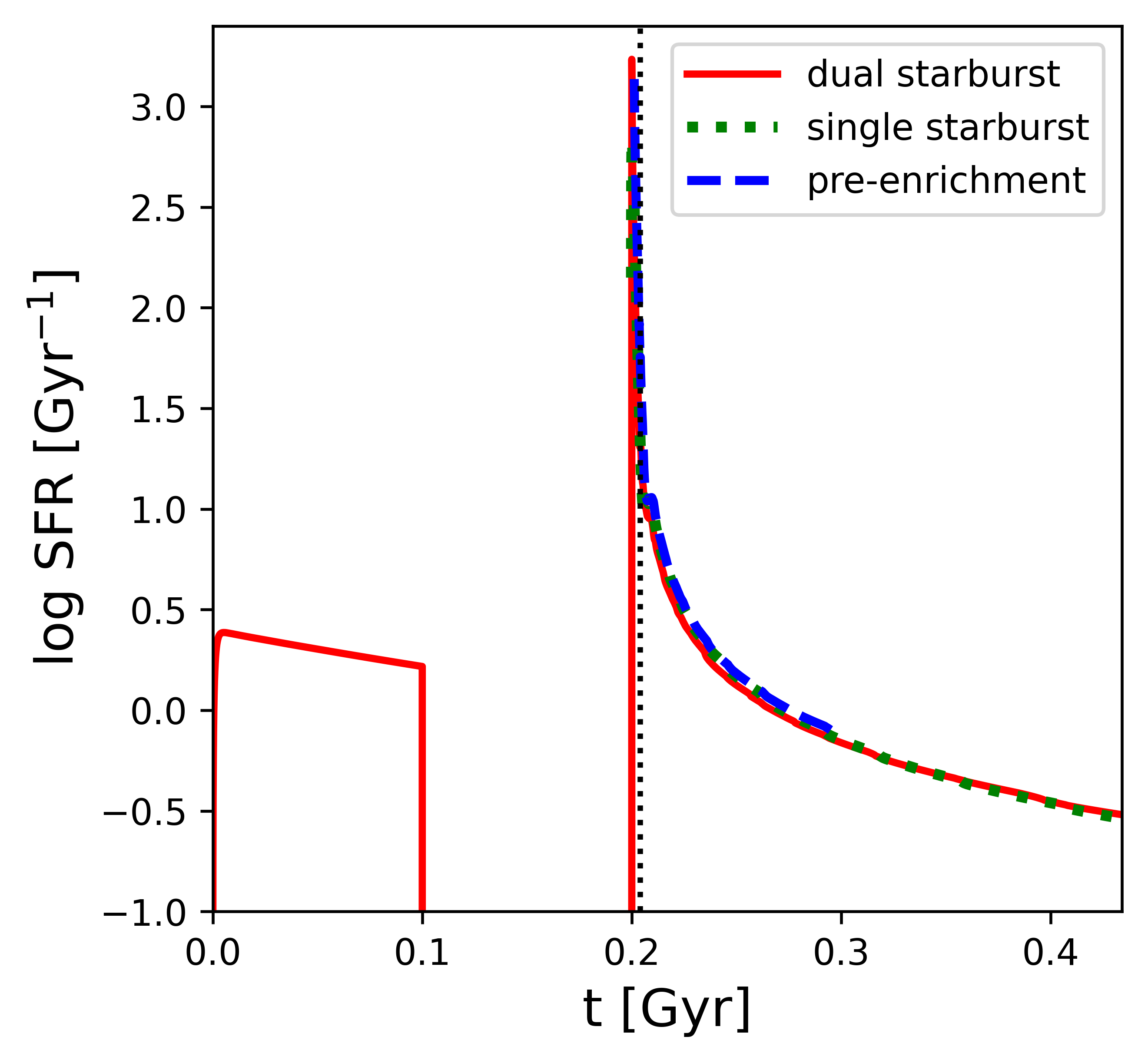
- Modeled two distinct starbursts separated by a 100 Myr quiescent phase to reproduce the observed CNO ratios in GN-z11.
- Incorporated nucleosynthesis yields from Wolf–Rayet stars up to 120 M☉, which dominate enrichment during the post-burst phase.
- Tested multiple configurations: varying burst durations, intervals, and inflow timescales to assess robustness of the model.
- Compared results against single-burst models with VMS and/or pair-instability supernovae, and pre-enrichment scenarios.
- Predicted isotopic ratios (e.g., 13C, 18O) and other element abundances (F, Na, Al) for future observational validation.
Experimental results
Research questions
- RQ1Can intermittent star formation with a 100 Myr quiescent phase reproduce the super-solar N/O ratio observed in GN-z11?
- RQ2Do Wolf–Rayet stars from the second burst explain the observed enhancement of nitrogen, fluorine, sodium, and aluminum in GN-z11?
- RQ3Why do single-burst models with very massive stars or pair-instability supernovae fail to match the observed CNO ratios?
- RQ4Is pre-enrichment from external sources necessary to explain the high metallicity and N/O in GN-z11?
- RQ5Can elemental and isotopic abundance patterns serve as diagnostics for feedback-regulated, stochastic star formation in early galaxies?
Key findings
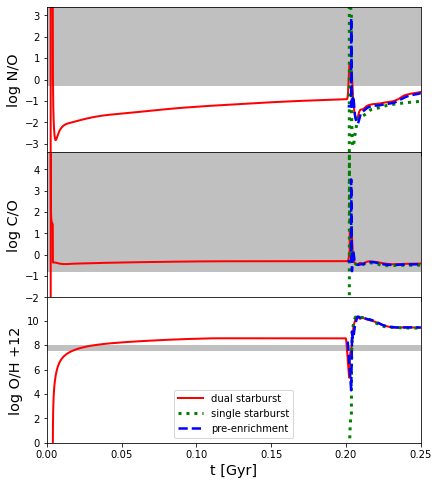
- The observed CNO abundance ratios in GN-z11 are successfully reproduced by a dual-burst star formation history with a 100 Myr quiescent phase, independent of initial mass function, nucleosynthesis yields, or supermassive stars.
- Wolf–Rayet stars (up to 120 M☉) become the dominant enrichment source immediately after the second burst, temporarily enhancing N, F, Na, Al, and isotopes 13C and 18O.
- The peak N/O ratio is achieved within less than 1 Myr after the second burst, indicating a short-lived chemical signature that could be erased quickly.
- Single-burst models with very massive stars or pair-instability supernovae fail to reproduce the data: VMSs do not increase N/O sufficiently, and PISNe reduce N/O ratios.
- Pre-enrichment scenarios also fail to match the observations, indicating internal enrichment via intermittent bursts is required.
- The model predicts high fluorine abundance, which can be tested with ALMA, and supports the presence of radiation-driven outflows that clear dust in super-early galaxies.
Read this paper
Open the full text in the Nubint reader and ask about any passage as you read.
Read this paper on NubintThis review was generated by AI from the original paper. Please check the paper before citing it.