
[Paper Review] Rapid Flood Inundation Forecast Using Fourier Neural Operator
This paper proposes a Fourier Neural Operator (FNO)-based surrogate model for rapid, real-time flood inundation forecasting by learning mappings from hydrodynamic simulations. Trained on six historical storm events in Houston, the FNO model achieves superior performance over a U-Net baseline, maintaining high accuracy (CSI > 0.93 at 3-hour lead time) and demonstrating strong generalization across new locations without fine-tuning.
Flood inundation forecast provides critical information for emergency planning before and during flood events. Real time flood inundation forecast tools are still lacking. High-resolution hydrodynamic modeling has become more accessible in recent years, however, predicting flood extents at the street and building levels in real-time is still computationally demanding. Here we present a hybrid process-based and data-driven machine learning (ML) approach for flood extent and inundation depth prediction. We used the Fourier neural operator (FNO), a highly efficient ML method, for surrogate modeling. The FNO model is demonstrated over an urban area in Houston (Texas, U.S.) by training using simulated water depths (in 15-min intervals) from six historical storm events and then tested over two holdout events. Results show FNO outperforms the baseline U-Net model. It maintains high predictability at all lead times tested (up to 3 hrs) and performs well when applying to new sites, suggesting strong generalization skill.
Motivation & Objective
- Address the critical need for real-time, high-resolution flood inundation forecasting to support emergency planning and risk mitigation.
- Overcome the computational bottleneck of high-resolution hydrodynamic modeling (e.g., 2D shallow water equations) in urban settings.
- Develop a data-driven surrogate model that preserves physical consistency and generalizes across different storm events and locations.
- Demonstrate the feasibility of using Fourier Neural Operators (FNO) for multi-lead-time flood extent and depth prediction.
- Evaluate the model’s performance against a U-Net baseline and assess its transferability to new domains without fine-tuning.
Proposed method
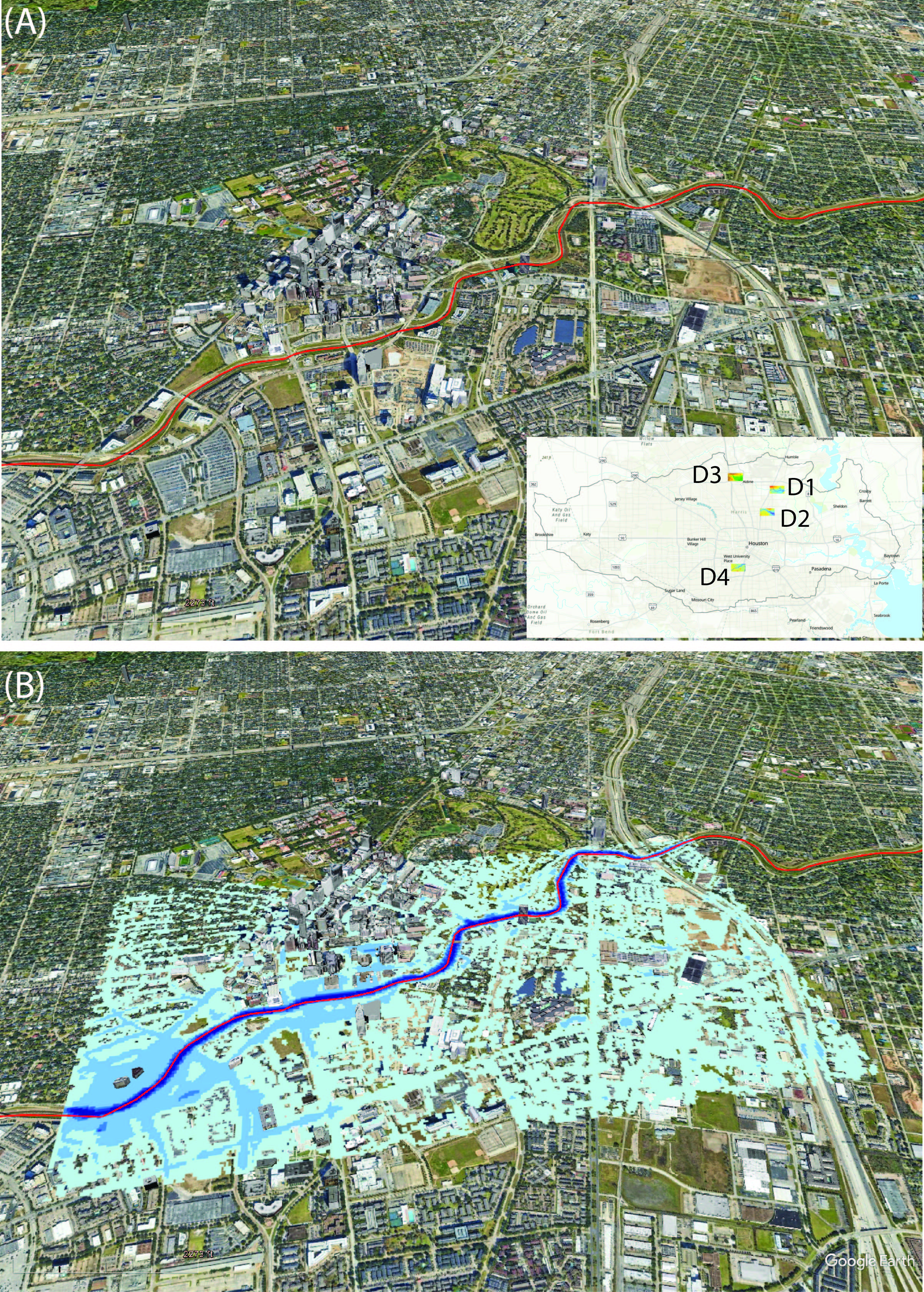
- Train an FNO model on 15-minute temporal sequences of simulated water depths from six historical storm events in Houston.
- Use a physics-informed loss function that penalizes errors in both water depth and spatial gradients to embed physical consistency.
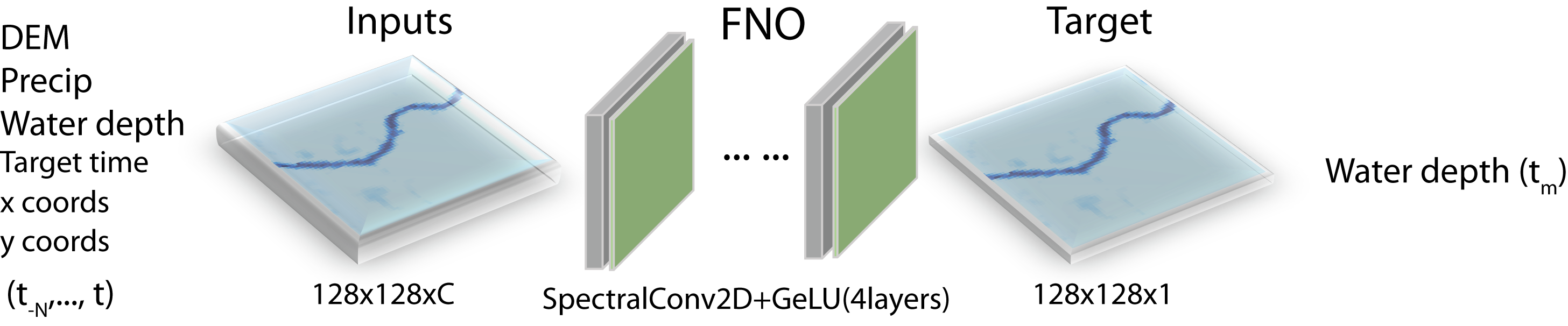
- Incorporate static geospatial features (e.g., digital elevation model) and dynamic inputs (e.g., rainfall, streamflow) as multi-channel input.
- Apply spectral convolutions via Fourier transforms to efficiently learn mappings between infinite-dimensional function spaces.
- Use a 12-frame lookback window (180 minutes) for temporal context, with ablation studies on longer lookback (24 frames) and precipitation-only inputs.
- Pre-train the FNO on multiple domains (D1–D3) and transfer to a new domain (D4) to evaluate zero-shot generalization capability.
Experimental results
Research questions
- RQ1Can an FNO-based surrogate model achieve accurate, real-time flood inundation prediction at street-level resolution with multi-lead-time forecasting?
- RQ2How does the FNO model compare to a U-Net baseline in terms of predictive accuracy and inference efficiency?
- RQ3To what extent does the physics-informed loss function improve model generalization and physical plausibility?
- RQ4Can an FNO model pretrained on similar domains be effectively transferred to a new, unseen urban location without fine-tuning?
- RQ5What is the impact of including antecedent water depth versus only precipitation as input on model performance?
Key findings
- The FNO model achieved a CSI of 0.9808 and MAE of 0.0044 at 15-minute lead time on the 2019/05/08 event, outperforming the U-Net baseline (CSI: 0.9752, MAE: 0.0056).
- At 3-hour lead time, the FNO maintained a CSI of 0.9324 and MAE of 0.0153, showing consistent performance across long lead times.
- The FNO model with 24-frame lookback (6 hours) did not improve performance, indicating limited benefit from longer memory in this context.
- A precipitation-only FNO variant (FNO-12P) showed drastically reduced performance (CSI: 0.4861 at 15 min), highlighting the importance of antecedent water depth.
- The multi-domain FNO (FNO-MD), pretrained on D1–D3 and applied to D4 without fine-tuning, achieved a CSI of 0.9659 at 15 min and 0.9032 at 180 min, demonstrating strong zero-shot generalization.
- Inference time for the FNO model was only 0.002 seconds per sample, enabling real-time deployment, while training time per epoch was 72 seconds on an RTX 3090 GPU.
Better researchstarts right now
From reading papers to final review, dramatically reduce your research time.
No credit card · Free plan available
This review was created by AI and reviewed by human editors.