
[Paper Review] Rapid Locomotion via Reinforcement Learning
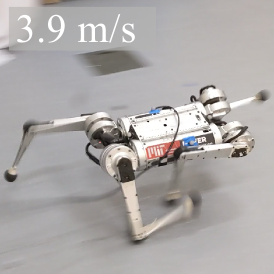
This paper presents an end-to-end reinforcement learning controller for the MIT Mini Cheetah that achieves record-breaking agility, sustaining speeds up to 3.9 m/s on diverse terrains like grass, ice, and gravel. The method uses an adaptive curriculum for velocity commands and online system identification to enable zero-shot sim-to-real transfer, enabling high-speed running, spinning, and robust disturbance response without vision or hand-designed models.
Agile maneuvers such as sprinting and high-speed turning in the wild are challenging for legged robots. We present an end-to-end learned controller that achieves record agility for the MIT Mini Cheetah, sustaining speeds up to 3.9 m/s. This system runs and turns fast on natural terrains like grass, ice, and gravel and responds robustly to disturbances. Our controller is a neural network trained in simulation via reinforcement learning and transferred to the real world. The two key components are (i) an adaptive curriculum on velocity commands and (ii) an online system identification strategy for sim-to-real transfer leveraged from prior work. Videos of the robot's behaviors are available at: https://agility.csail.mit.edu/
Motivation & Objective
- To enable high-speed, omnidirectional locomotion on diverse natural terrains such as grass, ice, and gravel.
- To overcome training instability in multi-task reinforcement learning when scaling velocity commands to high speeds.
- To achieve robust, zero-shot sim-to-real transfer for agile locomotion without relying on hand-designed dynamics models.
- To demonstrate emergent behaviors like tripping recovery and motor failure compensation through end-to-end learning.
- To push the limits of agility in legged robots using minimal sensing and scalable policy learning.
Proposed method
- An end-to-end deep reinforcement learning policy is trained in simulation using a reward function that encourages high-speed, omnidirectional movement.
- An adaptive curriculum dynamically expands the set of velocity commands based on physical feasibility, avoiding infeasible or overly difficult tasks early in training.
- Online system identification is used to calibrate the simulated policy to real-world dynamics, enabling zero-shot deployment.
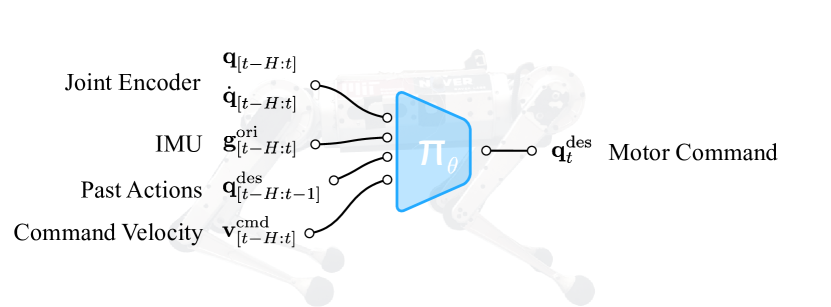
- The policy observes only proprioceptive state (joint angles, velocities, IMU) and velocity commands, with no vision or terrain geometry.
- The training uses a multi-task RL setup where each unique combination of linear and angular velocity is treated as a separate task.
- A teacher-student distillation strategy is employed to improve sample efficiency and generalization, though the core method relies on direct end-to-end training.
Experimental results
Research questions
- RQ1Can an end-to-end reinforcement learning policy achieve high-speed locomotion on diverse natural terrains without vision or terrain sensing?
- RQ2How can curriculum learning be automatically adapted to physical constraints to stabilize training for high-speed locomotion?
- RQ3To what extent can sim-to-real transfer be achieved with zero-shot deployment using only proprioceptive feedback?
- RQ4What emergent behaviors arise from end-to-end learning in complex, high-speed locomotion tasks?
- RQ5How does the performance of a learned policy compare to hand-designed model-predictive controllers in terms of agility and robustness?
Key findings
- The controller achieved a sustained top speed of 3.9 m/s on flat ground, setting a new record for the MIT Mini Cheetah.
- On uneven grass terrain, the robot maintained an average speed of 3.4 m/s over a 10-meter sprint, demonstrating robustness to terrain irregularities.
- The policy enabled high-speed spinning at 5.7 rad/s on flat ground and successfully executed spinning on icy terrain, indicating strong disturbance rejection.
- The system demonstrated emergent behaviors such as recovery from tripping and compensation for a malfunctioning motor, observed during real-world deployment.
- The controller achieved a Froude number of 5.1, the highest reported for the Mini Cheetah, though lower than the Cheetah 2.
- Zero-shot sim-to-real transfer was successful across diverse terrains, including grass, ice, and gravel, with no real-world fine-tuning.
Read this paper
Open the full text in the Nubint reader and ask about any passage as you read.
Read this paper on NubintThis review was generated by AI from the original paper. Please check the paper before citing it.