
[Paper Review] RARES: Runtime Attack Resilient Embedded System Design Using Verified Proof-of-Execution
RARES presents a lightweight, hardware-assisted runtime attack resilience framework for resource-constrained embedded systems using a 16-bit control register (Ctrl_register) to detect memory modification attacks in real time. It enables use-case-specific prevention and onboard recovery without abrupt system resets, achieving only 2.3% resource overhead on an FPGA with full formal verification preserved.
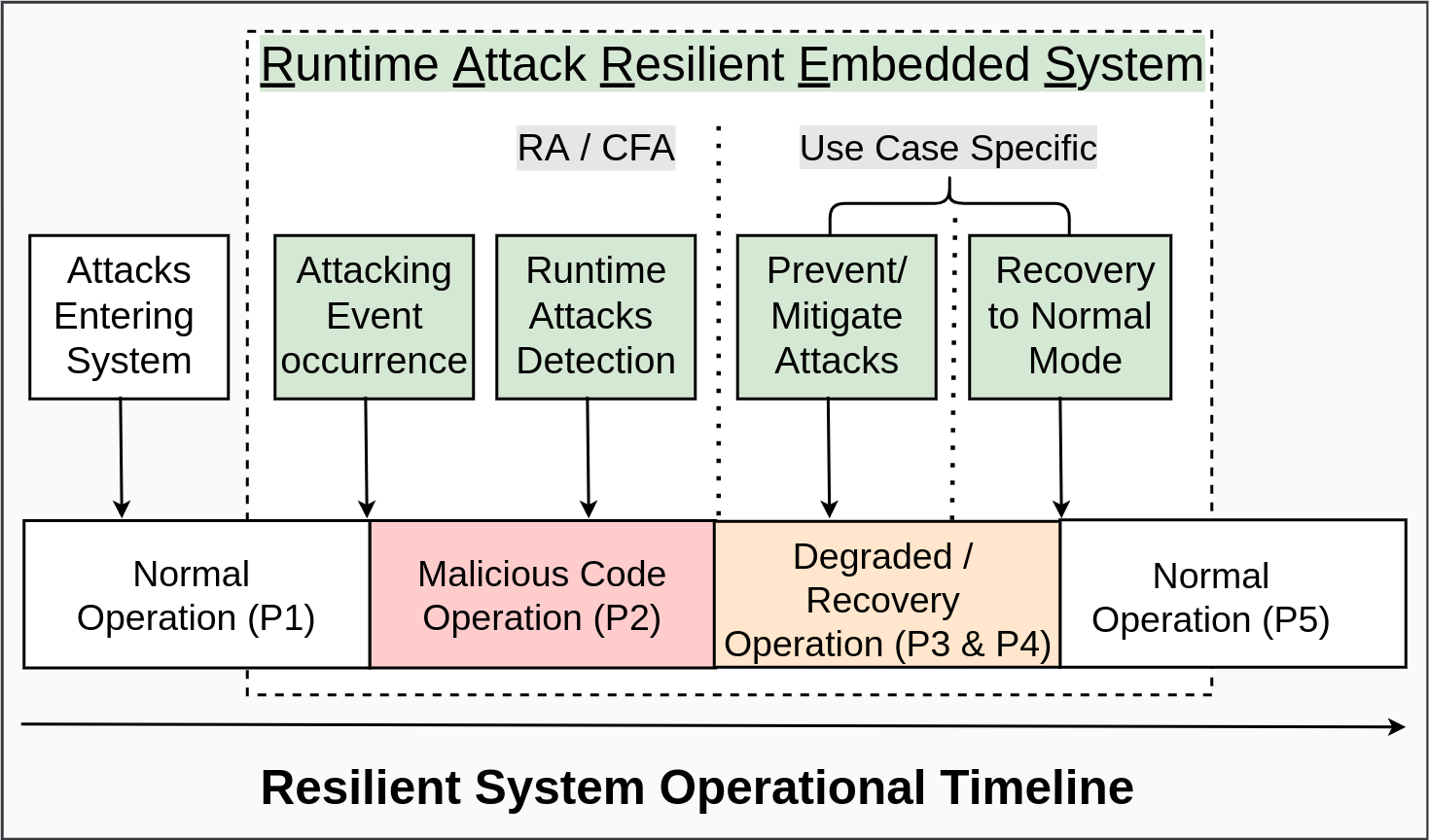
Modern society is getting accustomed to the Internet of Things (IoT) and Cyber-Physical Systems (CPS) for a variety of applications that involves security-critical user data and information transfers. In the lower end of the spectrum, these devices are resource-constrained with no attack protection. They become a soft target for malicious code modification attacks that steals and misuses device data in malicious activities. The resilient system requires continuous detection, prevention, and/or recovery and correct code execution (including in degraded mode). By end large, existing security primitives (e.g., secure-boot, Remote Attestation RA, Control Flow Attestation (CFA) and Data Flow Attestation (DFA)) focuses on detection and prevention, leaving the proof of code execution and recovery unanswered. To this end, the proposed work presents lightweight RARES -- Runtime Attack Resilient Embedded System design using verified Proof-of-Execution. It presents first custom hardware control register (Ctrl_register) based runtime memory modification attacks classification and detection technique. It further demonstrates the Proof Of Concept (POC) implementation of use-case-specific attacks prevention and onboard recovery techniques. The prototype implementation on Artix 7 Field Programmable Gate Array (FPGA) and state-of-the-art comparison demonstrates very low (2.3%) resource overhead and efficacy of the proposed solution.
Motivation & Objective
- To address the lack of continuous, lightweight runtime detection and recovery mechanisms for memory modification attacks in resource-constrained IoT and CPS devices.
- To enable system developers to design application-specific prevention and recovery strategies without relying on abrupt system resets.
- To integrate verified proof-of-execution with secure-boot and onboard recovery in a minimal hardware footprint.
- To classify and detect runtime memory modification attacks using a custom hardware control register (Ctrl_register).
- To maintain formal verification and security properties from prior systems like APEX while extending functionality.
Proposed method
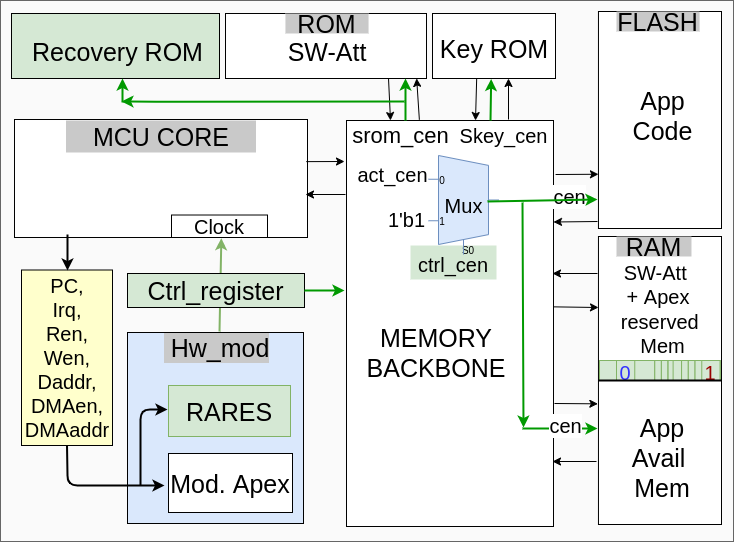
- Introduces a 16-bit hardware control register (Ctrl_register) that is updated at runtime to detect memory modification attacks, with read-only access from software.
- Classifies runtime memory modification attacks into three categories and uses Ctrl_register state changes to detect anomalies.
- Extends APEX with a lightweight hardware module to store Ctrl_register state and enable continuous runtime integrity monitoring.
- Supports use-case-specific prevention and recovery by allowing developers to define custom logic based on attack detection signals.
- Implements onboard recovery using a recovery ROM that stores critical code sections, enabling fail-safe operation without OTA or manual re-flashing.
- Preserves all 20 formal LTL verification properties of APEX, ensuring correctness and security guarantees.
Experimental results
Research questions
- RQ1How can runtime memory modification attacks be detected continuously and efficiently in resource-constrained embedded systems?
- RQ2Can a lightweight hardware control register (Ctrl_register) enable effective detection of runtime code tampering without significant performance or resource cost?
- RQ3How can system resilience be maintained without relying on abrupt system resets, especially in safety-critical applications?
- RQ4What is the minimal hardware overhead required to enable verified proof-of-execution, secure-boot, and onboard recovery in a runtime-resilient system?
- RQ5How can system developers integrate use-case-specific prevention and recovery mechanisms into a verified, lightweight runtime security framework?
Key findings
- RARES achieves only 2.3% increase in LUTs and 2.3% increase in hardware registers compared to APEX, demonstrating minimal resource overhead.
- The RARES-A variant, with a 16-bit Ctrl_register, adds just 2 bytes of reserved memory and 2.3% hardware overhead, while preserving all 20 formal LTL verification properties of APEX.
- The RARES-B variant, which includes an onboard recovery ROM for 16KB, incurs 7.37% more hardware registers and 10.3% more LUTs than RARES-A, still remaining lightweight.
- RARES successfully enables continuous runtime detection of memory modification attacks through the Ctrl_register mechanism, without relying on log-heavy techniques like CFA or DFA.
- Unlike prior systems such as APEX and VRASED, RARES avoids abrupt system resets, enabling degraded-mode operation until safe recovery is achieved.
- The solution is generalizable to other microcontrollers by attaching a custom hardware module, supporting diverse use cases with tailored recovery strategies.
Read this paper
Open the full text in the Nubint reader and ask about any passage as you read.
Read this paper on NubintThis review was generated by AI from the original paper. Please check the paper before citing it.