
[Paper Review] Re-ReST: Reflection-Reinforced Self-Training for Language Agents
This paper proposes Reflection-Reinforced Self-Training (Re-ReST), a method that enhances self-training for language agents by using a reflection model to correct low-quality outputs using external feedback (e.g., unit test results). The refined samples are then used to improve the agent’s performance, resulting in consistent gains across multiple tasks without inference overhead.
Finetuning language agents with reasoning-action trajectories is effective, but obtaining these trajectories from human annotations or stronger models is costly and sometimes impractical. In this paper, we investigate the use of self-training in language agents, which can generate supervision from the agent itself, offering a promising alternative without relying on human or stronger model demonstrations. Self-training, however, requires high-quality model-generated samples, which are hard to obtain for challenging language agent tasks. To address this, we present Reflection-Reinforced Self-Training (Re-ReST), which uses a extit{reflector} to refine low-quality generated samples during self-training. The reflector takes the agent's output and feedback from an external environment (e.g., unit test results in code generation) to produce improved samples. This technique enhances the quality of inferior samples and efficiently enriches the self-training dataset with higher-quality samples. We conduct extensive experiments on open-source language agents across tasks, including multi-hop question answering, sequential decision-making, code generation, visual question answering, and text-to-image generation. The results demonstrate the effectiveness of self-training and Re-ReST in language agent tasks, with self-training improving baselines by 7.6\% on HotpotQA and 28.4\% on AlfWorld, and Re-ReST further boosting performance by 2.0\% and 14.1\%, respectively. Our studies also confirm the efficiency of using a reflector to generate high-quality samples for self-training. Moreover, we demonstrate a method to employ reflection during inference without ground-truth feedback, addressing the limitation of previous reflection work. Our code is released at https://github.com/PlusLabNLP/Re-ReST.
Motivation & Objective
- Address the inefficiency of self-training in acquiring high-quality samples, especially for complex tasks.
- Overcome the limitation of discarding low-quality samples by enabling their refinement through reflection.
- Leverage external feedback (e.g., test outcomes) during training to guide accurate corrections, avoiding reliance on unreliable self-judgment during inference.
- Ensure zero inference cost by training the agent to directly generate correct outputs after reflection-based data augmentation.
- Demonstrate compatibility with existing self-consistency decoding and scalability across diverse language agent tasks.
Proposed method
- Introduce a reflection model that takes model-generated outputs and external feedback (e.g., execution results, test outcomes) as input.
- Use the reflection model to generate corrected, high-quality versions of incorrect or low-quality outputs.
- Augment the self-training dataset with these refined samples to improve the agent’s performance during fine-tuning.
- Train the agent on the combined dataset of original and reflected samples, using standard self-training objectives.
- Decouple reflection from inference: only the agent model is used at test time, eliminating runtime overhead.
- Ensure compatibility with self-consistency decoding by allowing the reflector to process multiple generations and produce improved variants.

Experimental results
Research questions
- RQ1Can reflection-based correction of low-quality model outputs significantly improve self-training efficiency and performance?
- RQ2Does using external feedback (e.g., unit tests) during reflection lead to more reliable and higher-quality sample refinements than self-judgment alone?
- RQ3To what extent can reflection-augmented self-training generalize across diverse language agent tasks such as code generation and multi-hop QA?
- RQ4How does Re-ReST compare to vanilla self-training and other self-improvement methods in terms of sample quality and downstream performance?
- RQ5Is the reflection mechanism compatible with existing inference-time decoding strategies like self-consistency?
Key findings
- Re-ReST achieves consistent performance improvements over vanilla self-training across five diverse tasks: multi-hop question answering, sequential decision-making, code generation, visual question answering, and text-to-image generation.
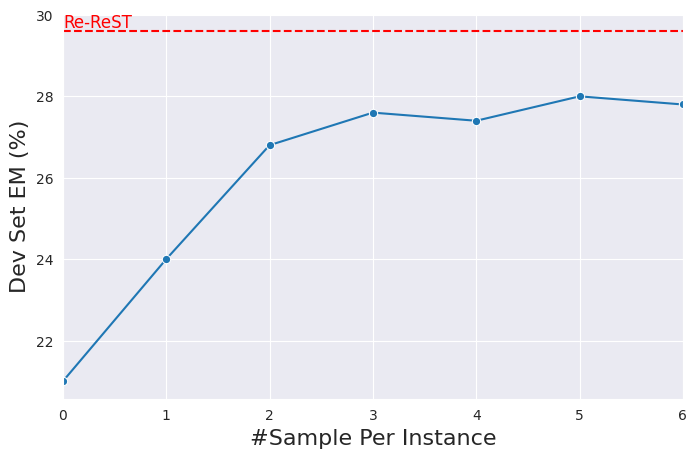
- Ablation studies confirm that the reflection model significantly increases the quality and utility of self-training samples, outperforming methods that rely solely on model sampling.
- The method is compatible with self-consistency decoding, indicating it can be integrated into existing strong inference pipelines without modification.
- The use of external feedback (e.g., test results) during training enables the reflector to produce accurate corrections, avoiding the performance drop seen in self-judgment-only reflection methods.
- The final agent model achieves better performance without any inference-time reflection, ensuring zero computational overhead at test time.
- The approach demonstrates strong generalization, with improvements observed even in low-shot and complex reasoning scenarios.
Read this paper
Open the full text in the Nubint reader and ask about any passage as you read.
Read this paper on NubintThis review was generated by AI from the original paper. Please check the paper before citing it.