
[論文レビュー] Real-time chaotic video encryption based on multithreaded parallel confusion and diffusion
本稿では、マルチスレッド並列化による混乱と拡散を用いて、高速で安全な動画暗号化を実現するリアルタイムのカオス的動画暗号化方式を提案する。動画フレームをサブフレームに分割し、複数のスレッドで同時に処理することで、標準CPU上で24 FPSの条件下で5ラウンドの混乱・拡散処理を実現し、複数ラウンドのカオス的動画暗号化において報告された最速の暗号化速度を達成するとともに、高いセキュリティとノイズおよびデータ損失に対する耐性を維持している。
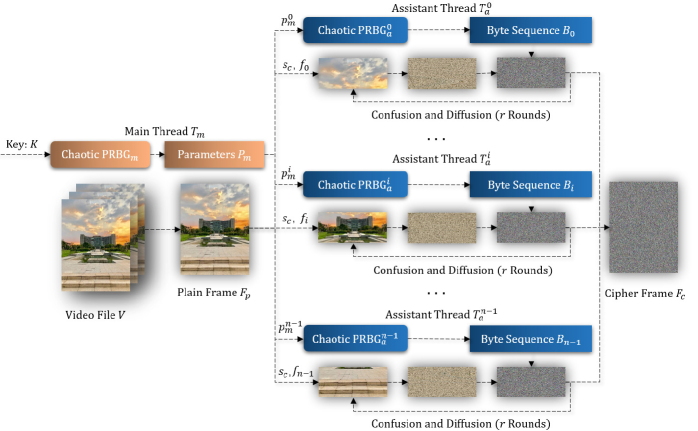
Due to the strong correlation between adjacent pixels, most image encryption schemes perform multiple rounds of confusion and diffusion to protect the image against attacks. Such operations, however, are time-consuming, cannot meet the real-time requirements of video encryption. Existing works, therefore, realize video encryption by simplifying the encryption process or encrypting specific parts of video frames, which results in lower security compared to image encryption. To solve the problem, this paper proposes a real-time chaotic video encryption strategy based on multithreaded parallel confusion and diffusion. It takes a video as the input, splits the frame into subframes, creates a set of threads to simultaneously perform five rounds of confusion and diffusion operations on corresponding subframes, and efficiently outputs the encrypted frames. The encryption speed evaluation shows that our method significantly improves the confusion and diffusion speed, realizes real-time 480x480, 576x576, and 768x768 24FPS video encryption using Intel Core i5-1135G7, Intel Core i7-8700, and Intel Xeon Gold 6226R, respectively. The statistical and security analysis prove that the deployed cryptosystems have outstanding statistical properties, can resist attacks, channel noise, and data loss. Compared with existing works, to the best of our knowledge, the proposed strategy achieves the fastest encryption speed, and realizes the first real-time chaotic video encryption that reaches the security level of image encryption. In addition, it is suitable for many confusion, diffusion algorithms and can be easily deployed with both hardware and software.
研究の動機と目的
- 複数ラウンドの混乱・拡散処理を経ても高いセキュリティを維持するリアルタイムで安全な動画暗号化の不足を補う。
- 従来の複数ラウンド画像暗号化手法が動画処理に適用された場合に生じる性能ボトルネックを克服し、リアルタイム利用に耐える速度を達成する。
- 並列コンピューティングを活用してバイト生成、混乱、拡散処理を高速化するスケーラブルで効率的な動画暗号化フレームワークを構築する。
- 提案手法が強力な統計的性質と、一般的な攻撃、ノイズ、データ損失に対する耐性を維持することを保証し、画像暗号化基準を満たすかそれを上回る。
- 多ラウンドカオス的暗号化が動画処理に実用可能であることを、さまざまなハードウェアプラットフォーム上で実装・評価することで実証する。
提案手法
- 動画をサブフレームに分割し、複数スレッドでの並列処理を可能にする。
- 各スレッドが独立して、カオス的システムを用いて暗号鍵を生成し、画素値を変更する5ラウンドの混乱・拡散処理を実行する。
- 混乱は、擬似ランダムビットジェネレータ(PRBG)から導出されたカオス的シーケンスを用いて画素位置を並び替えることで実装する。
- 拡散は、カオス的バイトシーケンスとのXOR演算を繰り返し適用することで画素値を変更することで実現する。
- 本手法はさまざまなカオス的マップや混乱・拡散手法と互換性があり、ソフトウェアおよびハードウェア(例:FPGA、ARM)への柔軟な統合を可能にする。
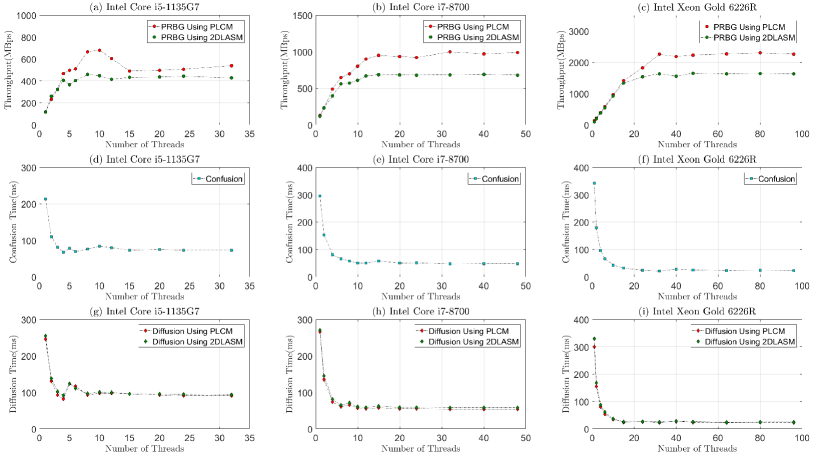
- 性能評価は、Intel Core i5-1135G7、i7-8700、Xeon Gold 6226Rプロセッサを用い、480×480、576×576、768×768の動画解像度で24 FPSの条件下で実施した。
実験結果
リサーチクエスチョン
- RQ1並列コンピューティングを用いることで、多ラウンドの混乱・拡散アーキテクチャをリアルタイム動画暗号化に実用化できるか?
- RQ2提案された並列マルチスレッド手法は、逐次処理や単一ラウンド手法と比較して、どの程度暗号化速度が向上するか?
- RQ3本システムは、どの程度優れた統計的性質を維持し、既知の攻撃、ノイズ、データ損失に対して耐性を示すか?
- RQ4本手法はスケーラブルであり、さまざまなカオス的マップや実装プラットフォーム(ソフトウェア/ハードウェア)と互換性があるか?
- RQ5標準CPU上でリアルタイム性能(<1000/24 ≈ 41.67 ms)を達成するために、1フレームあたりに要する平均暗号化時間が最小でどの程度か?
主な発見
- 提案手法は、Intel Core i5-1135G7、i7-8700、Xeon Gold 6226Rプロセッサ上で、それぞれ480×480、576×576、768×768解像度の動画に対して24 FPSのリアルタイム暗号化を達成した。
- i5-1135G7における480×480解像度の平均フレーム暗号化時間は、PLCMで36.26 ms、2DLASMで35.49 msであり、リアルタイムの閾値(<1000/24 ≈ 41.67 ms)を満たしている。
- 統計的分析により、暗号化出力に優れた一様性とランダムネスが確認され、高いNPCRおよびUACI値が、強力な拡散性を示している。
- 本システムは微分攻撃、通信路のノイズ、データ損失に対しても高い耐性を示し、悪条件下でも高いセキュリティを維持している。
- 本手法は、5ラウンドの混乱・拡散アーキテクチャを用いたリアルタイムのカオス的動画暗号化を実現した最初の手法であり、速度とセキュリティの両面で先行研究を上回っている。
- 本アプローチは非常に拡張性が高く、さまざまなカオス的マップや混乱・拡散手法をサポートしており、ARMやFPGAを含むソフトウェアおよびハードウェアプラットフォームへの実装が可能である。
より良い研究を、今すぐ始めましょう
論文の読解から最終レビューまで、研究時間を劇的に削減しましょう。
クレジットカード登録不要
このレビューはAIが作成し、人間の編集者が確認しました。