
[Paper Review] Real-Time Detection and Analysis of Vehicles and Pedestrians using Deep Learning
The paper compares YOLOv8 and RT-DETR models for real-time vehicle and pedestrian detection on urban-like data, finding YOLOv8m as the strongest baseline and YOLOv8l after augmentation, with RT-DETR variants also competitive.
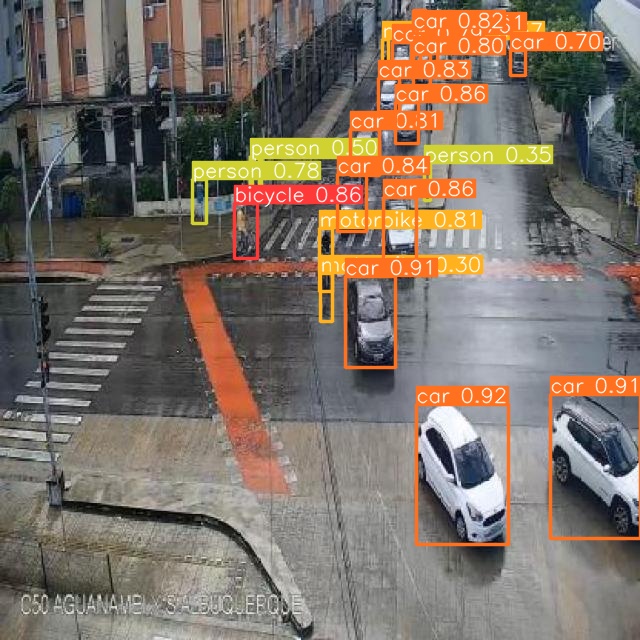
Computer vision, particularly vehicle and pedestrian identification is critical to the evolution of autonomous driving, artificial intelligence, and video surveillance. Current traffic monitoring systems confront major difficulty in recognizing small objects and pedestrians effectively in real-time, posing a serious risk to public safety and contributing to traffic inefficiency. Recognizing these difficulties, our project focuses on the creation and validation of an advanced deep-learning framework capable of processing complex visual input for precise, real-time recognition of cars and people in a variety of environmental situations. On a dataset representing complicated urban settings, we trained and evaluated different versions of the YOLOv8 and RT-DETR models. The YOLOv8 Large version proved to be the most effective, especially in pedestrian recognition, with great precision and robustness. The results, which include Mean Average Precision and recall rates, demonstrate the model's ability to dramatically improve traffic monitoring and safety. This study makes an important addition to real-time, reliable detection in computer vision, establishing new benchmarks for traffic management systems.
Motivation & Objective
- Develop a fast, accurate deep learning framework for real-time vehicle and pedestrian detection in diverse urban environments.
- Evaluate single-stage detectors (YOLOv8 variants) and transformer-based detectors (RT-DETR) on traffic data.
- Assess performance under baseline and augmented datasets and examine pedestrian-focused results.
Proposed method
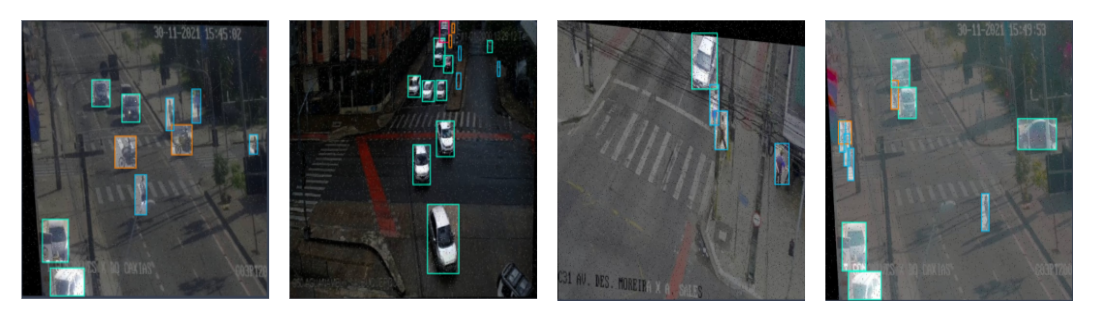
- Frame sampling from public traffic videos to create a dataset of 1,142 images with 3,388 annotations across six classes.
- Data augmentation including hue, exposure, noise, shear, saturation, and blur to expand the dataset to 3,082 images.
- Comparison of YOLOv8 (s, m, l, x) and RT-DETR (L, x) models on baseline and augmented datasets.
- Training: batch size 8, 640x640 images, up to 100 epochs on NVIDIA Tesla P1000; evaluation using mAP, precision, and recall.
Experimental results
Research questions
- RQ1Which model (YOLOv8 vs RT-DETR) offers the best trade-off between accuracy and speed for real-time vehicle and pedestrian detection?
- RQ2How does data augmentation affect detection performance across models and classes (vehicles vs pedestrians)?
- RQ3What are the per-class detection capabilities and how do pedestrian detections compare to vehicle detections under baseline and augmented conditions?
Key findings
- YOLOv8m achieves the highest baseline mAP of 0.898 with precision 0.861 and recall 0.867.
- RT-DETR-x shows competitive mAP (0.878 baseline) and strong precision (0.886) and recall (0.850) on baseline data.
- On augmented data, YOLOv8l attains the top mAP of 0.909 with precision 0.884 and recall 0.861.
- Pedestrian detection on augmented data: YOLOv8l achieves mAP 0.822 with precision 0.909 and recall 0.687 (varies by model).
- Test-time inference: YOLOv8 models run at 40 FPS; RT-DETR at 25 FPS, indicating suitability for real-time traffic monitoring.
Read this paper
Open the full text in the Nubint reader and ask about any passage as you read.
Read this paper on NubintThis review was generated by AI from the original paper. Please check the paper before citing it.